
Smiljan Radić Named 2026 Pritzker Architecture Prize Laureate
The Pritzker Architecture Prize has announced Chilean architect Smiljan Radić Clarke as its 2026 laureate, recognising a body of work that explores architecture through fragility, material experimentation, and an acute awareness of place.

Created for the XXII Chilean Architecture Biennial, Guatero, is a translucent skin that diffuses light and amplifies sound, creating an interior that feels intimate despite its scale. Light, sound, and movement subtly alter its interior condition. At once playful and elemental, Guatero creates an ambience of invitation within a volume that feels provisional yet fully inhabited. photo courtesy of Cristobal Palma
Based in Santiago, Pritzker Award winner Smiljan Radić has built an international reputation for projects that resist formal repetition. Instead of a fixed architectural language, each commission becomes a new investigation shaped by context, history, and the lived realities of its site.

Guatero is a luminous pneumatic form that occupies the exhibition space as a temporary atmospheric environment rather than a fixed object. Soft, contoured, and gently unstable, the structure relies on air pressure, transforming fragility into spatial experience. Photo courtesy of Cristobal Palma
“Architecture exists between large, massive, and enduring forms—structures that stand under the sun for centuries—and smaller, fragile constructions, fleeting and uncertain,” Radić explains. “Within this tension of different times, we try to create experiences that carry emotional presence, encouraging people to pause and reconsider a world that often passes them by with indifference.”
Architecture Shaped by Place and Memory

Set within Bicentenario Park, at the edge of Santiago, Restaurant Mestizo appears as an extension of the landscape. The roof, supported by weight-bearing stones sourced from a quarry in nearby Pirque, becomes horizon, shelter, and civic gesture at once, offering shade and continuity while dissolving the boundary between interior dining and surrounding terrain. Photo courtesy of Gonzalo Puga
Radić’s work is marked by a refusal to treat buildings as isolated objects. Site is understood not only in physical terms but also as a convergence of history, social practices, and political circumstances. This approach allows each project to emerge from its specific conditions rather than a recognisable stylistic signature.

Wind, light, and distant views of the Andes are moderated through depth and proportion to create a spatial condition rooted in ground, climate, and shared presence in the Restaurant Mestizo. Photo courtesy of Gonzalo Puga
The Pritzker Award jury citation highlights how his work operates “at the crossroads of uncertainty, material experimentation and cultural memory,” noting that Radić often favours fragility over certainty. His buildings can appear temporary or deliberately unfinished, yet they offer spaces of shelter and quiet optimism.

Embedded within the rocky terrain of Chile’s central coast, Casa Pite explores the relationship between dwelling and landscape. The structure organizes itself as a sequence of retaining walls and terraces, binding architecture to rock rather than placing it upon the land. Photo courtesy of Cristobal Palma
Across projects, strategies for engaging the landscape and environment vary widely. At the Restaurant Mestizo in Santiago (2006), parts of the structure are embedded into the terrain rather than placed upon it. The Pite House in Papudo (2005) is oriented carefully to respond to wind and light. Meanwhile, the expansion of the Chilean Museum of Pre-Columbian Art, titled Chile Antes de Chile (2013), demonstrates Radić’s interest in adaptive reuse rather than replacement.
Material Restraint and Structural Precision

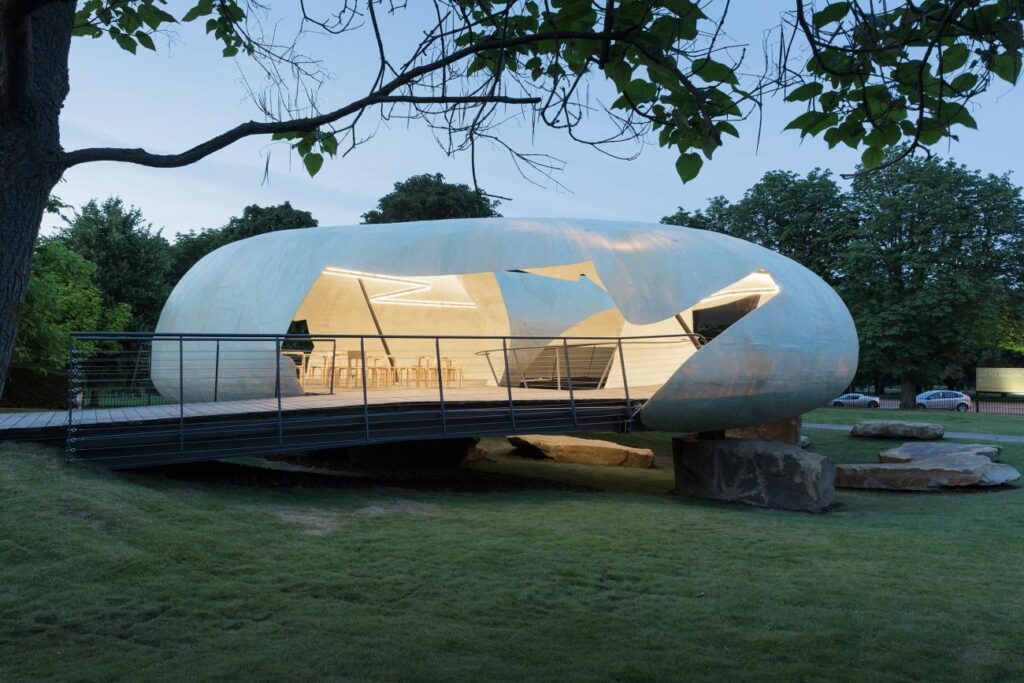
Serpentine Gallery Pavilion presents shelter as a seemingly-suspended condition. A translucent f iberglass shell appears to hover above the lawn of Kensington Gardens, resting improbably on a ring of immense load-bearing, locally-sourced stones. Photo Courtesy Iwan Baan.
Radić’s buildings often appear austere or elemental, but beneath this apparent simplicity lies precise engineering and carefully considered construction. Materials such as stone, concrete, timber and glass are deployed to shape the experience of light, sound and enclosure.
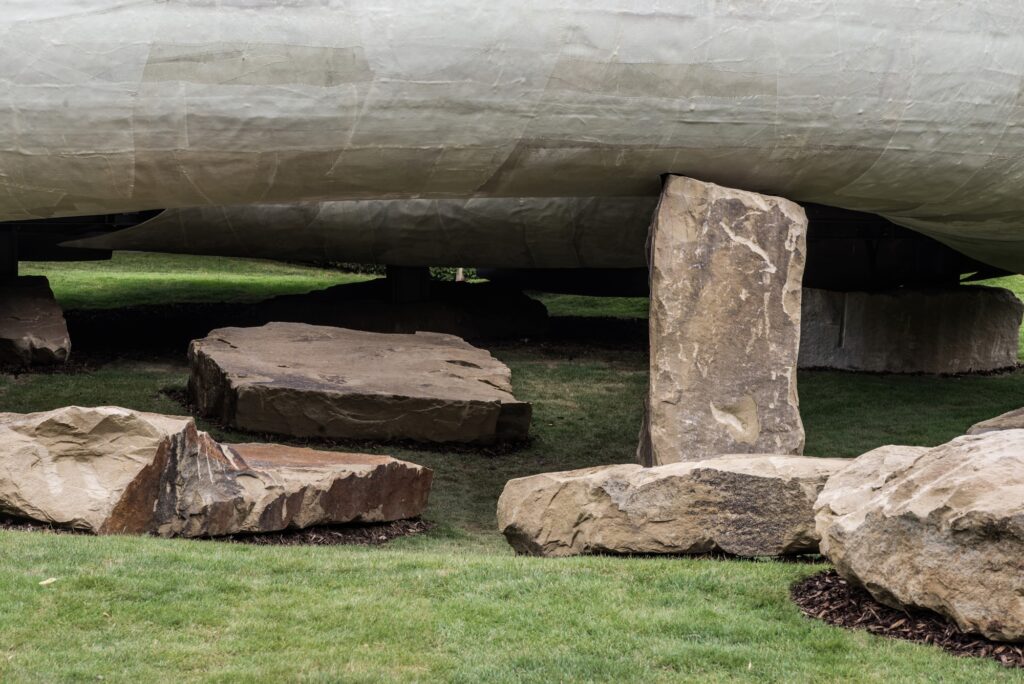
The pavilion appears both ancient and provisional, anchored by the gravity of stone and animated by the shifting daylight filtered through its skin. Photo Courtesy Iwan Baan
At the Serpentine Gallery Pavilion 2014 in London, designed by th Pritzker winner, a translucent fiberglass shell rests upon massive stones sourced locally, creating a structure that feels both grounded and ethereal. The enclosure remains partial, filtering light while maintaining a porous relationship with the surrounding park.
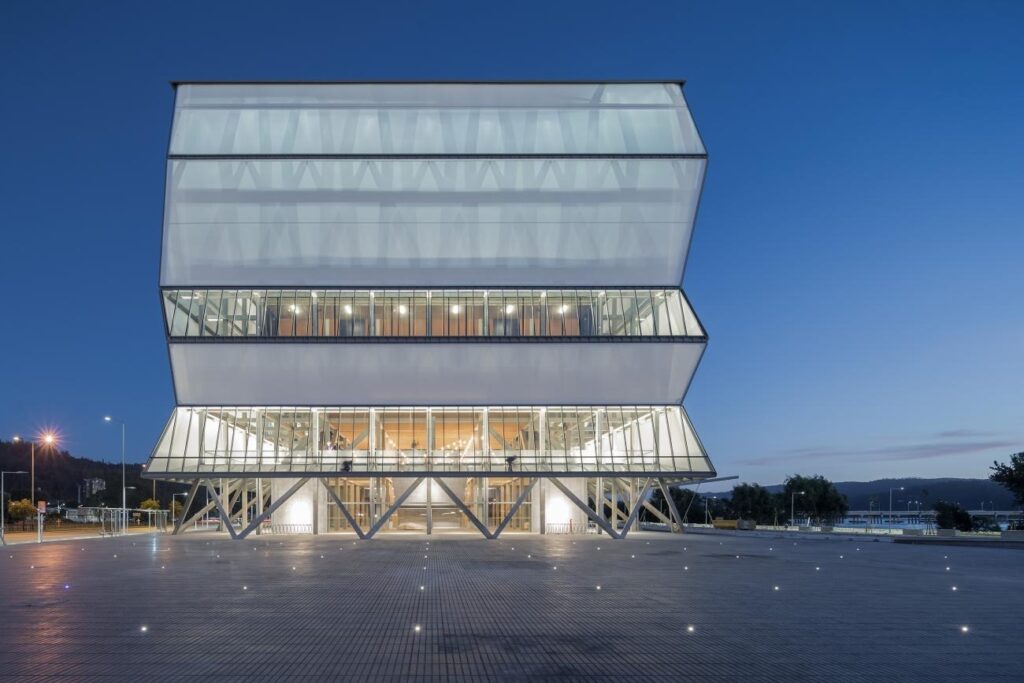
Teatro Regional del Biobío occupies the river’s edge as a disciplined composition of volume and skin. The envelope is layered with carefully engineered semi-translucent polycarbonate cladding, mounted over a steel frame, that modulates light and supports acoustic performance. Photo courtesy of Hisao Suzuki
Similarly, the Teatro Regional del Biobío in Concepción (2018) uses a semi-translucent envelope to modulate daylight while enhancing acoustic performance, demonstrating how structural discipline and atmospheric quality operate together in Radić’s architecture.

Restaurant Mestizo. Photo courtesy of Gonzalo Puga
As the jury notes, his work often resists easy description. “His buildings are not conceived simply as visual artefacts; rather, they demand embodied presence.”
Spaces of Contemplation and Human Scale
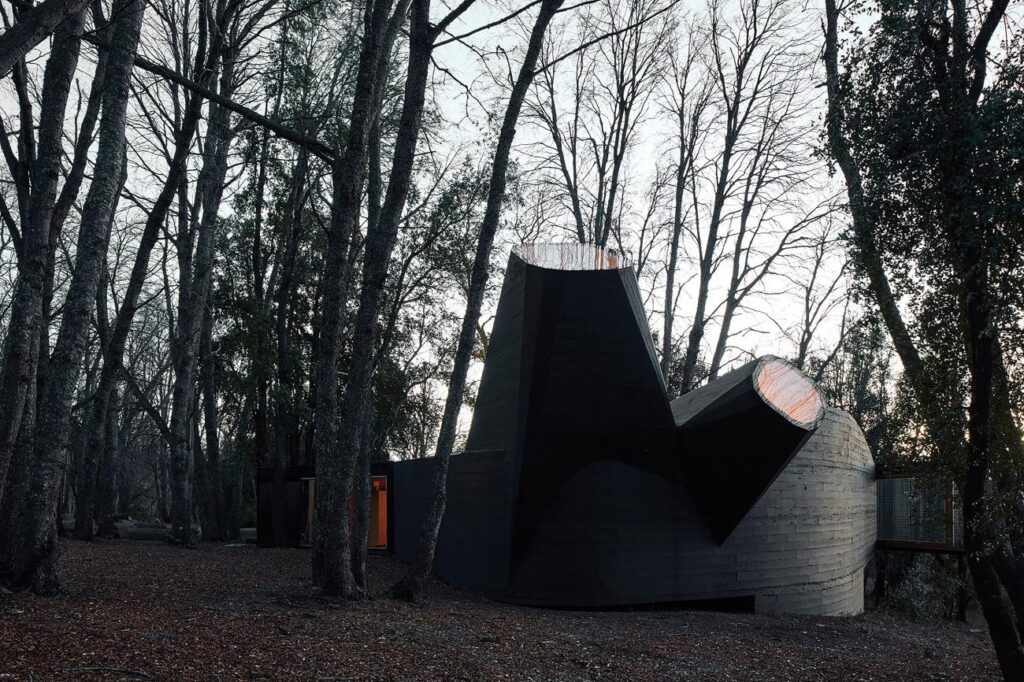
House for the Poem of the Right Angle signifies contemplative retreat, structured by measure, orientation, and silence. Situated within a forested landscape, the house turns upward and inward, organizing itself around a disciplined sequence of thick walls that temper the climate and sound, and apertures that are oriented upward to capture light and time. Photo courtesy of Smiljan Radić
Beyond their formal or structural qualities, Radić’s buildings are often defined by an emotional intelligence that shapes how architecture is experienced over time. They tend to be protective, inward-looking spaces that acknowledge human vulnerability.
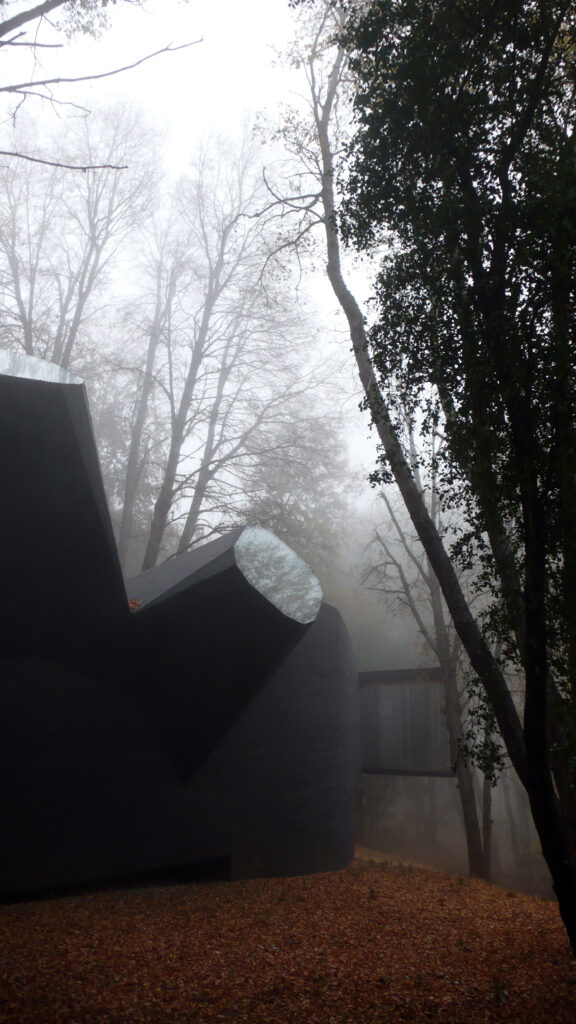
Photo courtesy of Smiljan Radić
Projects by the Pritzker winner such as the House for the Poem of the Right Angle in Vilches (2013) create environments of quiet retreat, using carefully placed openings and controlled light to encourage stillness and reflection.
Serpentine Gallery. Photo Courtesy Iwan Baan
His own residence and studio, Pequeño Edificio Burgués in Santiago (2023), further illustrates this sensibility. The house maintains privacy while opening expansive views across the city, with chain-link curtains concealing the interior from the outside. Weather, sound and shifting light remain part of daily life within the space, while a subterranean studio below provides a more introspective environment for work.
Architecture as Continuity Rather than Replacement

NAVE, Performing Arts Center reimagines a damaged early-twentieth-century residence as a framework for contemporary performance. Rather than erase the existing structure, Radić retains its domestic shell and inserts new volumes within, creating a layered interior in which rehearsal rooms, workshops, and openended performance spaces coexist with the memory of the former house.
Radić’s interventions frequently engage with existing structures, allowing past and present to coexist. At NAVE in Santiago (2015), a residential heritage building damaged by earthquake was adapted into a cultural venue for performance and experimentation. New volumes were inserted into the existing structure, while a rooftop terrace topped by a circus tent introduces a light and celebratory atmosphere above the more grounded spaces below.

Casa Pite demonstrates Radić’s capacity to transform exposure into intimacy, allowing architecture to mediate between elemental force and human scale. Photo courtesy of Cristobal Palma
In 2017, Radić also established the Fundaci.ón de Arquitectura Frágil in Santiago, a platform for public dialogue and research. The foundation houses an archive of experimental works, references, and studies that often feed back into the architect’s design process.
A Practice Shaped over Three Decades

Embedded within the rolling topography, the Vik Millahue Winery extends laterally rather than rising above its surroundings, dissolving into the scale of the valley. Inside, production, storage, and tasting unfold into a continuous spatial sequence.Photo courtesy of Cristobal Palma
Over more than thirty years, Radić’s practice has produced a wide range of projects across cultural institutions, residences, installations and civic buildings in countries including Albania, Austria, France, Italy, Spain, Switzerland and the United Kingdom.

Public spaces unfold gradually, moving from shadowed interiors to elevated terraces that overlook the cultivated fields. Radić quietly intervenes through the calibration of structure and orientation to stabilize vastness in this Vik Millahue Winery building. Photo courtesy of Cristobal Palma
Notable works of this Pritzker winner include Prism House (2020), Chanchera House (2022), Vik Millahue Winery (2013), and the installation The Boy Hidden in a Fish at the Venice Architecture Biennale in 2010.

Carbonero House occupies the landscape between the forest and the sea. Constructed from timber and blackened mesh, the ephemeral volume appears suspended. Its dark, porous envelope absorbs light rather than reflects it, dissolving mass into atmosphere and allowing wind, shadow, and sound to enter the architectural experience. Carbonero proposes architecture as provisional shelter, attentive to climate, terrain, and time. Photo courtesy of Smiljan Radić
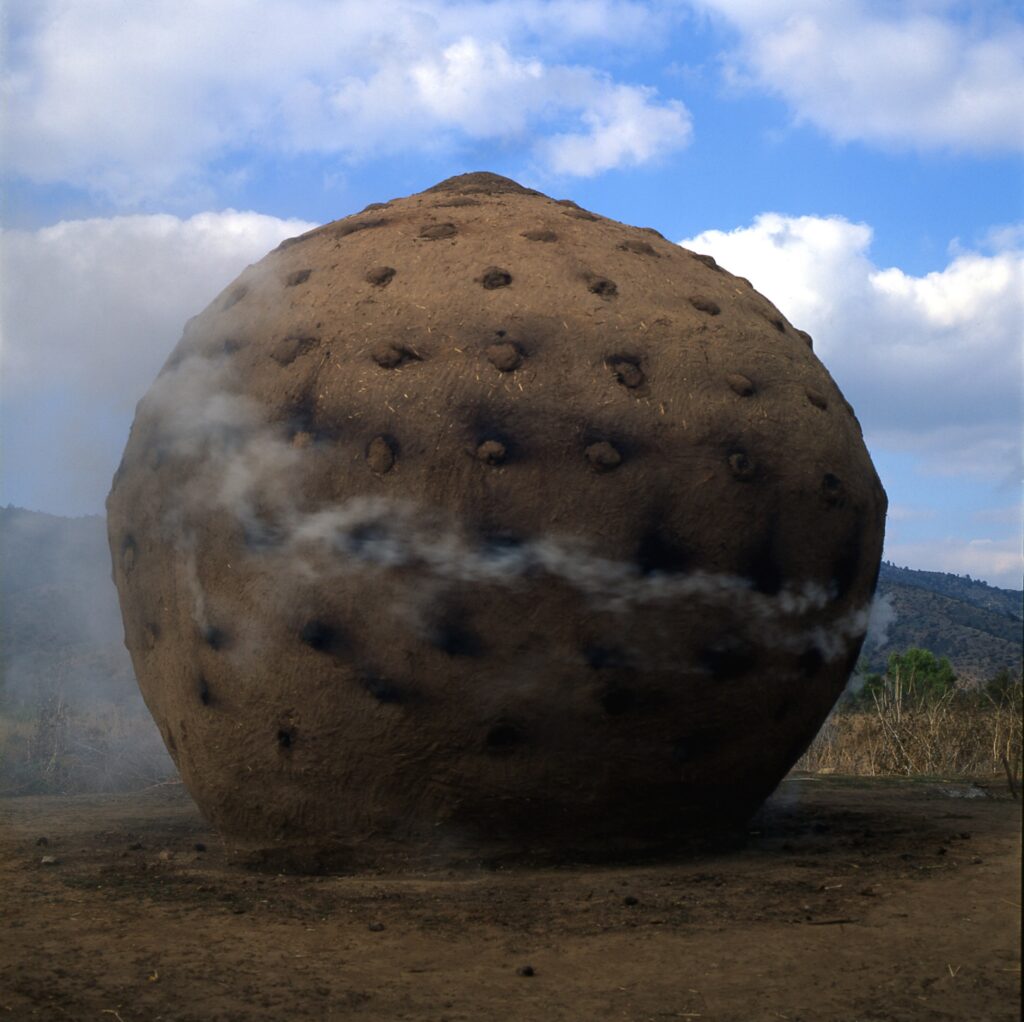
Photo courtesy of Smiljan Radić
Radić, who founded his studio in 1995, becomes the 55th laureate of the Pritzker Architecture Prize. He continues to live and work in Santiago, with upcoming projects underway in Albania, Spain, Switzerland and the United Kingdom.