
Designer’s Community (DC): A Culture of Collaboration
An eco-system that thrives on sharing and evolving, that is how the founders of Designer’s Community (DC) dream of introducing change, one idea at a time. By Sajini Sahadevan.
A group of designers based in Thiruvananthapuram, capital to India’s southern state Kerala, is daring to ‘Imagine’, as John Lennon sang decades ago, of their ideal world where the language of art and design are the norm. Simply called Designer’s Community (DC), it thrives out of a 120-year-old bungalow in the heart of the city, it is now Kerala’s most unusual creative hub, comprising architects, designers, artists and performers.

Designer’s Community is a co-working space for anyone who doesn’t want to feel “boxed-in”.
For its founders, DC is more than a workspace: it’s a way of life. “We wanted to build something that made sense for our times,” says Abrar Ali, 32, architect and co-founder. “A place where we could work, think, and live without fitting into rigid boxes.”
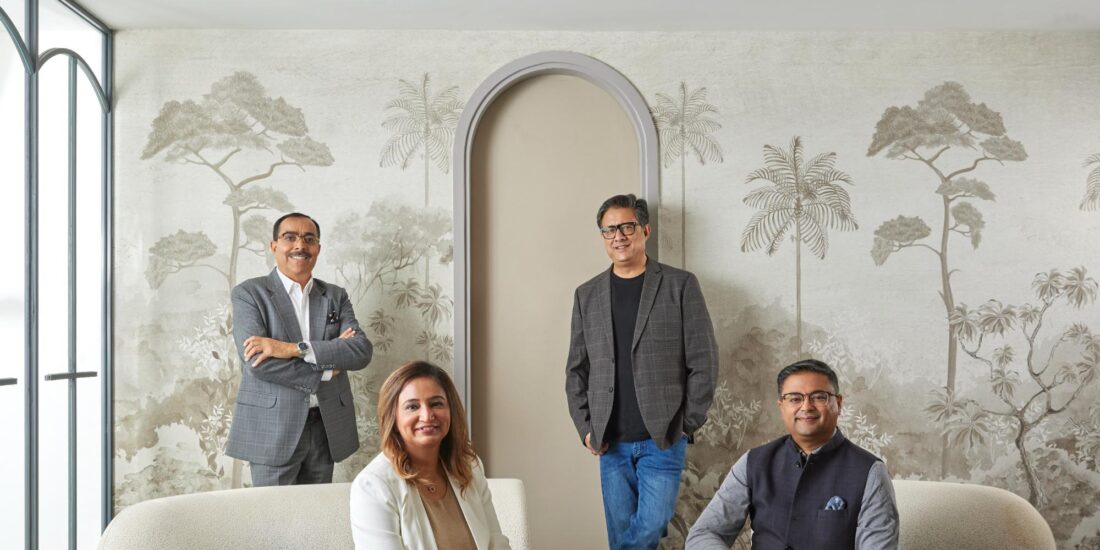
Seven years ago, Abrar began DC with his peers Ujwal M, Govind Sarma Mohan, Jishnu Vijay and Prijith Vijayan.
Walking through the large hall and adjacent rooms within the bungalow, built in traditional Kerala architecture style, it is evident that what began as a modest co-working experiment has become a bustling ecosystem of creative studios and micro-enterprises. Today, each room hums with activity: architecture firms, sustainability start-ups, fashion designers, musicians and filmmakers share walls and ideas. Abrar, co-founder of an architecture studio called Urban Ants that he runs with Ujwal out of DC, is proud of the young minds nurturing nascent ideas here as they navigate livelihoods in a fast-moving world.

Regular contributors at an early morning brainstorming session.
Govind, now based in London, co-founded an architecture firm called Idam at the time where he practised for six years. “DC was meant to be a platform for young designers to collaborate and learn from each other,” he says.
“There were 12 contributors too. We definitely are growing organically and realise that DC has become a culture and lifestyle entity,” Abrar remarks, taking time with the definition.
From Workspace to Movement

Created for Sapience
Abrar calls DC “a community of communities”. Never meant to be a conventional co-working space, there are no cubicles or glossy branding. Alongside his architecture firm Urban Ants, the bungalow hosts initiatives like Mattam (sustainability), Neythu (fashion), Beyond 7 (music) and Dying Art (film). Others explore entrepreneurship, finance or policy design.
Conflicts, when they arise, are handled through collaboration. “We look at what’s the best fit for a project,” Abrar explains. “It’s about collectivism, not competition.”
Over time, DC has also become a haven for those seeking more than just creative work. “Many students come here after struggling with anxiety or burnout,” says Ujwal, who also teaches urban design at a private architecture college. “Once they realise they’re not alone, they begin to find hope and community.”
DC is also open to anyone who wants to work out of the space from 10AM to 7PM.
Being the Change, Breaking the Design Barrier

DC Co- Founders Govind and Abrar.
At the core of DC’s philosophy is a radical idea: to make design the layman’s language.
“People still think design is for intellectuals,” says Abrar. “We want to change that. Design is everywhere, in how you plan a street, a kitchen or a business policy. There are a lot of people like us who chose to stay back in Thiruvananthapuram. We are building an eco-system that works for us.”
The community hosts regular gatherings to make this vision tangible. Charcha, a monthly debate initiative, brings together members and newcomers for conversations, critique and camaraderie. “It’s about breaking the stereotype of the designer as a serious intellectual,” Abrar laughs. “We find fun in everything.”

The community designed and curated Sapience, a festival exploring Kerala’s knowledge economy, as aprt of Keraleeyam’ 23 for the Govt. of Kerala.
Then there’s Sketchwalk, a fortnightly event that invites anyone, artist or not, to sketch the city. “You needn’t draw perfectly,” says Abrar. “Some people record sounds, others observe patterns. It’s about capturing an experience, not producing a perfect image.”
Through such initiatives, DC is gradually reframing how Thiruvananthapuram perceives creativity. Not as something lofty but as a lived experience.
Olam: The Festival That Sparked a Network

The entrance to Designer’s Community, housed in a 120-year-old bungalow.
Now in its fifth edition, Olam was first held in 2018, envisioned as a celebration of entrepreneurship in art, design and culture. Over three days, it drew hundreds of designers, students and curious locals and has since grown into an annual creative gathering.
“Olam has created an invisible network,” Abrar says. “Around 600 to 700 people from across India, places such as National Institute of Design (NID), National Institute of Fashion Technology (NIFT) and others, came together to make it happen. Every edition teaches us something new. It’s chaos, but the good kind.”
Designing the City Itself

Designer’s Community partnered with ‘ക’ Mathrubhumi International Festival of Letters 25′ (MBIFL), eventualising ‘Co-Create @ ka corner’, a creative conversation in the city before the event.
Now, the founders are thinking bigger. They’ve set their sights on creating a Design District for Thiruvananthapuram by 2027. “We want to scale sensibly,” Abrar says. “Kerala has moved past its primary development phase. Now design needs to guide its next one. From the micro to the macro, be it policy, systems or infrastructure, design is central to progress.”
“Anybody can design. Just like how anyone can dance. It takes this question to the public: Why does one design? We aim to promote design awareness by showing how design brings value addition to anything.”

Glimpses from the festival
Every June 5, on World Environment Day, also DC’s anniversary, the community holds a “goal-setting meeting”. Members review milestones, set new ones and remind themselves of why they started DC. “Goals shouldn’t become a liability,” Abrar adds. “There’s good stress and bad stress. We try to nurture the kind that helps you grow. That’s what we want for those who come here.”
Design Without Borders

Charcha: an opportunity to seek, learn, debate and grow.
As DC’s members move abroad, they’re carrying its ethos with them, exploring new outposts in London and Dubai, aiming to recreate the collaborative spirit of the Thiruvananthapuram hub.
When Govind left for London to pursue a master’s in Interior and Architecture Design, he found his understanding of community design deepening. “What works in India doesn’t necessarily work in London,” he says. “The key is to identify a specific, unmet need.”

Ujwal M, Co-founder Designer’s Community
His research led him to what he calls the “£10,000 dilemma” – the frustration of affluent cyclists who lack safe storage for their expensive bikes. That insight became The Hub, a premium, service-led space designed to serve London’s cycling community. It offers four key experiences: a ‘Social Core’ with a café and bar; a ‘Performance Zone’ for smart training; a ‘Service Bay’ for expert repairs and a ‘Rider Suite’ with secure valet storage and luxury showers.
“It’s not just another bike shop with a café,” Govind clarifies. “It’s a third place, an ecosystem that connects people through shared values.” Its design aesthetic, what he calls “Industrial-Luxe”, merges raw concrete and brickwork with oak, walnut and steel finishes. The project, he says, is an evolution of what DC taught him: that design, at its best, builds communities.
DC has also conducted some events in Dubai like Sketchwalk and Busker’s Meet, gauging the pulse there. “There are plans to shift into a space later this year,” Abrar says.
“Designers should be able to engage a community of their own without being left out, no matter where they travel. Dubai already acts as a meeting point for the world, even as a popular destination for flight layovers. So it is a good platform to interact with designers from around the world.
Abrar shares that a festival is being planned towards the end of 2026. He feels that though there are designers and people from other creative fields in the emirate who come together for small events, that sense of community is lacking. “Our intention is to draw them into physical spaces, carve out time in between that bustling schedule. We now have around 30-40 people involved in our activities there.”
Community for the young

Abrar Ali, co-founder, Designers Community speaking at an event.
For Ria Reji, a young architect with Urban Ants, coming across DC helped find her moorings in the city when she was curating her portfolio as a student. That was three years ago. “We speak a common language here,” she says. “It’s easier to crack ideas as a team.” At DC, she’s juggled multiple roles – graphic designer, space planner and manager, discovering what she enjoys most. “It’s taught me management and adaptability. If I’m ideating in one project, I am executing in another.”
Hidden between two looming apartment blocks and shaded by old mango trees, the bungalow has become a magnet for 20 and 30-somethings looking for meaning in their work. For some, it’s also a refuge after regular work hours. “Where some people go to a temple or mosque, others come to DC,” Abrar smiles. “It’s where artists and designers, slightly outside the mainstream, find belonging.”
That sense of kinship runs deep. “Even if you’re an introvert, you’ll find a nook here,” says Ria. “And if you don’t show up for a few days, someone will ask where you are. That means something.”
The Bigger Picture

Members of the Community at their Onam celebration.
As Kerala’s creative industries slowly find their voice, DC stands as proof that big change can start in small rooms. What began as five friends sharing rent has become a model for collaborative living and working, one that merges design, empathy and purpose.
Abrar believes that’s where the future lies. “Each community is a superhero,” he says. “Bring people with different skills together and they can achieve anything.”