
Martand Khosla: Reading a Sketch, Building a Museum
Architect Martand Khosla on Designing the M. F. Husain Museum in Doha
When Lawh Wa Qalam: The M. F. Husain Museum opened in Education City, Doha, it marked a rare moment in the cultural history of the Middle East: the creation of a museum dedicated entirely to a single Indian-born artist. More than a repository of artworks, the museum stands as a spatial translation of M. F. Husain’s restless imagination, his journeys across geographies, his modernist language, his deep engagement with history, and his lifelong curiosity about cultures, stories, and people.

HH Sheikha Mosa bint Nasser with the sketch of the Musem by Husain.
Designed by architect and artist Martand Khosla, the museum did not begin with a conventional architectural brief. Instead, it began with a sketch, left behind by Husain himself. Not an architectural drawing, but an intent.

Opening Night of Lawh Wa Qalam: The M. F. Husain Museum
“It was the first time our studio worked with a sketch given to us as a starting point,” Khosla recalls. “Usually, the architect produces the sketches. Here, we had to interpret one. And because Husain was no longer around, we had to ask: what can be taken literally, what becomes metaphorical, what becomes philosophical?”
This act of reading, rather than merely designing, became foundational to the project.
Building within a City of Learning

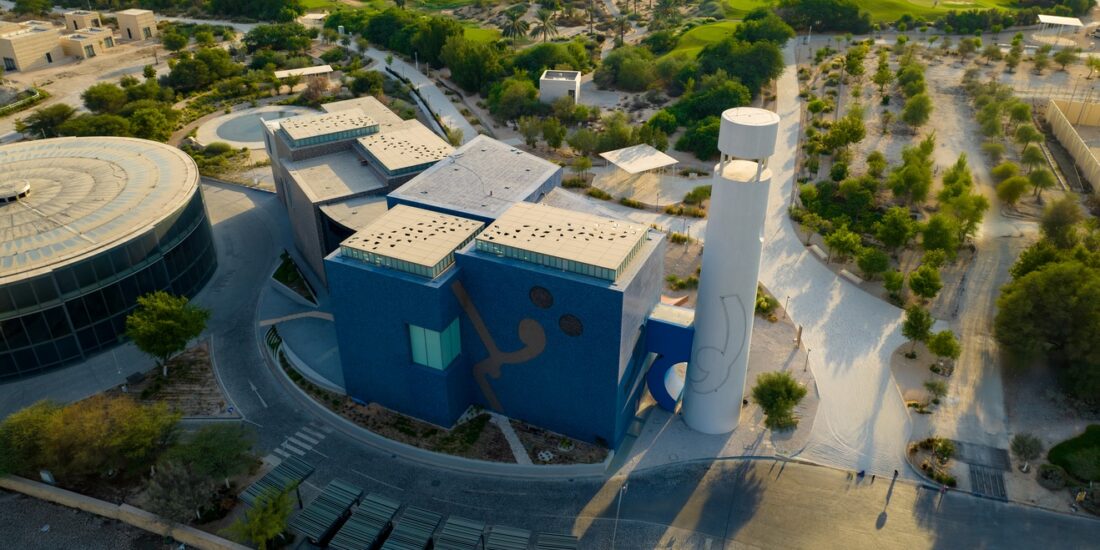
The setting of the Lawh Wa Qalam: The M. F. Husain Museum within Education City.
Education City is not just a site; it is a success story of one of the most important pillars in Qatar’s development. Home to universities, research institutions, libraries, museums, and cultural hubs, it represents Qatar’s long-term investment in knowledge as infrastructure. For Khosla, designing within this context meant that the museum could not be a passive container of objects.
“Education City has buildings by some of the great masters of our times, Rem Koolhaas, Arata Isozaki. What I admire is not just their elegance, but their rootedness in purpose,” he says. “We wanted this to be more than a building that houses Husain’s works. It had to be a space of inquiry, debate, and learning.”
 The museum sits on a raised plinth, an architectural decision that Khosla describes as metaphorical as much as spatial.
“We imagined it as a stage. A platform for discourse,” he explains. “It is surrounded by institutes of learning, and so making it a place of learning in itself was central to the project.”
This intention manifests in subtle ways. The main staircase doubles as an amphitheatre. The library is not hidden but placed centrally, inviting pause, study, and return. The atrium references Sufi forms, creating an inward-looking contemplative core.
“Museums today cannot only be places where you look at art,” he says. “They must also become places of active learning and discourse.”
From Intent to Architecture: Translating Husain’s Sketch

Lawh Wa Qalam: The M. F. Husain Museum
Unlike most museums that begin with a site and programme, Lawh Wa Qalam began with a drawing that was never meant to be a building.
“A sketch is not an architectural drawing,” Khosla reflects. “It is an intent. It has blurred boundaries.”
Decoding this intent required a collective effort. The design process involved Qatar Foundation, curators, museographers, historians, architects, and exhibition designers.
“There were moments when we had curators, museum professionals, architects, exhibition designers—all discussing what the sketch could mean,” he says. “Interpretations ranged from symbolic readings to biographical references, to cultural mappings.”
For Khosla, who is both an architect and a practicing artist, this dual lens became an advantage.
“As an artist, I’ve spent my life thinking about how artworks are read and understood. As an architect, I translate ideas into built form. This project allowed me to oscillate between both.”
The result is not a literal translation of Husain’s sketch, but a spatial interpretation of its ethos.
Where Khosla’s Architecture Emerges

The centre of the Museum.
Despite the collaborative nature of the project, Khosla is clear that his architectural language is distinct.
“My practice is rooted in South Asian modernism,” he explains. “It draws from early post-independence modernist movements but responds to climate, materiality, and cultural context.”
He draws an evocative parallel between Husain’s generation of painters, Raza, Souza, and architects like B. V. Doshi and Charles Correa.
“There was already a synergy. Husain was a modernist in art. For me, modernism becomes form.”
If the most striking feature of the museum is its colour and external materiality, Khosla insists that its spatial logic, the way volumes intersect, the way spaces unfold, is deeply aligned with his own architectural approach.
“The rectilinear volumes, their connections—that’s very much how I would have approached a museum. What changed was the outer skin. That’s where this imaginary conversation with Husain began.”
A Museum That Evolves

Lawh Wa Qalam: The M. F. Husain Museum
For Khosla, adaptability is not optional in contemporary museum design, it is fundamental.
“The first question is curatorial: can the spaces evolve with different types of work—video, sound, installation, performance? The museum is equipped for that,” he says. “The second is urban: can it become a space of activation, not a static object?”
He envisions the museum and its surroundings as a living cultural territory.
Husain’s life was shaped by movement, across borders, languages, and cultures. That transnational spirit deeply influenced the architecture.
“I hope this museum strengthens ties between Qatar and India, and between South and West Asia,” Khosla says. “And I hope Husain’s worldview becomes part of educational discourse here.”
In this sense, the museum becomes not just a tribute, but a pedagogical tool, an architectural method for cultural dialogue.
What the Museum Asks of Its Visitors

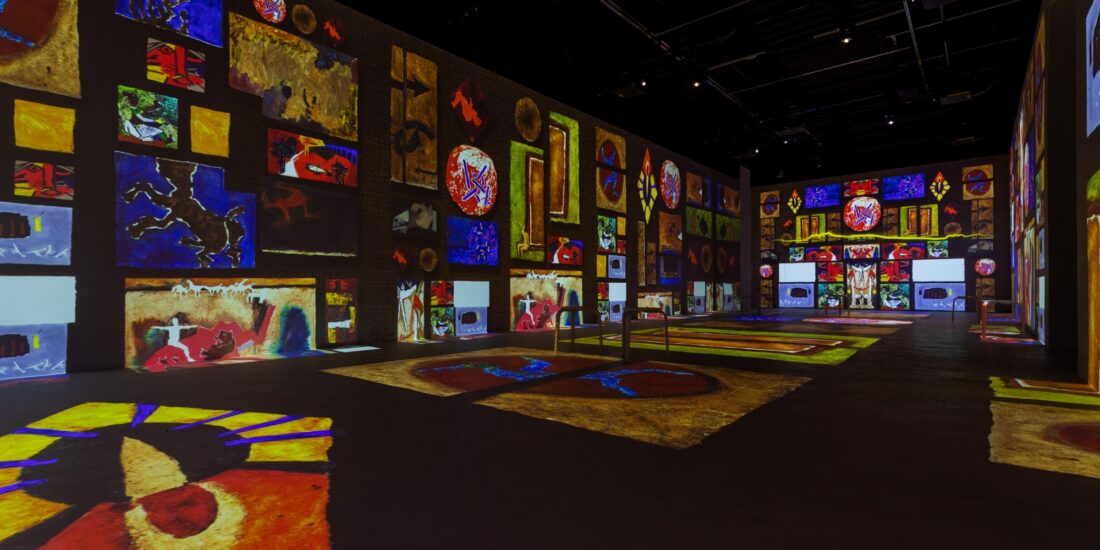
Interiors of the Lawh Wa Qalam: The M. F. Husain Museum
Khosla resists prescribing what visitors should feel.
“The richer the interpretation, the better,” he says. “The primary conversation should be between the visitor and the artworks. Architecture should facilitate that, not overpower it.”
He hopes people leave not with answers, but with questions.
When asked about the biggest personal insight from the project, Khosla pauses.
“Initially, it was about learning how to read a drawing,” he says. “Then I began to wonder if a new architectural language was emerging for me.”

Lawh Wa Qalam: The M. F. Husain Museum
Every corner of the building, he explains, holds a reference, historical, cultural, or personal.
“A whole vocabulary developed around this one building,” he says. “It’s been fascinating.”
Khosla had previously designed the M. F. Husain Gallery at Jamia Millia Islamia in New Delhi. The contrast between the two projects is revealing.
“The Jamia gallery is a minimal modernist building,” he explains. “White plaster, louvers, a sculptural court. It was designed to show multiple artists’ works.”
By contrast, the Doha museum is dedicated to a single artist. “It’s materiality, its colours, its formal language, all derive from Husain’s sketch. The architecture rightfully references that connection.”
Architecture as Cultural Infrastructure

Lawh Wa Qalam: The M. F. Husain Museum
Khosla believes deeply in architecture’s civic responsibility.
“It shapes not just institutions, but cities—and the experiences of people within them,” he says. “It must acknowledge human scale, climate, movement, solitude, and interaction.”
In Education City, he sees a rare commitment to sustainability and cultural relevance.
“To me, it is one of the most meaningful architectural landscapes in the region,” he adds.
A Museum as Promise

M.F. Husain.
More than a building, Lawh Wa Qalam stands as a testament to what architecture can do when it listens, to art, to history, to context.
In translating Husain’s sketch into space, Khosla has not merely built a museum. He has created a place of learning, of questioning, and of cross-cultural resonance.
And in doing so, it quietly asks: what might architecture become if it began with listening?
All Images Courtesy Qatar Foundation