Vibhor Sogani on Shaping the Language of Public Art
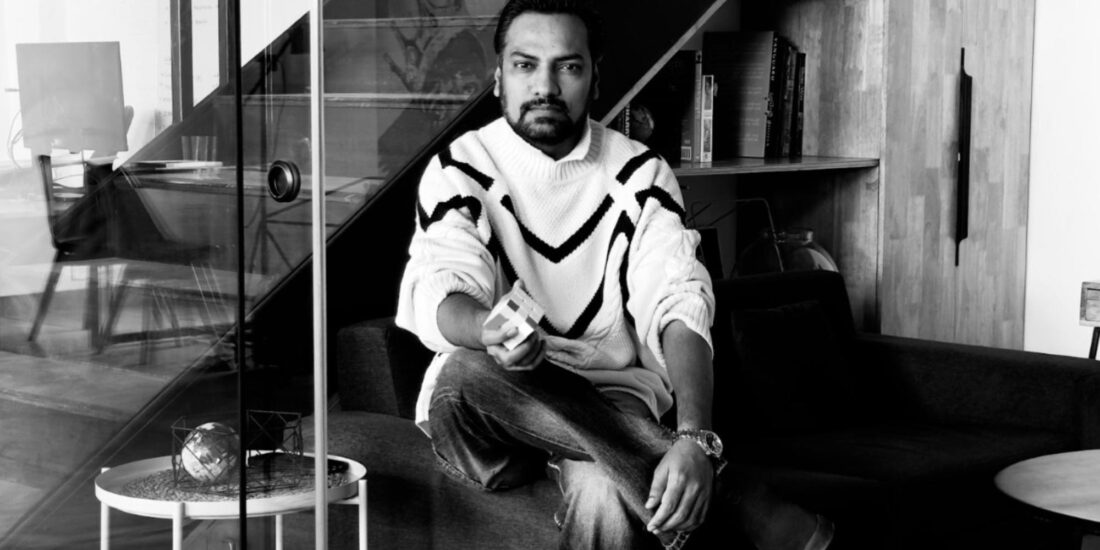
For over two decades, Vibhor Sogani has redefined how public spaces in India speak to their citizens. He is a sculptor, designer, and storyteller at heart. In a conversation with Aishwarya Kulkarni, Vibhor opens up about his journey from industrial design to monumental public sculptures, his creative process, and the philosophy behind turning steel and light into emotion.
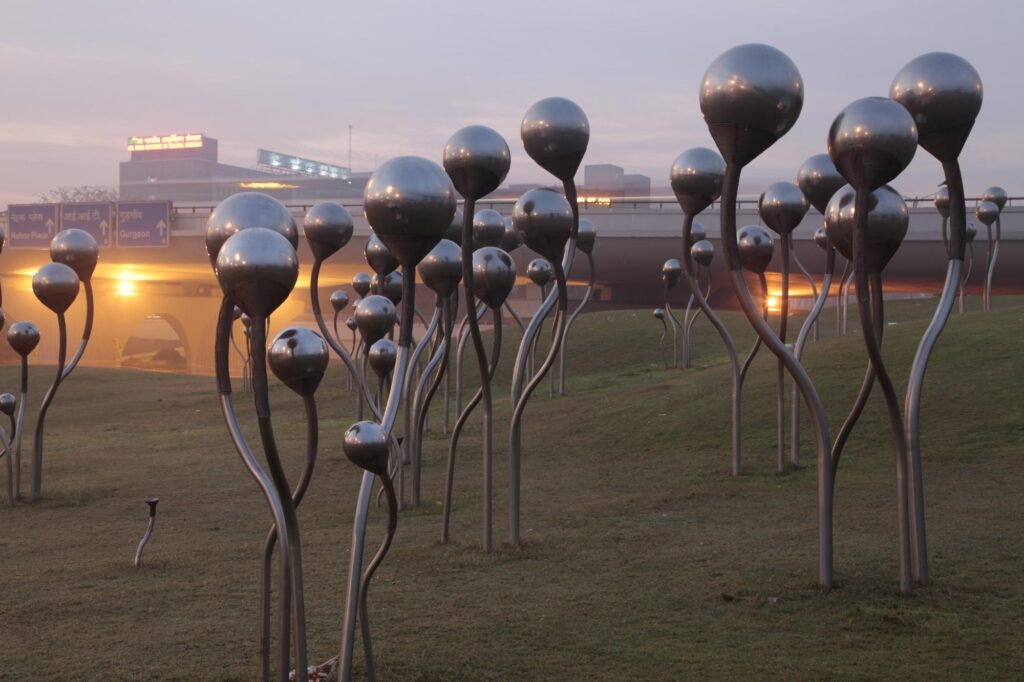
‘Sprouts’, a 40 feet high Public Art Installation in stainless steel located in the heart of capital city, New Delhi.
As someone who has lived in Delhi for years, I have often passed by the large sprout-shaped installation near AIIMS and wondered what the thought behind it was. To me, it always stood tall and curious, a symbol I couldn’t quite decode. Speaking to the artist who created it, Vibhor Sogani, was indeed memorable, and it decoded the thought process behind how artists think and translate ideas into forms that speak to everyone without using words, and how something placed in the middle of a busy city can quietly become part of everyone’s memory.
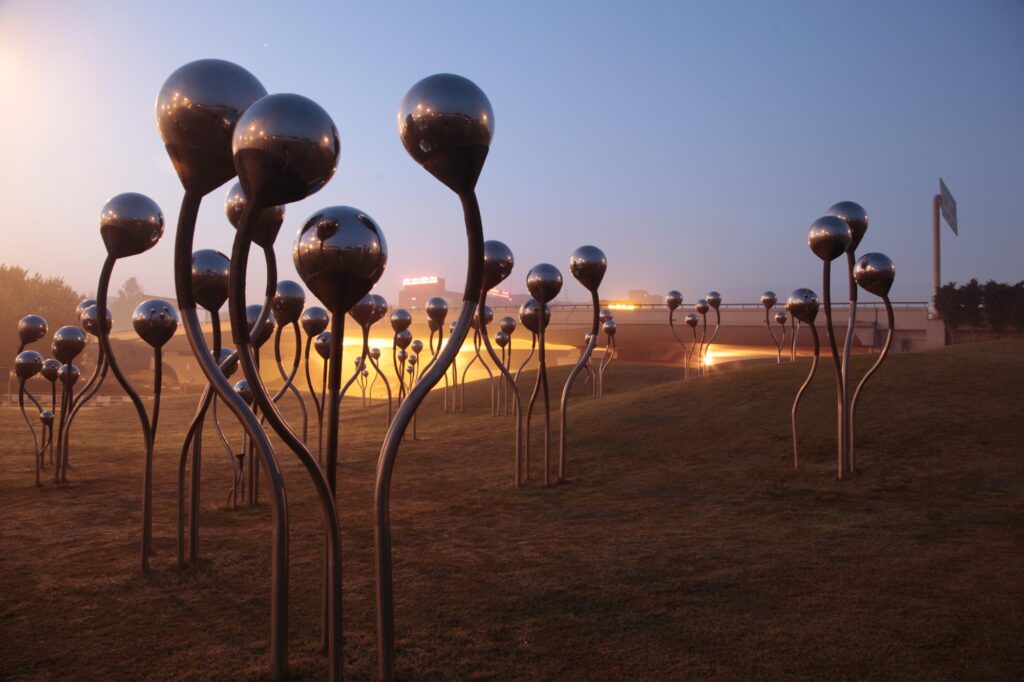
This public art installation embodies India, as a growing nation, through stainless steel—a symbol of modernity and progress. The sprouts, emerging from the earth, evoke the essence of growth, renewal, and transformation.
In Vibhor Sogani’s world, art is not confined to galleries or guarded pedestals as it lives in roundabouts, airports, and skylines. Because beauty, at its best, is a shared experience, one that belongs to all of us who pause, even for a moment, to look up.
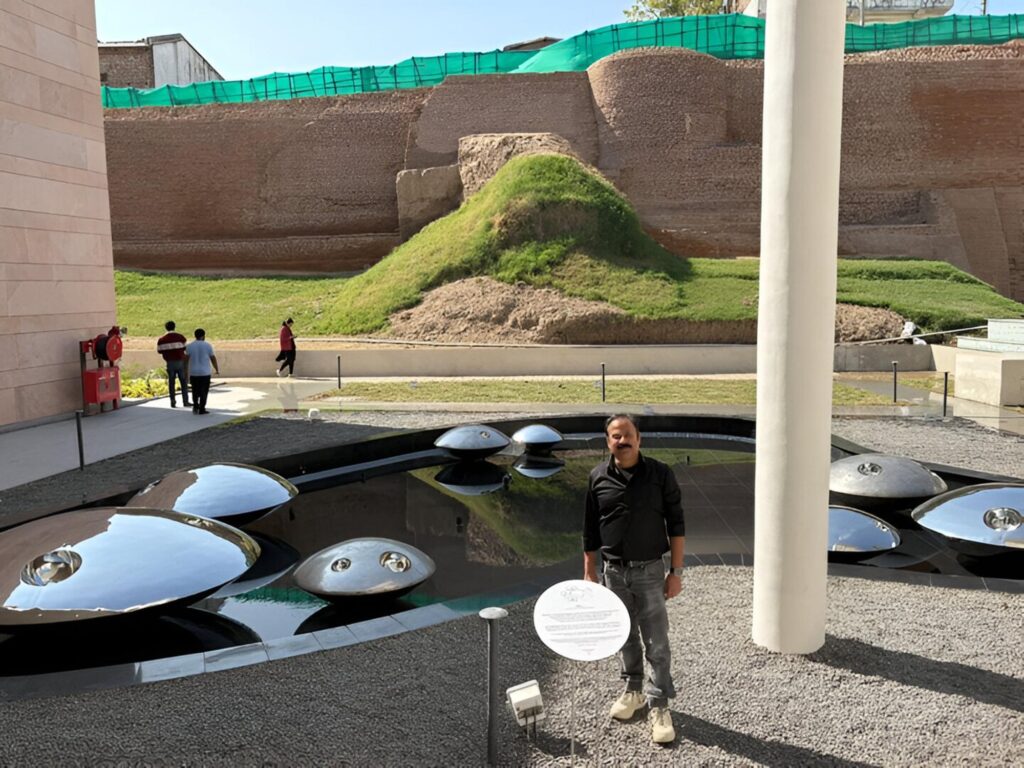
The artist and his creation, Sangam
SCALE: What is the story of the Vibhor Sogani studio?
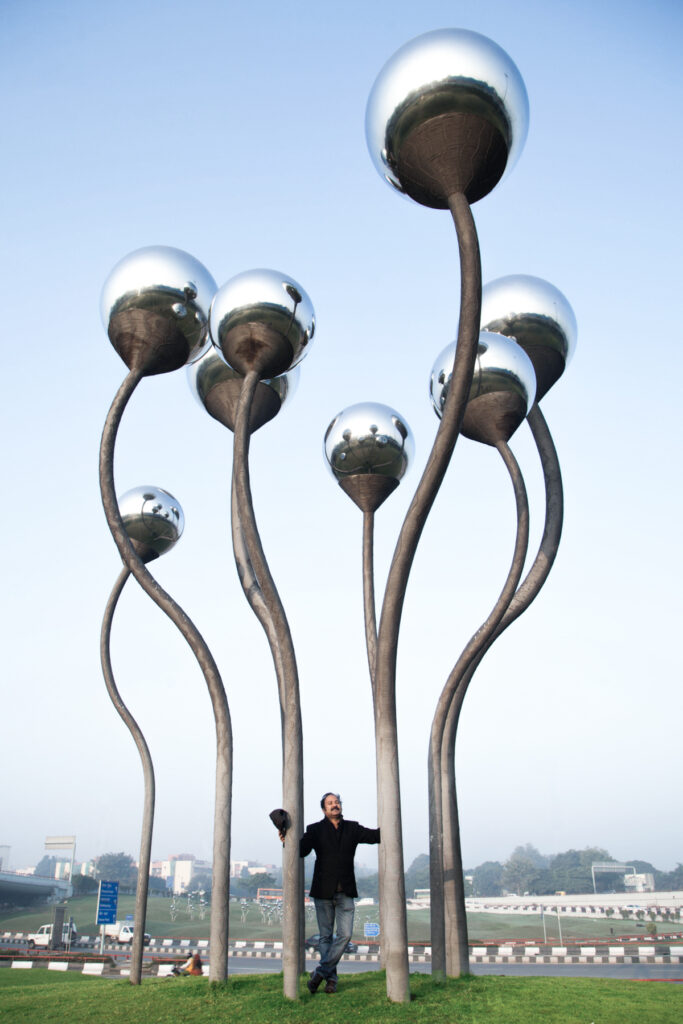 Vibhor: I studied industrial design at the National Institute of Design in Ahmedabad, and after graduating, I began my career in product design. I was creating everything from tableware to furniture to lighting. But over time, I felt constrained by the scale of these objects, as they were all confined within a house.
The turning point in my professional journey came when I began experimenting with public art. I realized I could create something on a monumental scale that still had design principles at its core – balance, ergonomics, and clarity. Sculpture offered me freedom of scale and expression, and that’s how my journey from product to public art began, and the Vibhor Sogani studio was formed.
SCALE: Your studio in Delhi works across diverse domains: art, design, lighting, and urban installations. How do you balance these worlds?
Vibhor: For me, they’re not separate. Whether it’s a small light or a 40-foot sculpture, the thought process is the same: to bring emotion into material. In the early years of my studio, I focused a lot on lighting design because I found light to be a living material as it changes mood, texture, and perception. Gradually, I realized that my work in lighting was feeding my sculpture practice. Light teaches you subtlety; sculpture teaches you permanence.
Today, our studio has three verticals, design, lighting, and art, and they constantly feed into each other. The same team may be working on a chandelier one day and a massive installation the next!
SCALE: Your most famous work, Sprouts, is one of the largest public art installations in India. Could you share how that came about?
 Vibhor: It was in 2008, when Delhi was preparing for the Commonwealth Games, and the city was undergoing major infrastructural changes. I was invited to propose an artwork for a large traffic island near AIIMS. My proposal was Sprouts. It is an installation of steel forms emerging from the ground, symbolising India’s growth after 60 years of independence. The idea came from a simple observation: after rain, you see fresh sprouts emerging from the soil. That image stayed with me, and it felt like India at that time, young and restless. The installation stands 40 feet tall and is spread over six acres. It took over two years from concept to completion. What’s beautiful is that people have made it their own, and it’s now a landmark.
SCALE: You’ve mentioned before that you see public art as a conversation with citizens. Could you elaborate?
Vibhor: Public art, unlike gallery art, doesn’t have a niche audience. It’s for everyone – a passerby, a child in a car, a person waiting at the signal. For me, the goal is to create something that connects immediately yet invites deeper thought. I call it layered accessibility. You may first see Sprouts as beautiful shiny objects. But when you read about it, you understand its symbolism which is growth, renewal, optimism. Good public art should blend aesthetics with meaning. It’s a dialogue that unfolds over time.
SCALE: What does your creative process look like, and how do you go from concept to form?
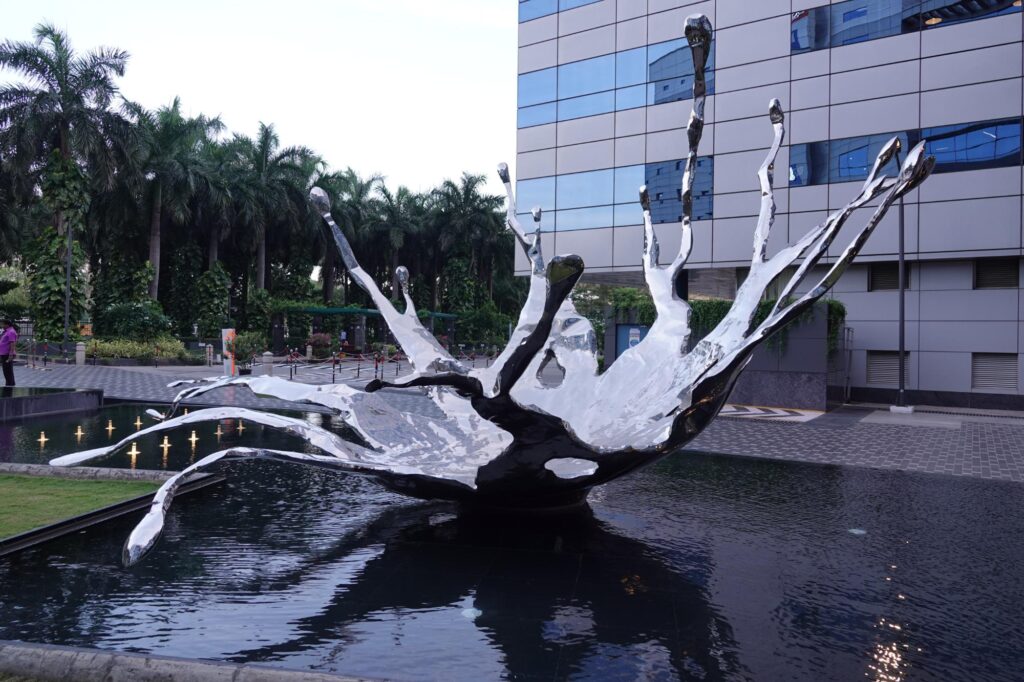
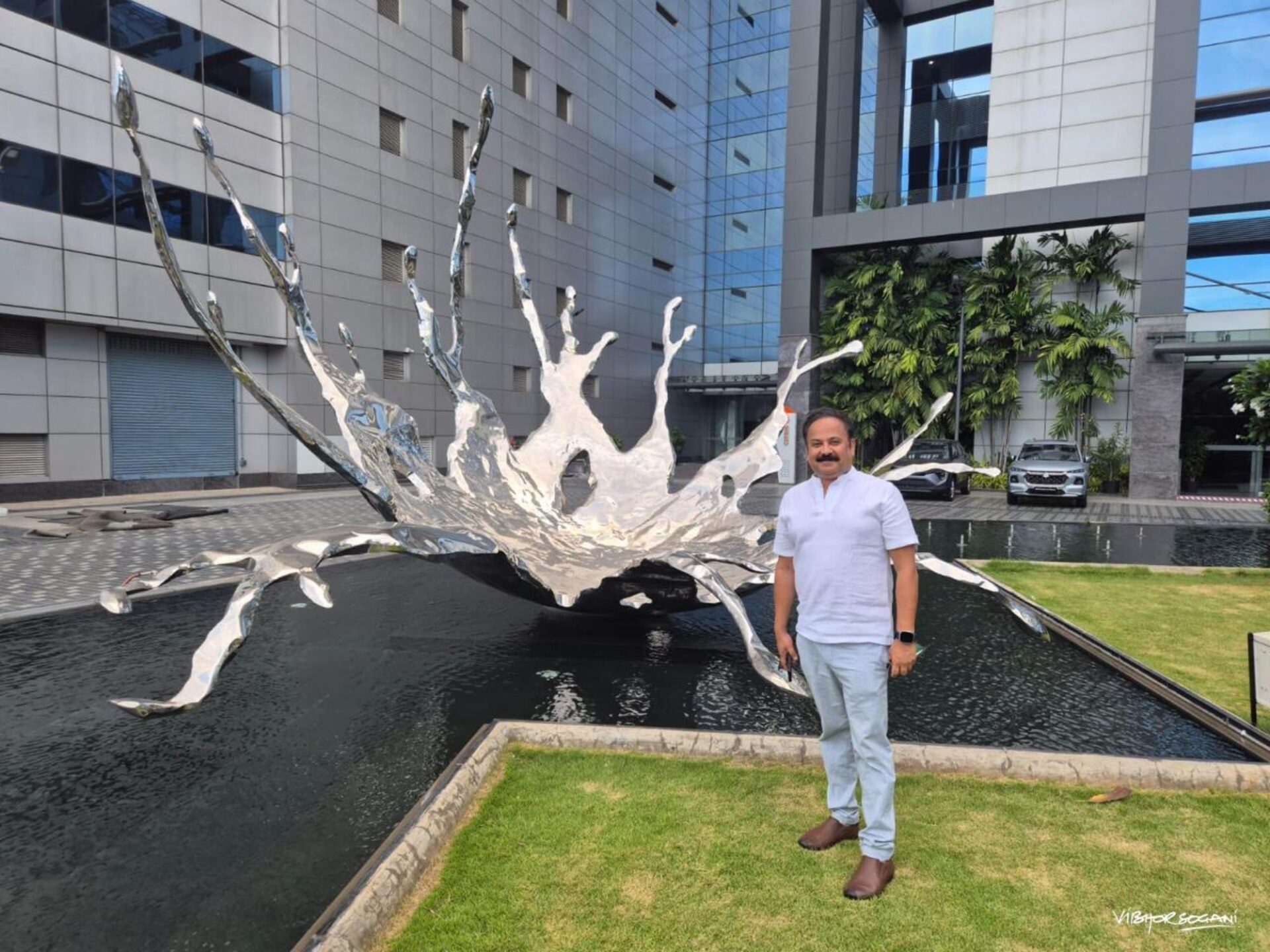
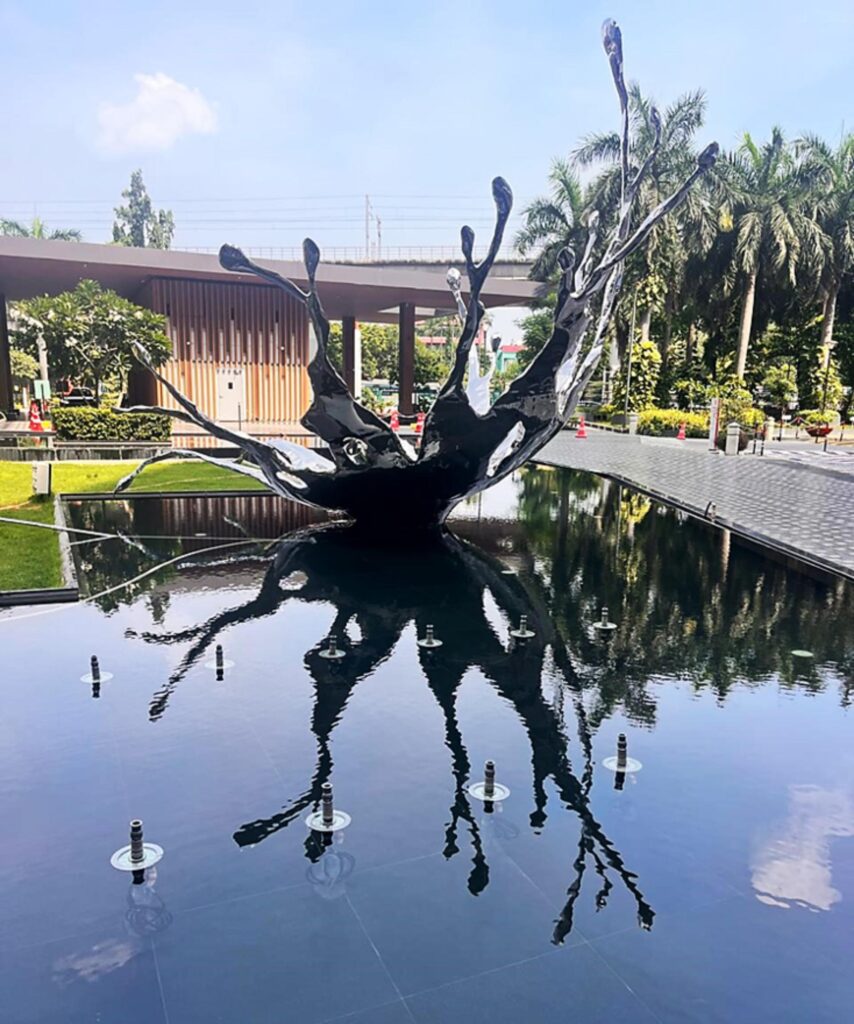
Splash
Vibhor: My process always starts with a trigger emotion. It could be an image, a thought, or even a piece of music. I try to translate that emotion into my art.
I make small hand sketches, sometimes just shapes or flow lines, and then start modeling them in clay or digital form. Once I have a direction, my team develops 3D renders to understand proportions and light behavior. Material is central. I mostly work with stainless steel, mirror finish, and light because they embody reflection, both literally and metaphorically. In India, light has deep cultural and spiritual meaning. So when light interacts with steel, it feels alive. Every project also demands an understanding of engineering. My studio collaborates with structural engineers, fabricators, and foundries to ensure the art is not just beautiful but safe and enduring.
SCALE: You’ve done several urban installations since Sprouts. Could you tell us about a few that are close to you?
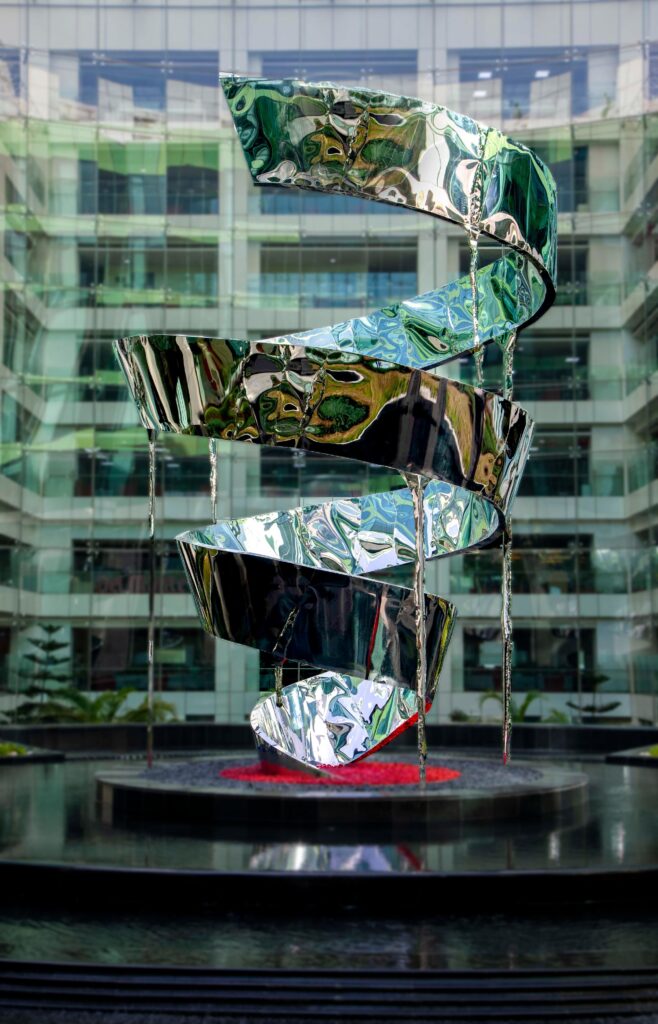
A’rise
Vibhor: Yes, Sprouts opened many doors. After that, I did Kalpavriksha in Ahmedabad, a tree of life in stainless steel symbolizing abundance and sustainability.
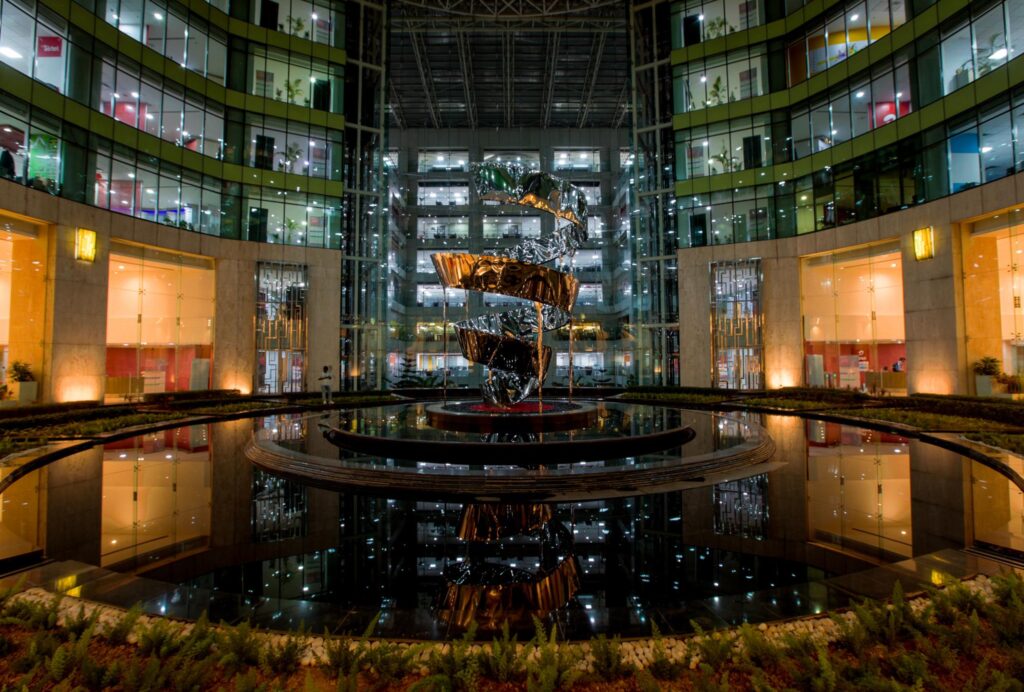
A’ rise for Airtel.
Another piece, A’rise, a 22-foot-tall form inspired by the rising journey of the ‘Airtel’ brand, as an ode to their journey. Deepam is one of my more fascinating explorations. It is an attempt to capture the essence of enlightenment, and to express the divinity that light holds within our cultural fabric.
Public installations also teach humility, as you have to deal with permissions, safety codes, and civic coordination. It’s not just about aesthetics but also patience and negotiation.
SCALE: Let’s talk about your smaller works and exhibitions. You’ve also shown in galleries and international fairs. How does that compare to public art?
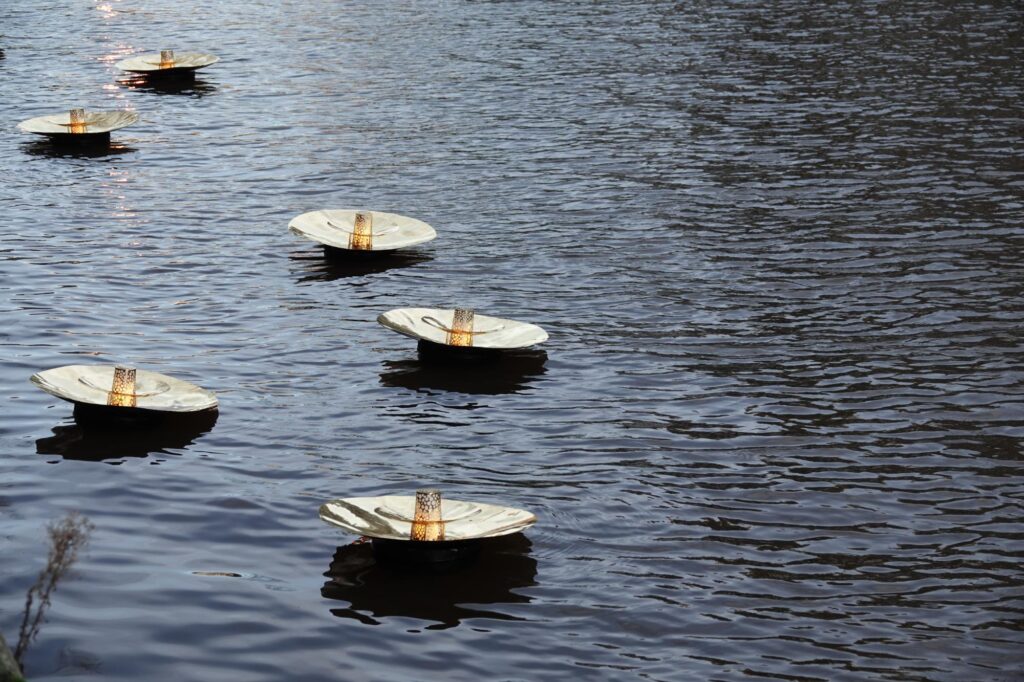
Deepam
Vibhor: Gallery work is more intimate. It allows you to be personal, experimental, and even political. In 2012, I did an exhibition called Mahatma in Me, a series of stainless-steel sculptures inspired by Gandhi’s principles. The forms were minimal, reflective, and interactive, and viewers saw themselves in the work, reinforcing Gandhi’s idea that change begins with self.
I’ve also shown internationally, in Singapore, Dubai, London, Australia, Africa, Denmark and Amsterdam. Each city responds differently. In India, people look for meaning; abroad, they often respond to form first. But I enjoy both scales. Public art gives me reach; gallery art gives me depth.
SCALE: What do you think is missing in India’s approach to public art?
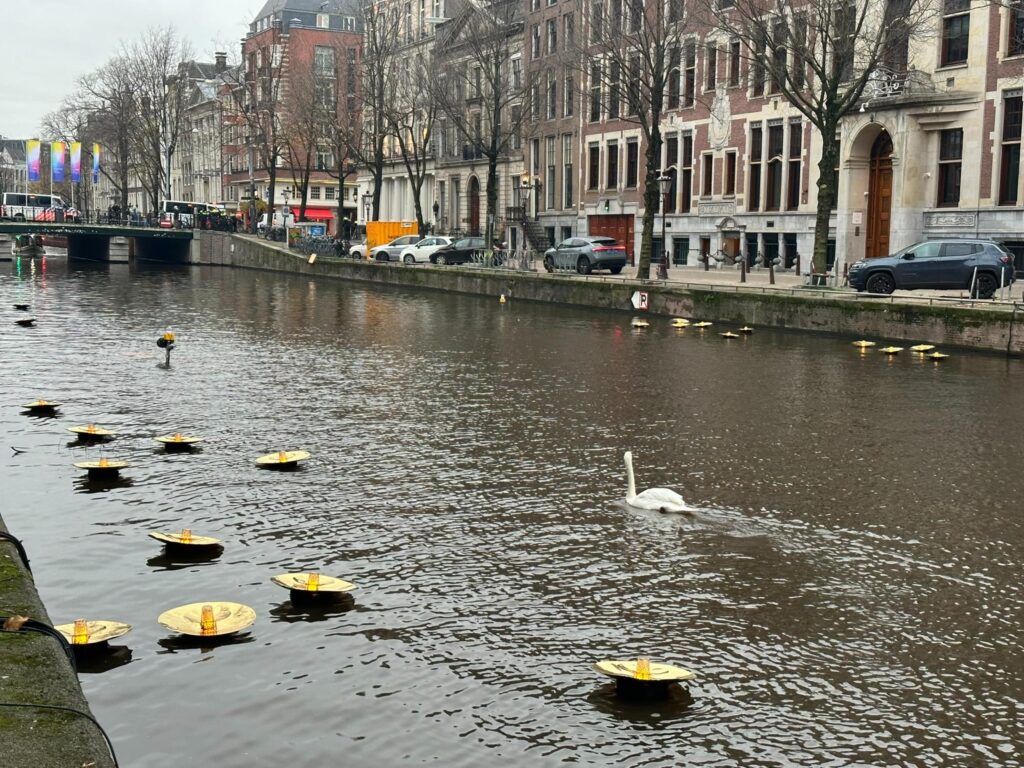
Deepam in Amsterdam.
Vibhor: We’re still learning how to integrate art into urban design. In many developed countries, there’s a “percent for art” policy, that is, like 1% of any public project’s budget goes to art. That ensures artists are part of the planning process, not an afterthought. In India, public art often comes in too late, after the project is done, someone says, “Let’s put a sculpture here.” That mindset must change. Art should be part of the city’s DNA, not decoration. Also, we need maintenance systems. Public art needs care; otherwise, it decays physically and emotionally. I often tell authorities: installation is just the beginning, not the end.
SCALE: Your works balance monumentality with simplicity. How do you achieve that?
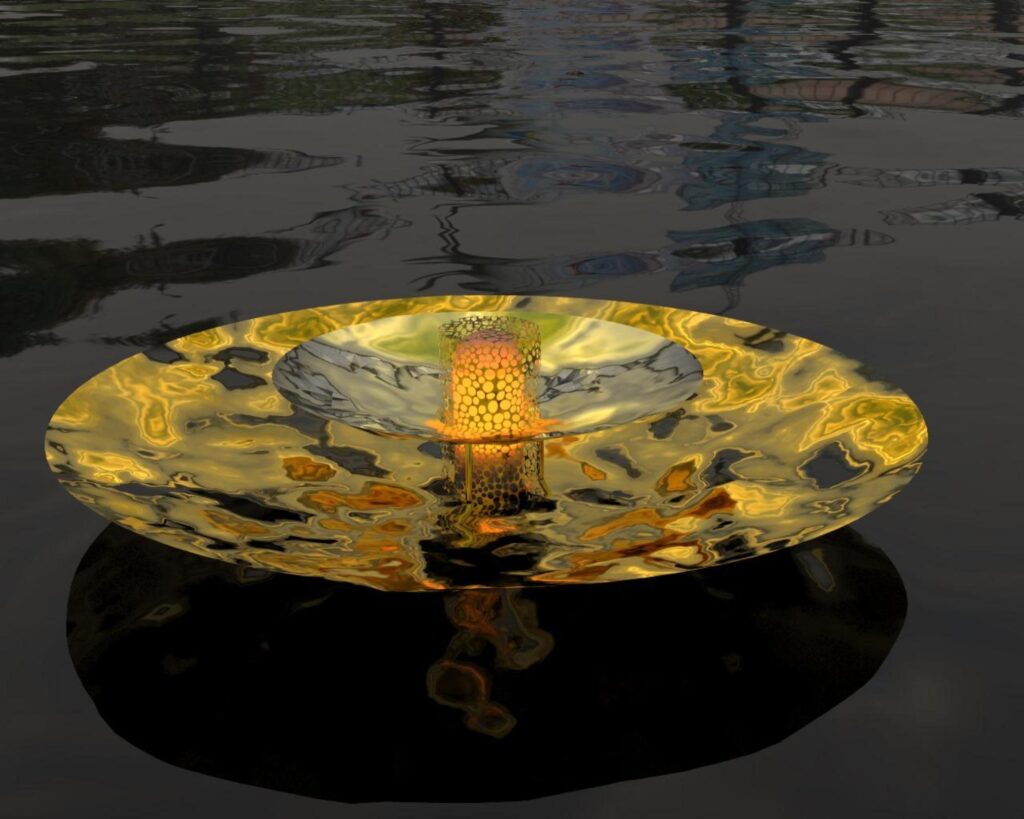
The details of Deepam.
Vibhor: By subtraction. Design teaches you to remove everything unnecessary. My goal is to reach the essence of an idea where one line, one curve can hold an entire emotion. For example, in Kalpavriksha, every branch was designed to spiral upwards, suggesting growth.
The sculpture looks complex, but it comes from a very simple sketch of an upward curve.
Simplicity is deceptive, and it takes time to reach.
SCALE: What’s your relationship with material, especially metal?
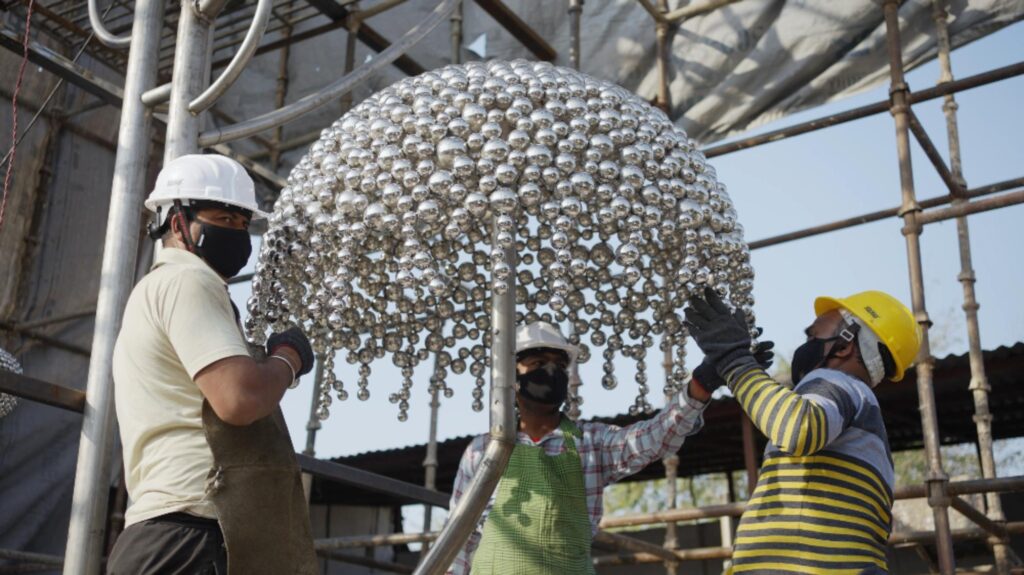
Installation work of Joy
Vibhor: Metal is alive. It reflects, it oxidises, it endures. I’ve always been drawn to stainless steel because it interacts with light and surroundings, and it never looks the same twice. When people move around my sculptures, they see themselves in them; the art literally mirrors the world. I also experiment with brass, corten steel, and LED-integrated installations. Technology fascinates me. My new works explore motion sensors and programmable lighting, bringing digital language into physical form.
SCALE: Do you see yourself as more of a designer or an artist today?
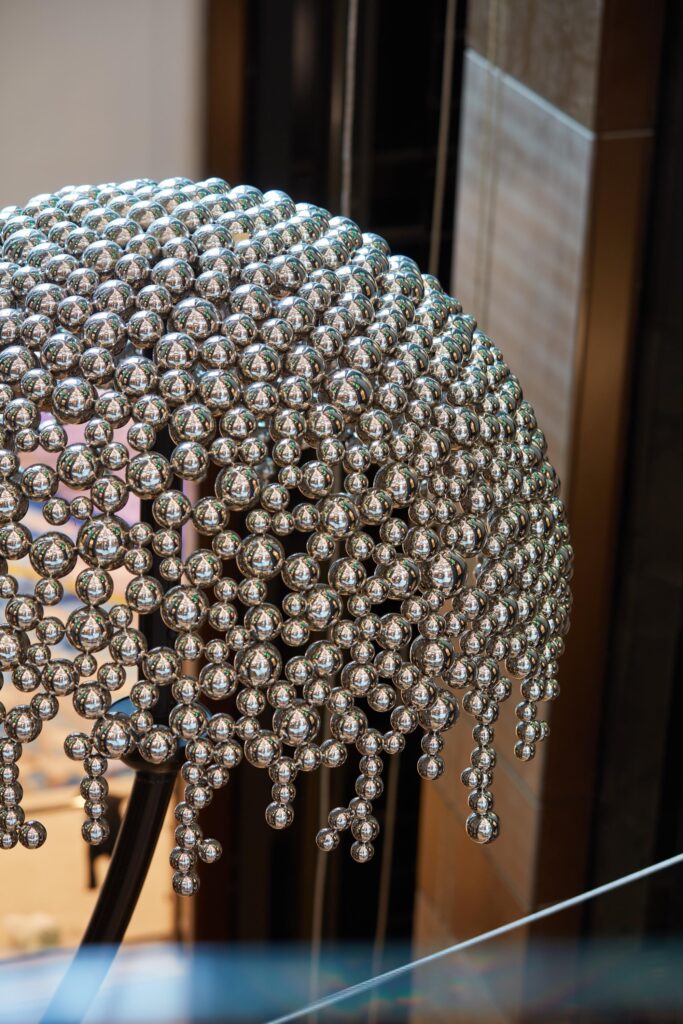 Vibhor: I’d say I’m both. My training was in industrial design, but my soul lies in art. Design gave me structure of how to think, how to make. Art gave me freedom; how to feel! When you merge the two, you get something meaningful yet functional. That’s why I call my work design-led art. It’s emotional, but it’s also engineered.
 SCALE: Finally, what continues to inspire you after all these years?
Vibhor: India itself. There’s so much energy, contradiction, and emotion here. Every corner of this country gives you a story. I’m also inspired by everyday materials like metal, light, reflection, and the idea of resilience. My motto has always been: “Create something that outlives you.”
Public art allows that. You might be gone someday, but the sculpture remains, telling stories, reflecting lives, witnessing change.
.