
Archiving Architecture in the Arab World: Why Memory Matters
As Qatar Museums goes ahead its ambitious architecture programme — Architecture & Design: Turning Vision into a Universal Dialogue — the region finds itself at a critical juncture. With rapid development, shifting political landscapes, and climate pressures reshaping cities, the question of how to archive architectural history in the Arab world has never been more urgent.

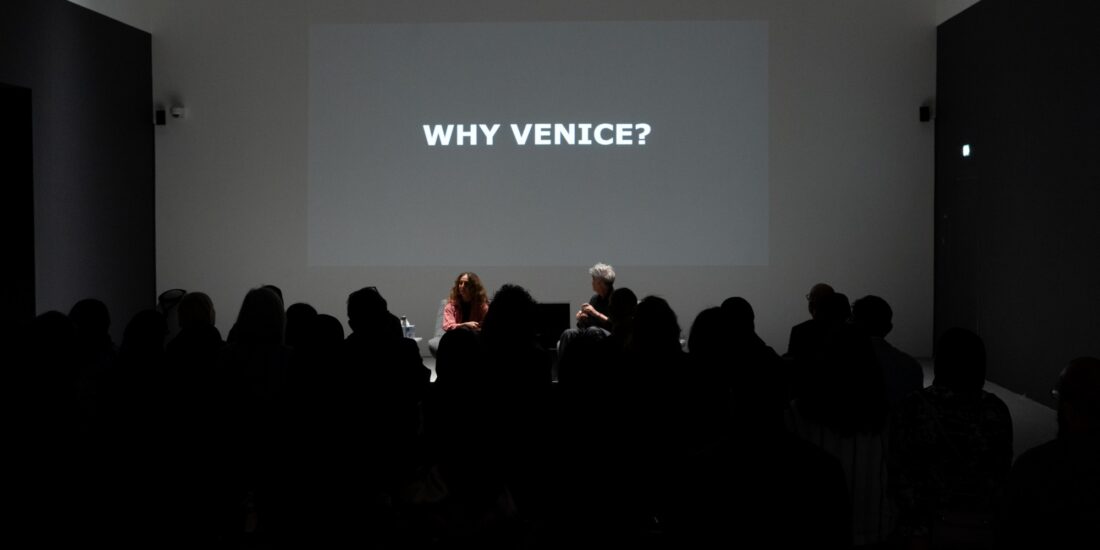
Aric Chen, Setareh Noorani and Georges Arbid at Al Riwaq.
Launched at Al Riwaq alongside the landmark I.M. Pei retrospective, the programme positions archiving not as an act of preservation alone, but as a form of cultural stewardship and future-building. It creates a dynamic space where architecture is celebrated, debated, and projected into the future.
Within this ecosystem, voices like Aric Chen, Georges Arbid, and Setareh Noorani, illuminate the stakes of remembering, documenting, and interpreting modernism in the region, each offering a different lens on why memory must be protected.
What emerges is not merely an academic discussion, but a collective call to safeguard the architectural soul of the region.
Shaping the Region’s Archival Future

Aric Chen and Setareh Noorani conducting the workshop as part of the QM programme.
Aric Chen, Director of the Zaha Hadid Foundation in London, is one of the most influential voices in how architecture is collected and interpreted today. Known for his tenure as Lead Curator of Design and Architecture at M+ Hong Kong, his work consistently challenges the idea that archives belong to the past. Instead, he treats them as dynamic systems of intelligence.
His talk for the programme, The Future of the Past: Learning from Architectural Archives, sets the tone for the entire initiative. Aric’s core assertion is simple but transformative: “Archives are resources of knowledge: lessons, precedents, ideas and concepts, often tried and tested, remain valuable today.”
His interest in the region began long before he understood the importance of recording it. “My first visit to the region was as a backpacking student in 1992, and one of my clearest memories is taking the bus from Tel Aviv to Cairo and being entranced by the villages, especially those towards the Egyptian border, in Gaza, and how beautifully they sat in the landscape and captured the light.”
The region which had its own charm and age-old traditions and knowledge that needed to be preserved, also was rampant with the temptation to constantly reinvent. This explains how knowledge embedded in mid-century modernist projects like shading devices, passive cooling, courtyard typologies, is often lost amid waves of redevelopment.

“An archive is not complete without stories, domestic rituals, and oral histories that reveal how people inhabit architecture,” says Setareh Noorani.
Setareh Noorani, an architect and researcher at the Nieuwe Instituut in Rotterdam, brings a nuanced, deeply human perspective to modernism. Her research follows the Indian Ocean region, Iran, the Gulf, East Africa, tracing how modernism was lived, adapted, resisted, and absorbed across cultures.
Her interest began with her own country, she says, “I’m Iranian, and cities like Tehran have been through rapid urban and architectural transformations post-40s under Mohammad Reza Pahlavi. Connecting to the international style in the 60s, the architecture in the beginning reflected Western ways of living, eschewing traditional building typologies, such as the shared courtyard – that typically supported a collective family structure, open activities, and shared maternal care. Realising the effect of indiscriminate importance of building method and materials, and the geopolitics expressed in architecture, led me to delve deeper into modernisms – along the entire Gulf and Indian Ocean region,”
This sensitivity to social change underpins her entire approach. For Setareh, an archive is not complete without stories, domestic rituals, and oral histories that reveal how people inhabit architecture.
She insists: “It’s important to learn about the conditions in which these modernisms became existent, and their impact on contemporary communities.”
Her perspective ensures that the archive includes life, not just buildings.

“Arab modernism is inherently transnational, shaped by local craftsmen, foreign architects, migrant labour, and regional mobility,” says Georges Arbid.
Georges Arbid, founder of the Arab Centre for Architecture (ACA) in Beirut, has spent decades safeguarding the region’s architectural heritage. His practice is urgent and activist: rescuing drawings before buildings are demolished, documenting neighbourhoods before they are transformed, and preserving oral histories before they disappear.
He leads Qatar’s programme session: Architectural archives as a tool for cross-cultural dialogue. For Georges, archives are not neutral. They are political, emotional, and vulnerable.
He often reminds us that Arab modernism was inherently transnational, shaped by local craftsmen, foreign architects, migrant labour, and regional mobility. To archive this lineage is to archive a web of cultural exchanges, collaborations, conflicts, and aspirations.
And it is precisely this cross-cultural layering that he believes must be made visible if the Arab world is to understand its modernity.
Archive as a Living Source

“Architecture is social, political, cultural, sometimes loved and sometimes contested,” says Aric Chen.
Aric articulates the foundational idea of the programme: “Much of the knowledge we need is already there if you look for it.”
This is counter to the narrative that the region must import solutions. Instead, Aric invites practitioners to dig into the region’s own past, its experiments, failures, and successes.
He also emphasises that architecture is never singular: “Architecture is social, political, cultural, sometimes loved and sometimes contested.”
This complexity requires archives that can hold multiple truths at once.
Georges’ work at ACA demonstrates that archiving is an act of not only documentation but of connection.
He insists that the Arab world’s modern heritage cannot be preserved without understanding the forces that shaped it: reconstruction after wars, the rise of oil economies, migration, Cold War alliances, developmentalist ambitions, pan-Arab optimism, and global professional networks.
Archiving such histories requires effort, persistence, and often rescue.

“When buildings go, so do the ideas, conversations, and dreams they contained.” says Georges.
For Georges, archiving is a site of visibility, a place where forgotten narratives resurface, where hidden contributions are acknowledged, and where architectural identity is reconstructed with care.
His core philosophy aligns deeply with Qatar Museums’ vision: a future that learns from its past, not erases it.
Setareh adds a crucial dimension: that modernism should not be read solely through architects’ intentions, but through how people adapted to it. She explores how families repurposed spaces, communities resisted certain typologies, how women experienced these shifts differently and how migrants occupied structures designed without them in mind.”
She explains: “Departing from traditional houses with courtyards, where communal duties of care were shared, to the nuclear family in tower blocks reshaped how people lived, cared, and related to one another.”
Her insistence that life itself must be archived modernises the very definition of architectural heritage.
“Mirroring it to the urgencies in the Netherlands, such as resource scarcity, spatial limitations, and an ongoing housing crisis, architectural archives have the capacity to show practical solutions and visionary statements to similar issues throughout time. At the same time, these archives should also tap into oral history to document endangered methods and perspectives around building,” she says.

Setareh Noorani, ” We must combat amnesia in this field.”
Setareh issues one of the strongest warnings: “We must combat amnesia in the field.”
Aric reinforces the urgency: “These efforts should be supported with urgency because they, like memory itself, are fragile.”
Georges embodies the consequences of forgetting: “Every year, buildings vanish across Beirut, Baghdad, Cairo, Kuwait City, and even Doha. Sometimes with warning, sometimes overnight. Often without documentation.”
The loss is not only physical, it is intellectual and emotional, according to Georges.
When buildings go, so do the ideas, conversations, and dreams they contained.
What Counts as Archive

Aric Chen, Georges Arbid, and Setareh Noorani
All three participants champion the need for expanded methods.
Setareh notes: “Documentary research gives us better tools to understand layered realities — how people commit to, adapt, or revolt against these structures.”
She insists on archiving by different methods: “By supporting dialogue and research into these histories – from many different angles, and experimental combinations of research methods – to connect to a wide range of citizens, students, and experts. This can range from site readings, organising walks, student social media take overs, hosting temporary interpretations in art commissions, or reflective written forms. We, at Nieuwe Instituut, have been doing this successfully with our collections, and continue to find new audiences and new interpretations to Dutch architectural history.”
 Georges’ ACA embraces this multiplicity, collecting drawings alongside memories, interviews, and even personal photographs. He showed the attendees how narratives through interviews helped the most in remembering and later on to scout for information that connected the dots on various architectural building formats.
Aric’s curatorial work also welcomes these varied forms of narrative.
Doha brings it all Together
Together, they broaden the very definition of architectural knowledge. And Doha becomes the harbinger of such exchanges that pushes for architectural archiving. Through Qatar Museums’ programme, Doha becomes a leading hub for rethinking architectural archiving.
The programme is an ecosystem that includes: 30+ regional and international experts, including Aric, Setareh and Georges with cross-disciplinary workshops and activations.
Aric describes Doha as: “A remarkable place of gathering and exchange… with a strong ethos for culture and collecting.”
Setareh sees the potential for Qatar to activate archiving through walks, site readings, student takeovers, and artistic commissions, expanding who gets to participate in architectural memory.
And Georges’ presence grounds the programme in regional realities: the fragility, complexity, and richness of Arab modernism.
Through Architecture & Design: Turning Vision into a Universal Dialogue, Qatar Museums does something profound: it positions the archive not as a static repository, but as a vibrant, evolving space, where past and future, memory and innovation, global voices and local stories converge.
And together, Aric, Setareh, and Georges remind us of a truth the region can no longer ignore:
Architecture is not only what we build: It is what we choose to remember.