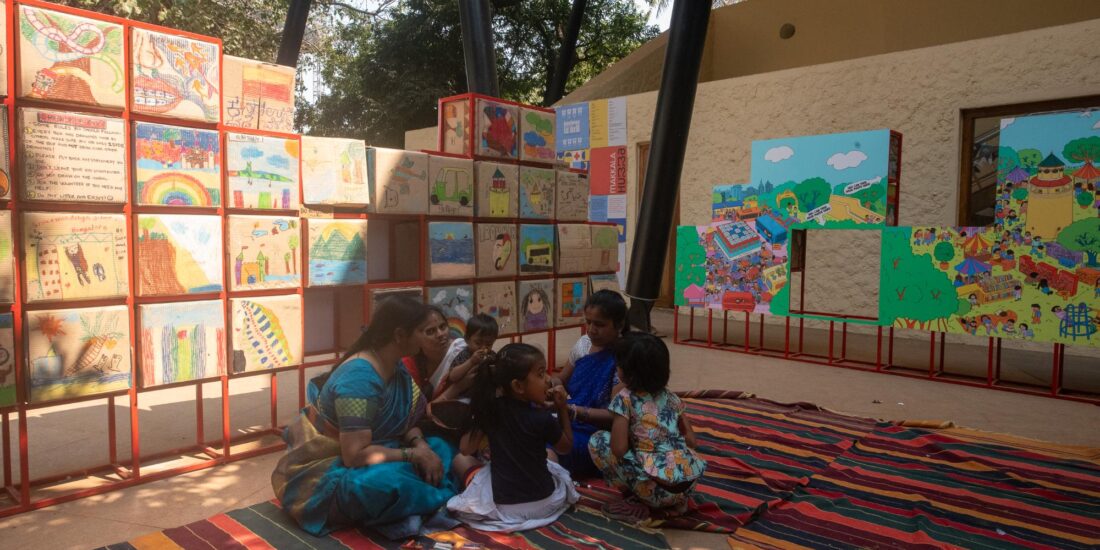
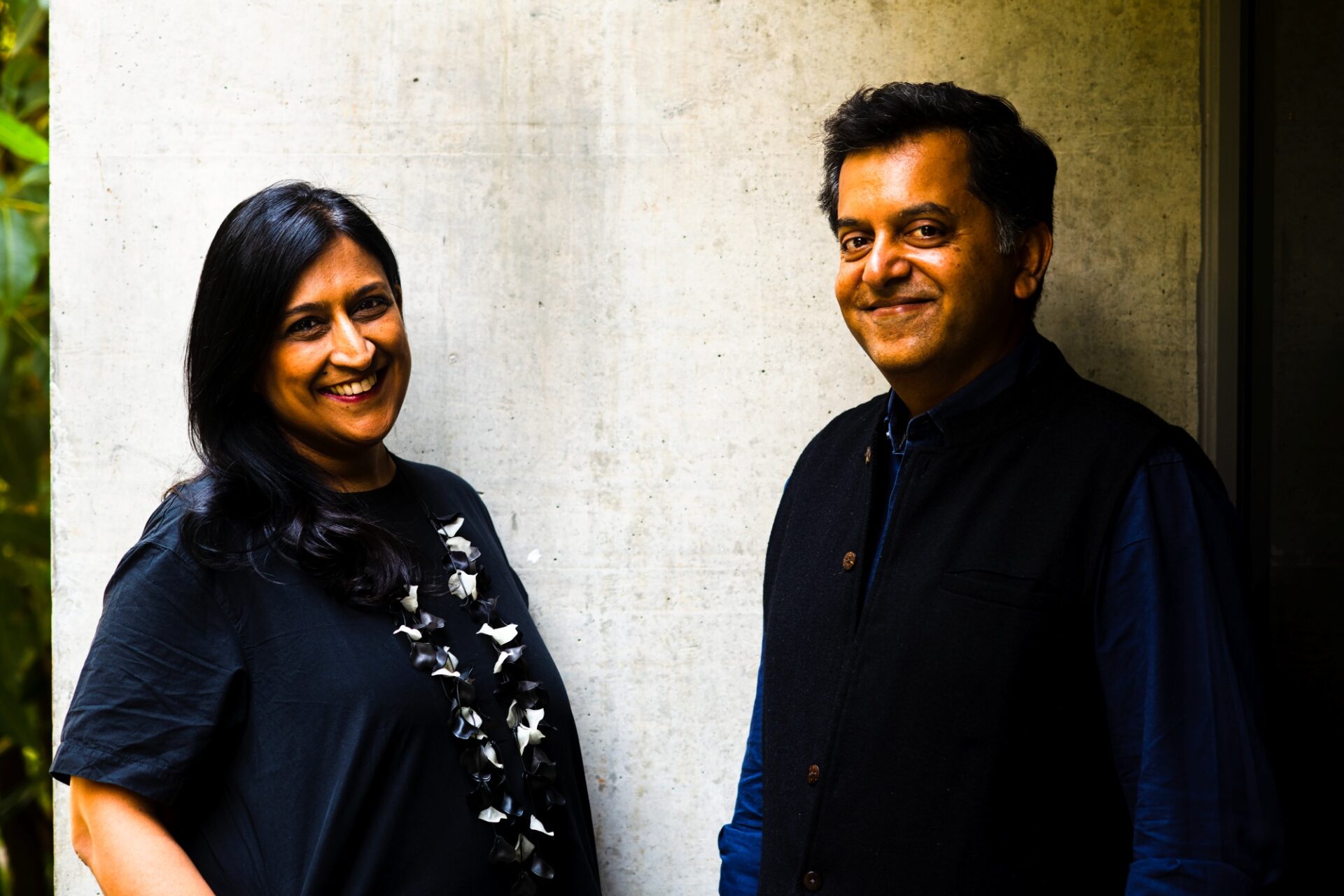
Bijoy Ramachandran on Clarity, Craft, and Time
What makes a building worth remembering is not always its form or scale. Sometimes it is simply the feeling that makes you stay a little longer than you planned. As Bijoy Ramachandran recalls from a lecture by Balkrishna Doshi, timelessness is that quiet moment when you are comfortable enough to delay leaving. That idea of staying, of lingering, sits at the centre of how Bijoy Ramachandran thinks about architecture. By Arya Nair
At the same time, Bijoy Ramachandran’s work is not driven by vague emotion alone. It is built on clarity. Early in his practice, while working with an international team on a hotel project, he encountered a level of precision in planning that left a lasting impression. Since then, clarity has become a discipline in his process. Every project begins with understanding. The site, the client, the budget, and the programme are not constraints but clues. He studies them carefully before drawing a single line.
In this interview, Bijoy shares insights into his firm Hundred Hands, discussing its design philosophy, his architectural influences, favourite books, and the experiences that have shaped his journey.
SCALE: Did architecture always seem like a natural choice for you?
Bijoy Ramachandran: Not at all. I am actually the first architect in my family. There was no direct influence or lineage that led me into the profession. When I was in school, around the twelfth grade, there was a teacher who would sit down with students and talk about what they might pursue after school. During one such conversation, he suggested architecture as a possible path. It was a casual suggestion, but it stayed with me.
Sometimes these decisions do not come from a grand plan. They begin with a small moment, a passing remark, and gradually take shape over time.
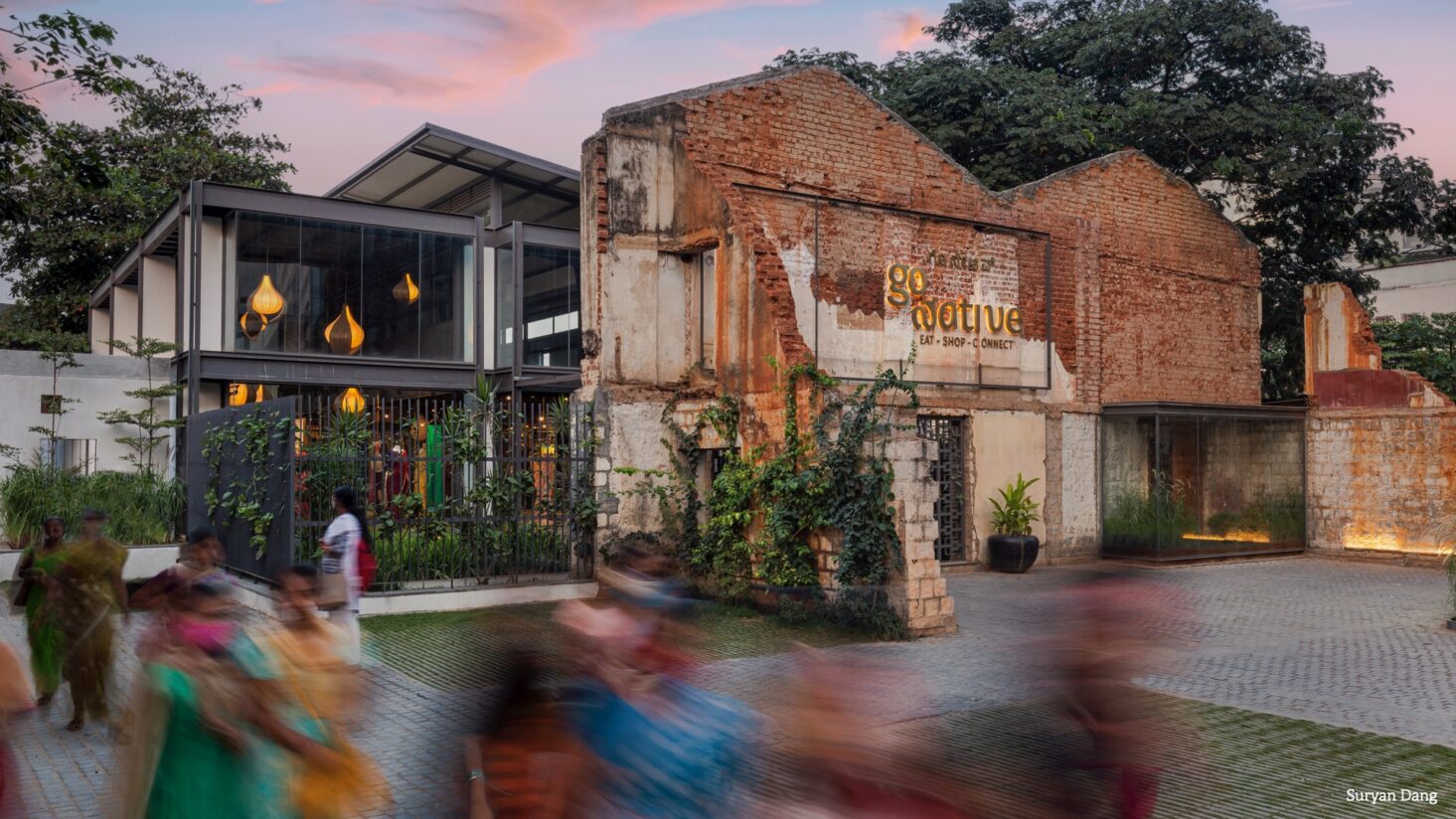
Go Native store at Whitefield, Bangalore, designed by Hundredhands.
SCALE: Why did you choose Bangalore after your time in the United States? What brought you back?
Bijoy Ramachandran: The decision felt quite natural. My wife grew up in Bangalore, and her family is based there, while my parents were still in Dubai at the time, so the city offered a sense of familiarity and support. We also had a daughter, and being close to family made the transition much easier. Beyond that, Bangalore has an openness to it, with people coming from across the country and beyond, which gives it the character of a diverse and welcoming metropolis, making it an easy place to return to and settle into.
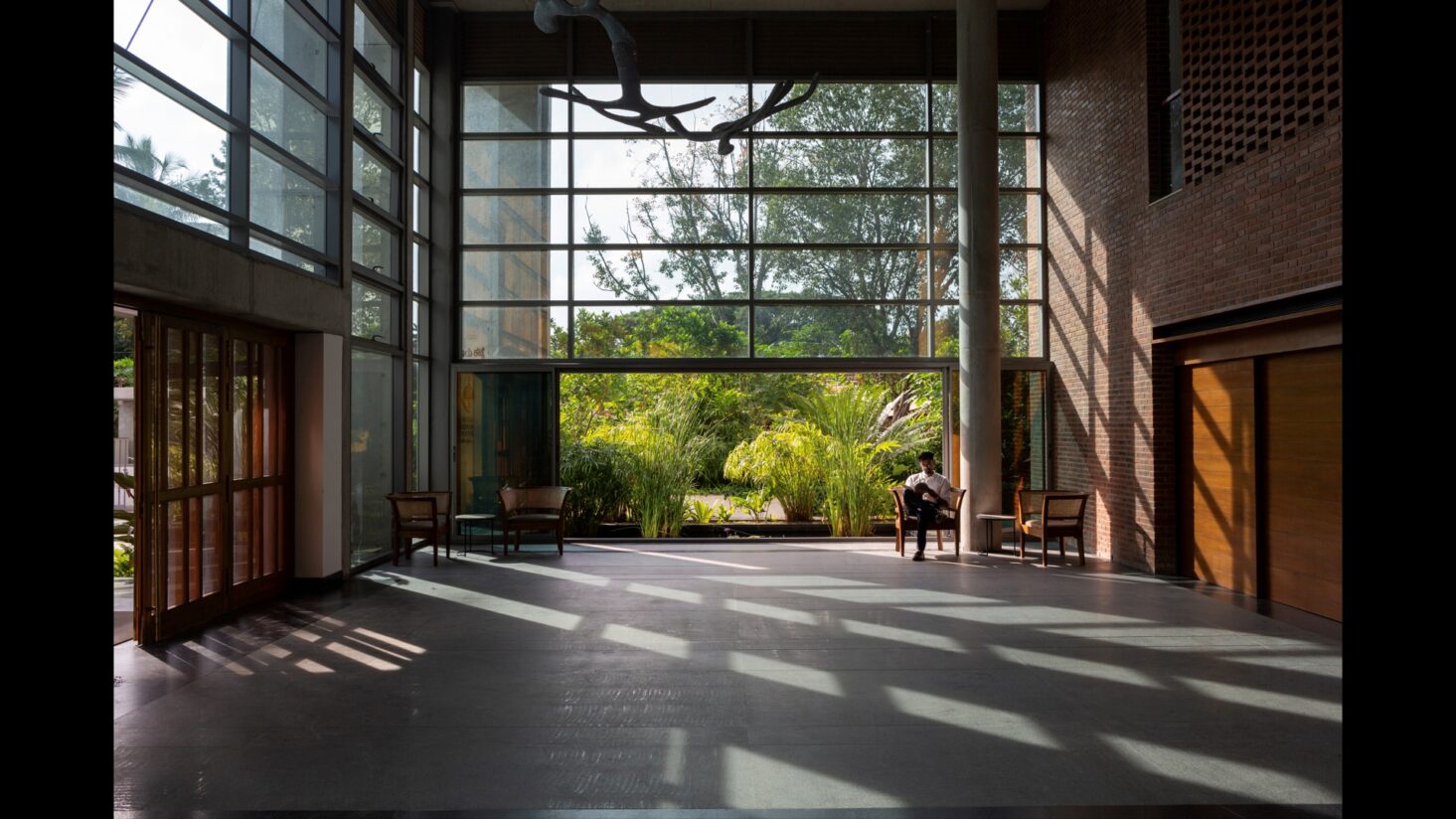
Bangalore International Centre houses a 300-seat auditorium, seminar rooms, a library, a gallery, a restaurant, and guest accommodation.
SCALE: How long has it been since you started Hundredhands? What were the early years like?
Bijoy Ramachandran: We started Hundredhands in July 2003. In the very early days, like most young practices, we were working on small projects, just to get going. Then something quite unexpected happened that changed the trajectory of the studio.
While I was working in New York, I had been involved in designing a large orphanage project with an organisation called Hope Foundation. A few months after we returned to India, around September 2003, I received a call from Mark Templer, who was then leading their India operations. He asked if I would be interested in taking up a much smaller project in Tiruchirappalli.
It was a modest one-acre site, but for a young practice, getting the opportunity to design an institutional building at that stage was quite rare. Typically, you begin with houses or small renovations. This felt like an extraordinary beginning.
We signed the contract in November that year, and that became our first project.
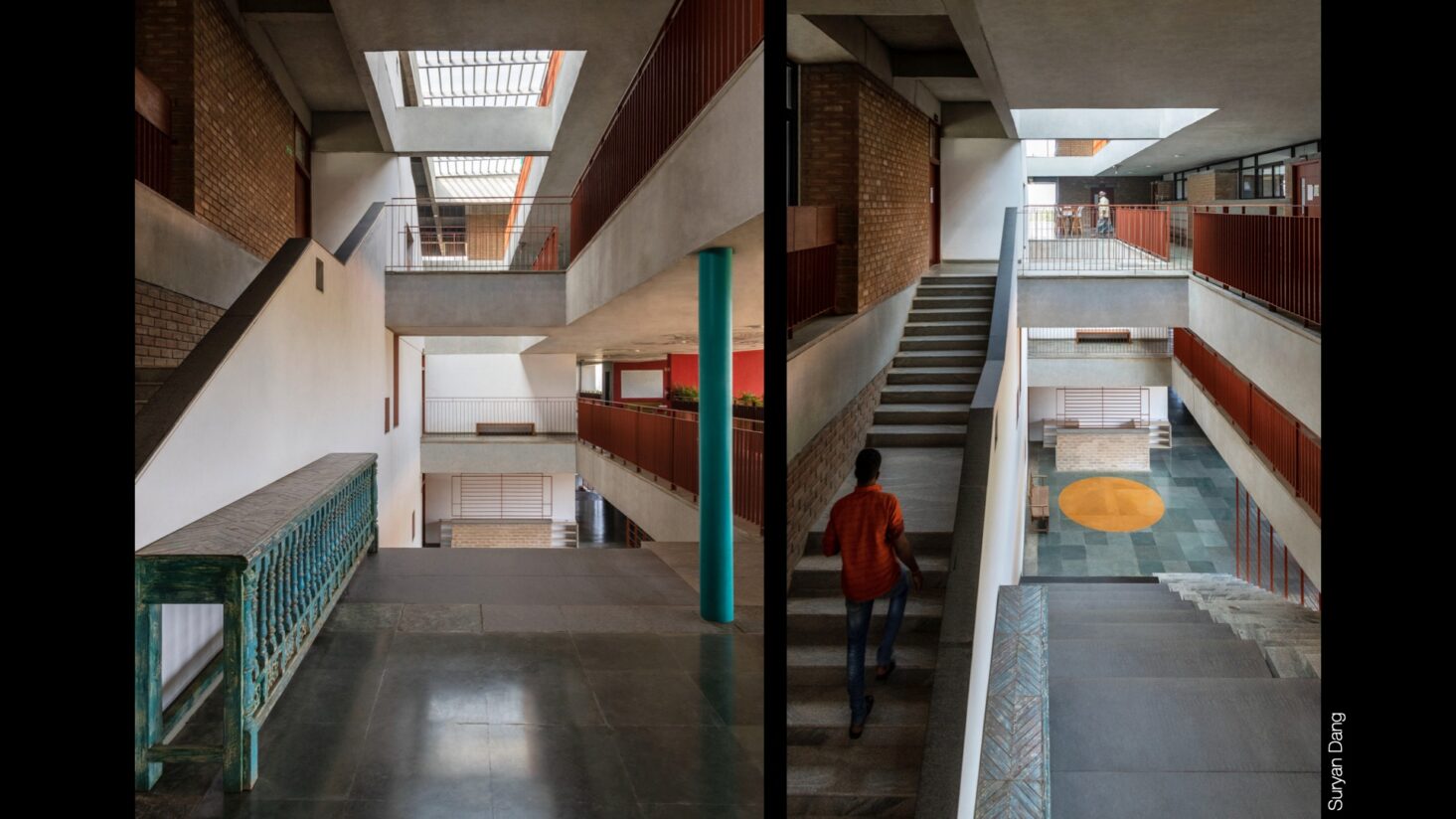
Airaa Academy.
SCALE: When you begin a project, what does your design process typically look like?
Bijoy Ramachandran: We once made films on Balkrishna Doshi, and in those conversations, he says something very important. He says that the clues are everywhere; one just has to remain alert. That idea has stayed with me.
At the start of any project, we try to absorb as much as possible. The brief, the client’s aspirations, the site conditions, and the budget: all of these become cues. They help us find a direction. Sometimes the starting point is something very specific that the client says. At other times, it is something powerful about the site itself. So the process does not follow a fixed path. It shifts depending on what the project offers.
What matters is being open and receptive, so that whatever we create feels relevant to the place and to the people who will use it.
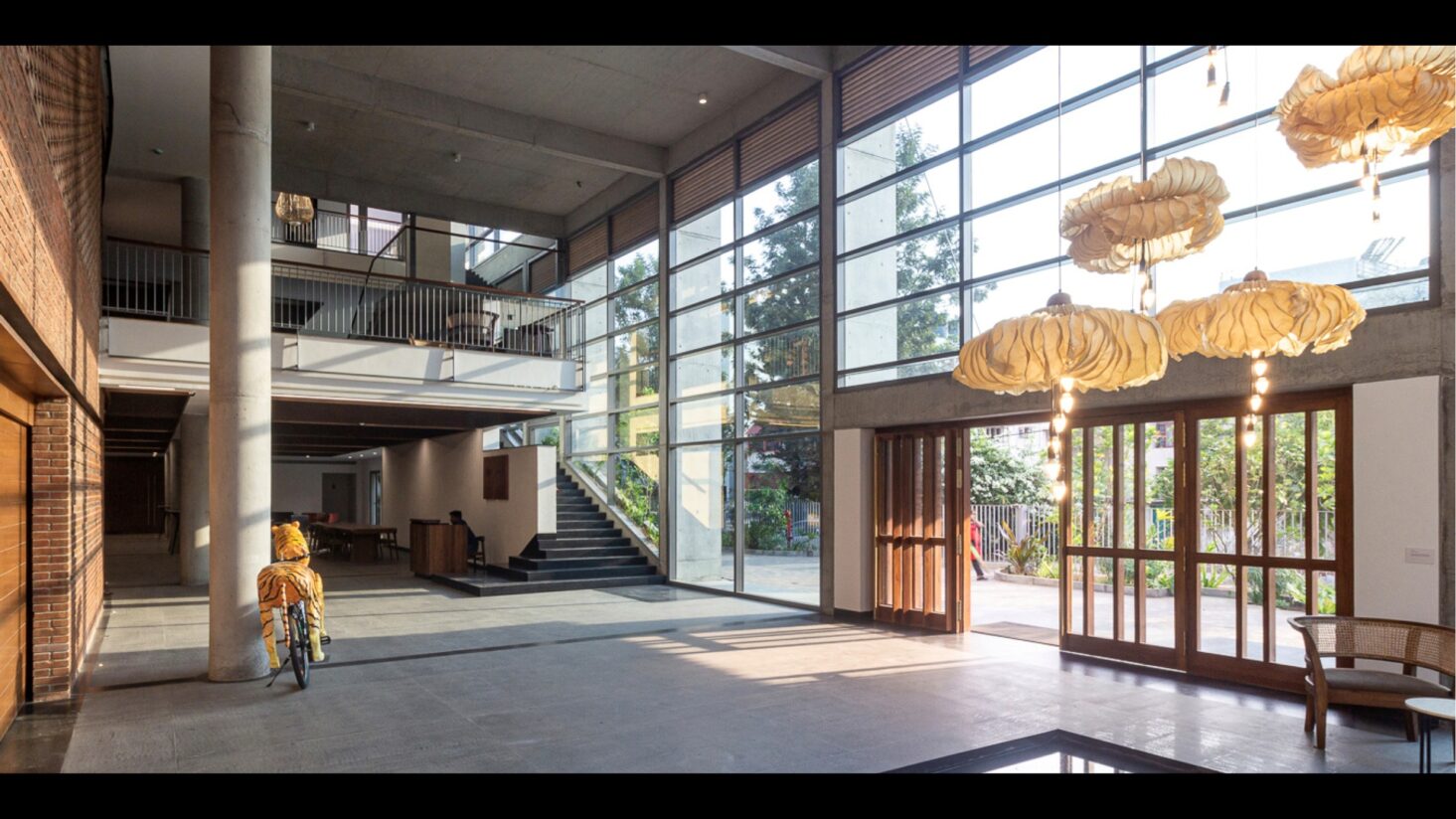
Bangalore International Center.
SCALE: How long has it been since you started Hundredhands? What were the early years like?
Bijoy Ramachandran: We started Hundredhands in July 2003. In the very early days, like most young practices, we were working on small projects, bits and pieces just to get going. Then something quite unexpected happened that changed the trajectory of the studio.
While I was working in New York, I had been involved in designing a large orphanage project with an organisation called Hope Foundation. A few months after we returned to India, around September 2003, I received a call from Mark Templer, who was then leading their India operations. He asked if I would be interested in taking up a much smaller project in Tiruchirappalli.
It was a modest one-acre site, but for a young practice, getting the opportunity to design an institutional building at that stage was quite rare. Typically, you begin with houses or small renovations. This felt like an extraordinary beginning.
We signed the contract in November that year, and that became our first project.
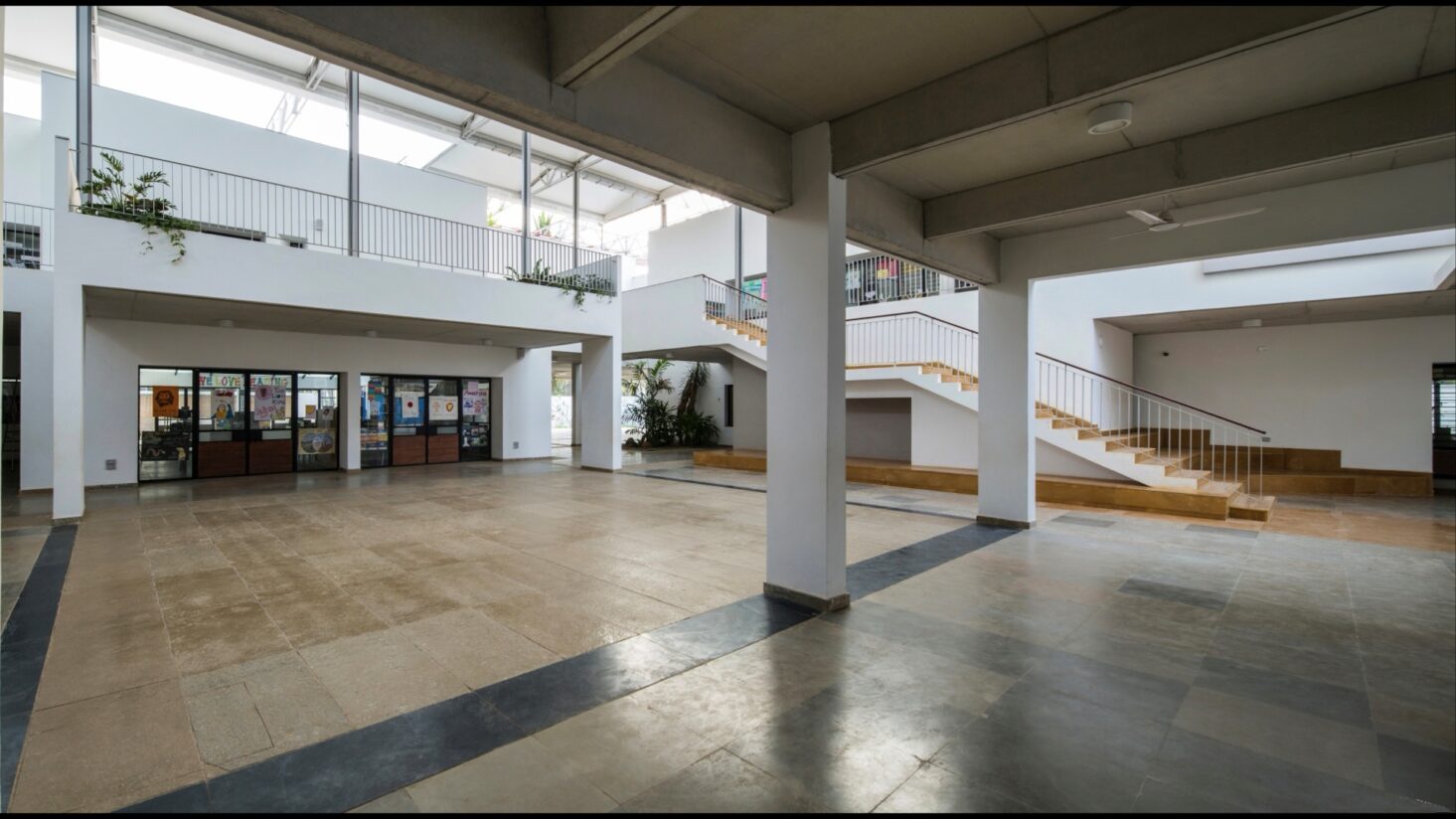
Neev Primary School, a challenging project completed in six months.
SCALE: When you begin a project, what does your design process typically look like?
Bijoy Ramachandran: We once made films on Balkrishna Doshi, and in those conversations, he says something very important. He says that the clues are everywhere; one just has to remain alert. That idea has stayed with me.
At the start of any project, we try to absorb as much as possible. The brief, the client’s aspirations, the site conditions, and the budget all of these become cues. They help us find a direction. Sometimes the starting point is something very specific that the client says. At other times, it is something powerful about the site itself. So the process does not follow a fixed path. It shifts depending on what the project offers.
What matters is being open and receptive, so that whatever we create feels relevant to the place and to the people who will use it.
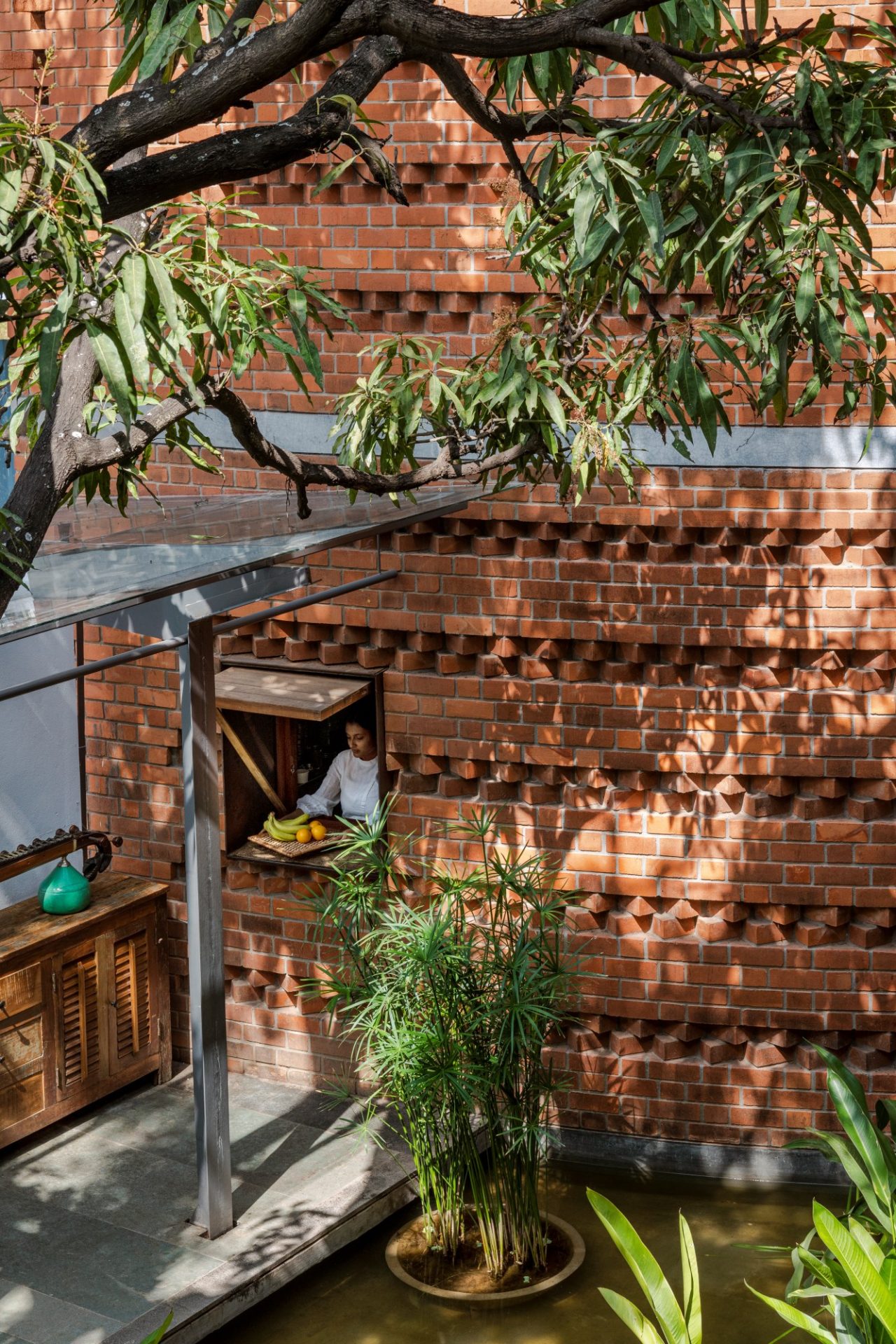
Brickwork in focus at Go Native.
SCALE: How does this translate into your working methods?
Bijoy Ramachandran: For me, drawing by hand is very important. I continue to sketch a lot, even though that is becoming less common now. Alongside that, we build physical models very early in the process. These help us understand the massing and how the building sits on the site.
The process is highly iterative. I might begin with a hand drawing, which is then developed into digital drawings or a SketchUp model by the team. We also build physical models, photograph them, and study them again. Based on that, I rework the drawings, refine certain aspects, or rethink parts of the design.
It becomes a continuous back and forth within the team. Sometimes the idea comes together quickly. At other times, it takes longer to understand whether something is truly working. But that rhythm of iteration is essential to how we arrive at a solution.
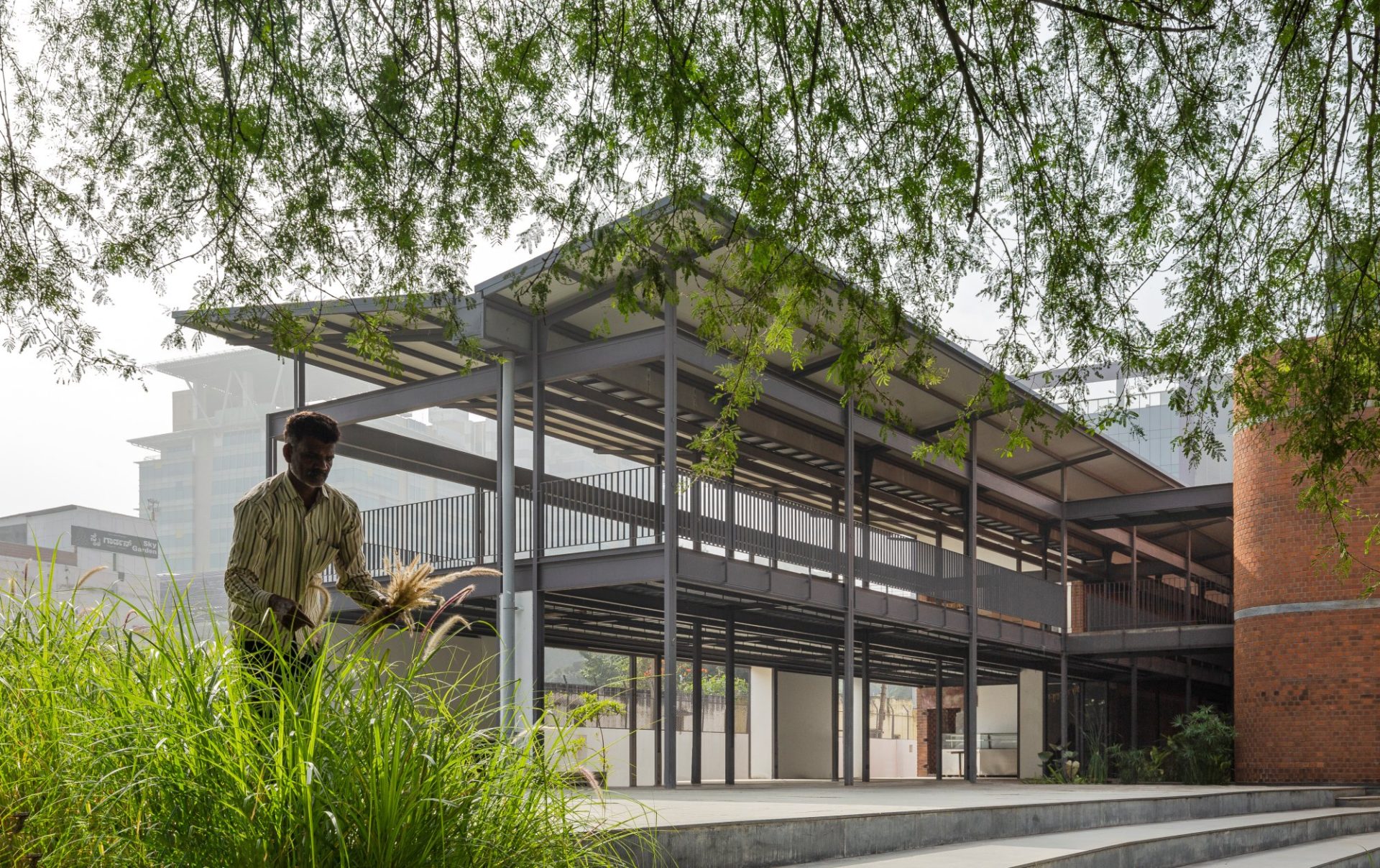
Go Native is a composition of contrasting conditions: one is always encountering different conditions of enclosure, opacity, robustness, colour and stability
SCALE: Over the past two decades, you must have worked with a wide range of clients. Have you noticed any significant changes in client expectations today compared to earlier years?
Bijoy Ramachandran: The most noticeable shift has been in awareness. Clients today have seen much more of the world and often come with references, ideas, and a familiarity with architecture that was less common earlier. At a fundamental level, however, what they want has not changed significantly; the core aspirations remain similar, but the way they are expressed has evolved. Sustainability, for instance, has become an almost universal concern, with most clients raising it at the outset, though the depth of engagement varies and is often linked to certifications and ratings. Overall, the real change lies not so much in expectations, but in the level of exposure and engagement that clients bring into the design process.
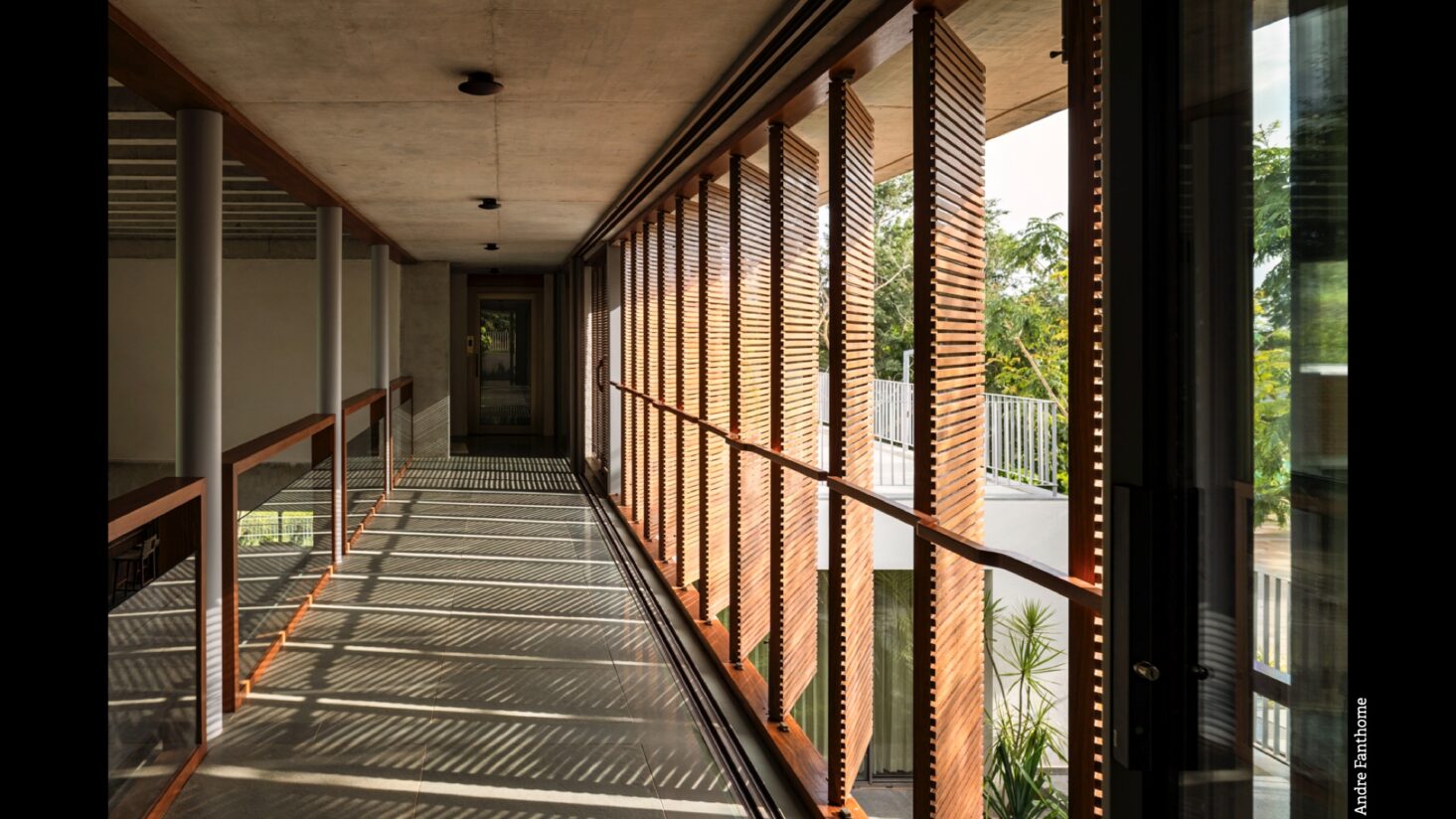
Images from Kanasu, the play of light and shadow, a design homage to the buildings that fascinated the architects.
SCALE: We noticed references in your studio to architects like Le Corbusier, Frank Lloyd Wright, and B. V. Doshi. Are these your primary influences? What do you draw from their work?
Bijoy Ramachandran: Interestingly, the architect who has influenced me the most is not even on the wall. That would be Louis Kahn. There is something deeply compelling about Kahn. His work carries a certain mystery, almost a sage-like quality. He speaks about architecture in timeless terms, about resonance and repose.
These are qualities that are difficult to find in contemporary buildings. You often have to go to places like Melukote or explore old ruins to experience that sense of stillness and depth. Kahn, however, seems to have accessed something of that eternal quality within modern architecture.
At the same time, Le Corbusier is an equally powerful presence. He is a kind of maverick genius. The sheer range of his work and the ideas he explored across his career are astonishing. In many ways, he was far ahead of his time. Even today, when we work with reinforced concrete, we often find ourselves revisiting territories he had already explored decades ago, whether in terms of structure, geometry, or spatial composition.
I remember when B. V. Doshi visited our office and saw these references on the walls. He remarked, half in jest, that it must be difficult to work in a space where everything has already been done. There is some truth to that. Architects like Corbusier have already played out so many possibilities.
But Kahn, for me, is searching for something else. Something more distant, more enduring. His writings are as important as his buildings. They allow you to access his way of thinking, his philosophical approach to architecture.
I was introduced to Kahn during my third year in architecture school. Around the same time, quite by chance, I came across a book on a pavement on MG Road that contained transcripts of radio talks from Voice of America. One of them was Kahn’s essay Form and Design, which remains one of the most profound texts on architecture.
That moment stayed with me. Even today, decades later, I find myself returning to those ideas. In many ways, Kahn continues to be a constant source of inquiry and inspiration for us.
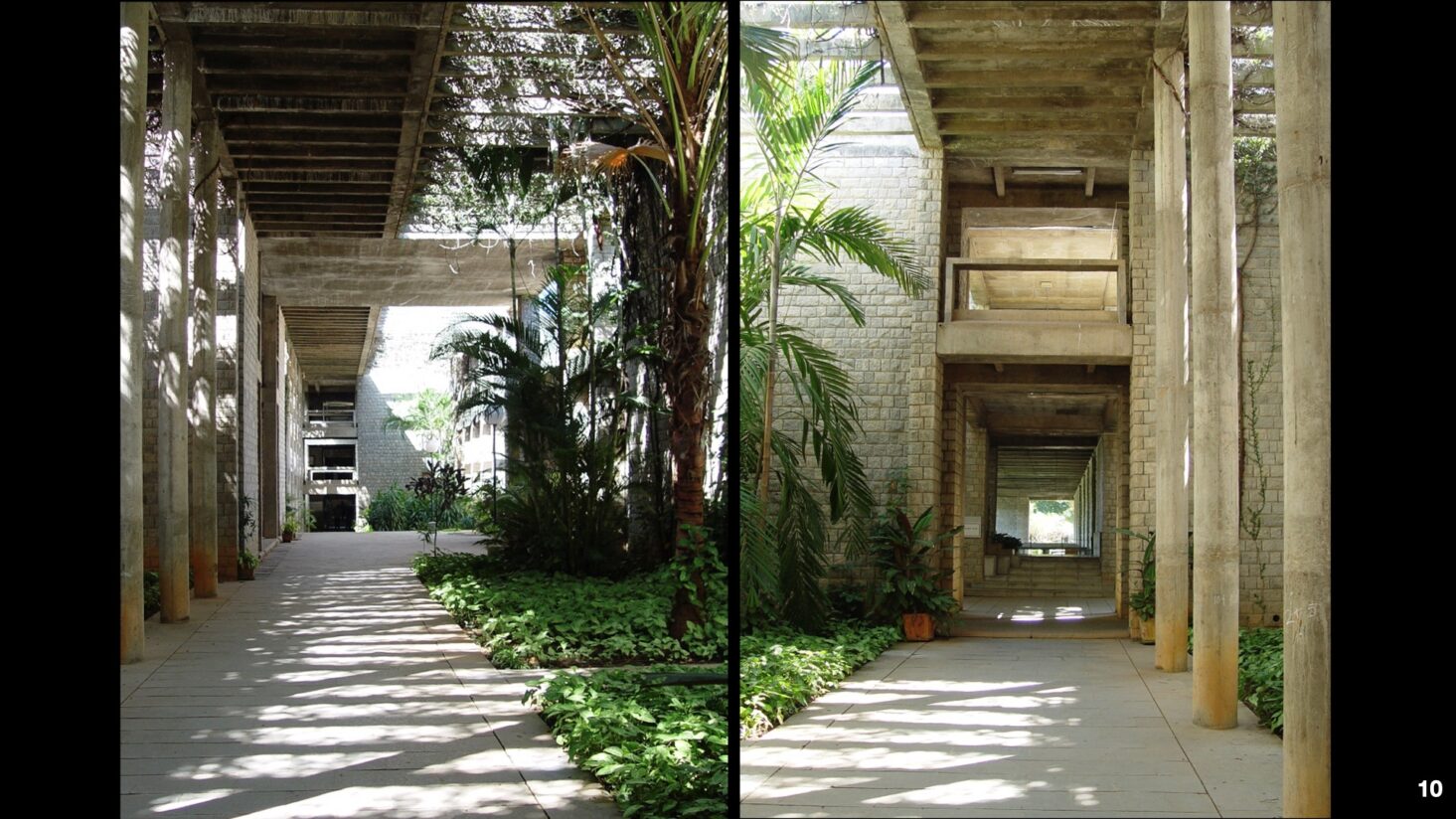
The play of light and shadow within the IIM Building in Bangalore.
SCALE: You mentioned institutions in Bangalore, particularly the Indian Institute of Management Bangalore. The play of light and shadow there, along with its references to Indian temple architecture, is quite striking. Is this something you have explored in your own work?
Bijoy Ramachandran: Not in a literal sense, but the ideas behind it are very important to us. The play of light and shadow is something we actively work with in our projects. We try to create a range of spatial experiences, where light is not constant but varied. There are moments of brightness and moments of darkness, and together they form an active palette.
These variations are always tied to function and context. Light can help define whether a space is public or intimate. It can guide how people gather, move, or pause within a building. This becomes especially important in schools, where we often explore how light changes across time, through the day and across seasons. The building then becomes something you experience differently each time you encounter it.
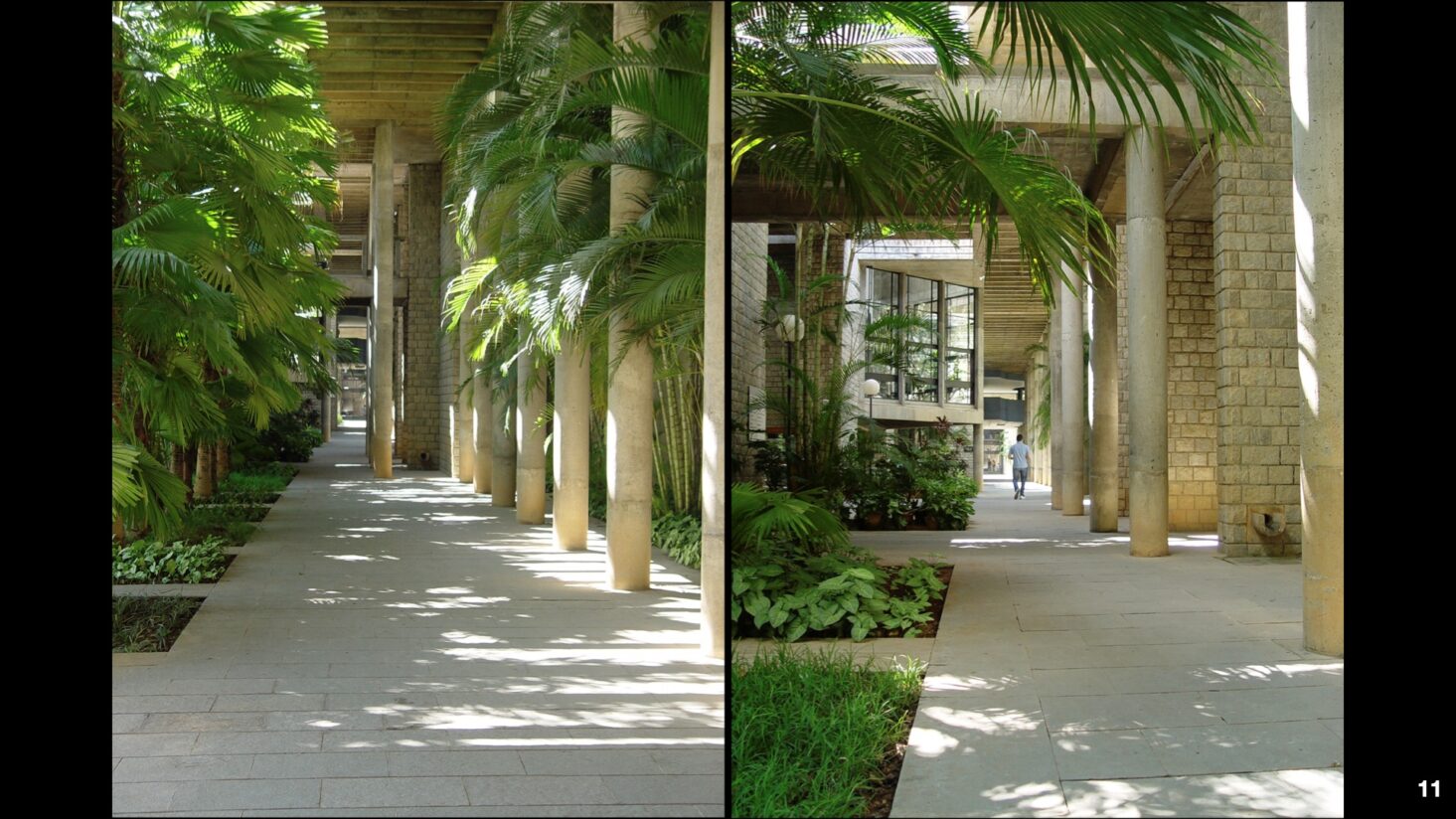
Doshi’s IIM building has always captivated the architect.
SCALE: How do you view B. V. Doshi’s work in this context?
Bijoy Ramachandran: For me, the IIM Bangalore campus is Doshi’s masterwork. It brings together many of his ideas into a single, powerful expression. What stands out is his ability to build a bridge between traditional Indian architecture and the modernist influences he absorbed during his time with Le Corbusier in Paris and Chandigarh.
There is a remarkable synthesis on that campus. As Peter Zumthor once observed, Doshi manages to bring together the formal inventiveness of Corbusier with the silence and repose of Louis Kahn. The result is architecture that feels both powerful and deeply familiar.
When you first encounter the spaces there, especially the large pergolas and interconnected corridors, there is a sense of awe. At the same time, it feels as though you have known it before. It evokes memories of places like Meenakshi Amman Temple, or other historic environments embedded in collective memory.
What the building achieves is something rare. It creates a deep emotional connection. It evokes what one might call a deeper architectural memory, something that goes beyond form and function.
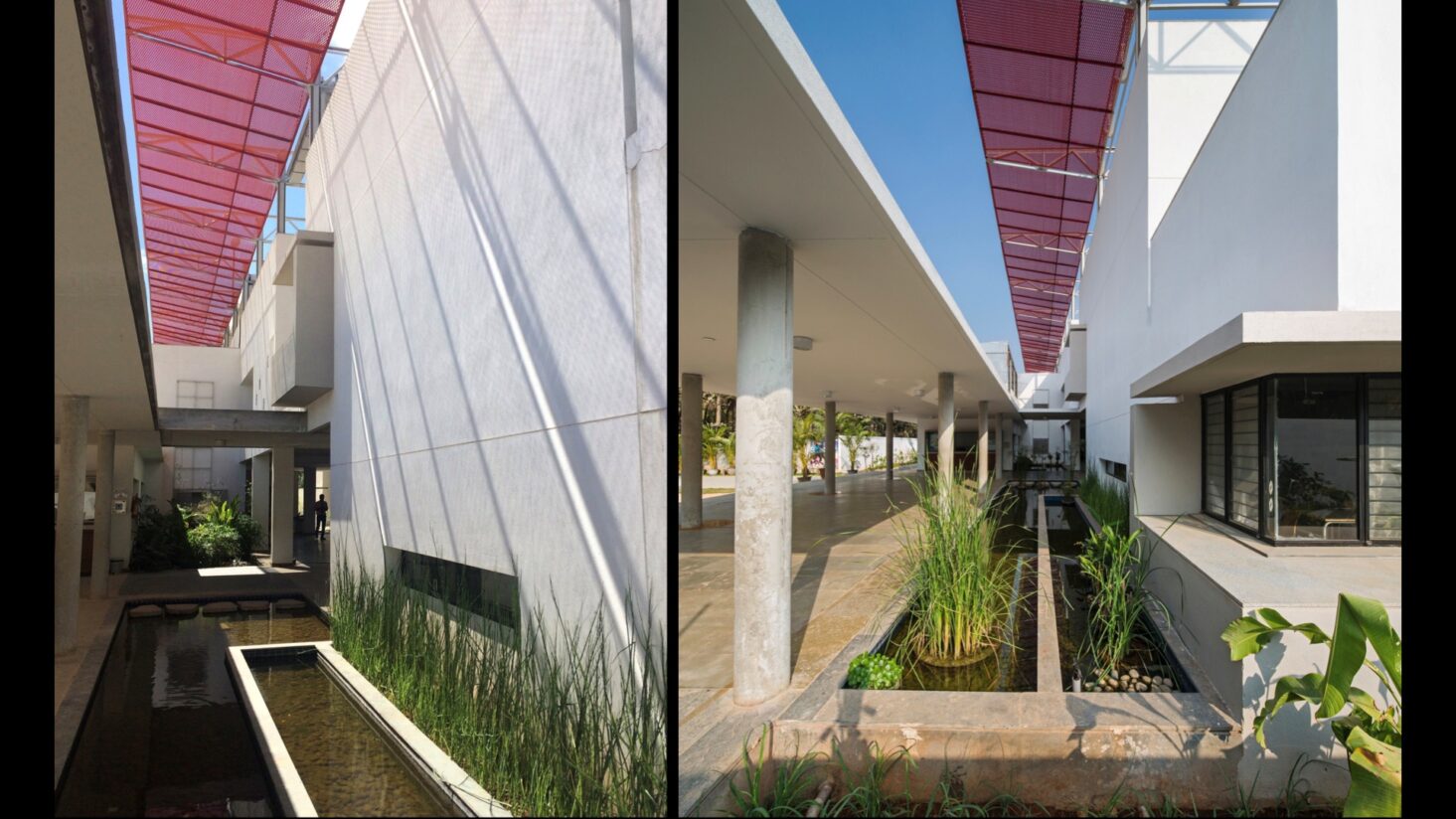
Glimpses from Neev Primary School
SCALE: Could you walk us through three of your projects: one that is closest to you, one that is most recent, and one that was particularly challenging?
Bijoy Ramachandran: If I had to choose a favourite, it would be the hotel we designed in Bangalore, originally known as Alila Bangalore, and later renamed Miraya Hotel.
It is a fairly large project, about 200,000 square feet, with 120 rooms, serviced apartments, and a height of nearly 50 meters. What made it especially meaningful was the collaboration with a British architectural team that developed the initial concept. Their clarity of thought and precision in planning were a great learning experience for us.
We were responsible for the interiors, and that became an intense and deeply engaging process. We built multiple full-scale mock-ups of rooms and furniture to refine every detail. My wife, Suni, played a key role in sourcing materials and crafts from across India, which eventually led to the growth of her sourcing practice.
At the same time, it was also one of the most demanding projects we have worked on. The operator, Alila, brought in a very rigorous design review process. The expectations were extremely high, and we went through numerous iterations before arriving at the final outcome. In hindsight, that pressure was valuable. It pushed the project to a level of resolution that we may not have otherwise achieved.
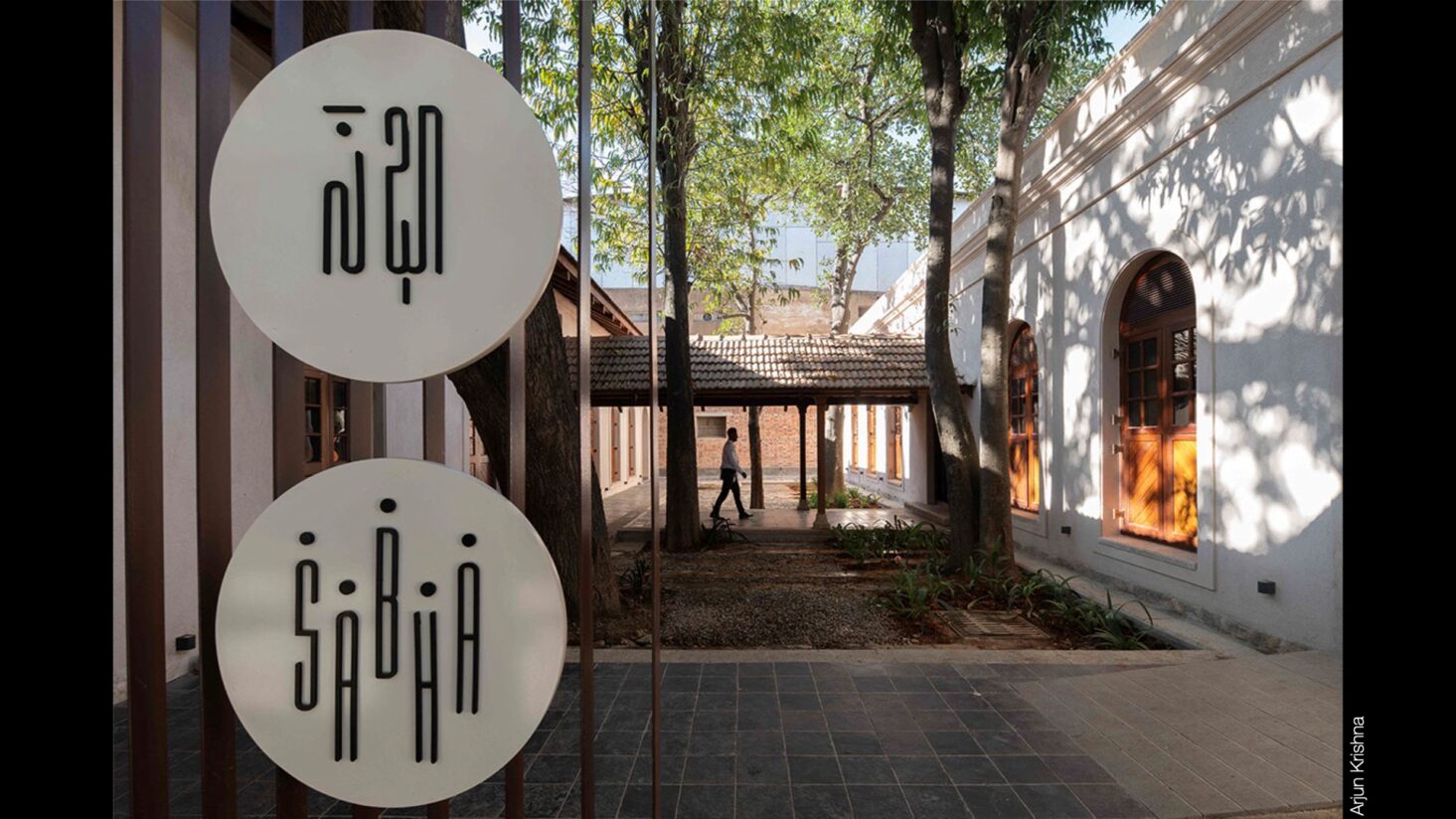
Sabha, one of the firm’s latest works.
SCALE: What about your most recent work?
Bijoy Ramachandran: One of our most recent projects is Sabha, a renovation of a 150-year-old school.
This project came together through an extraordinary alignment of people. The client, Mr Ravichandar, provided a very clear brief and created the right environment for us to work. That kind of trust is rare and invaluable.
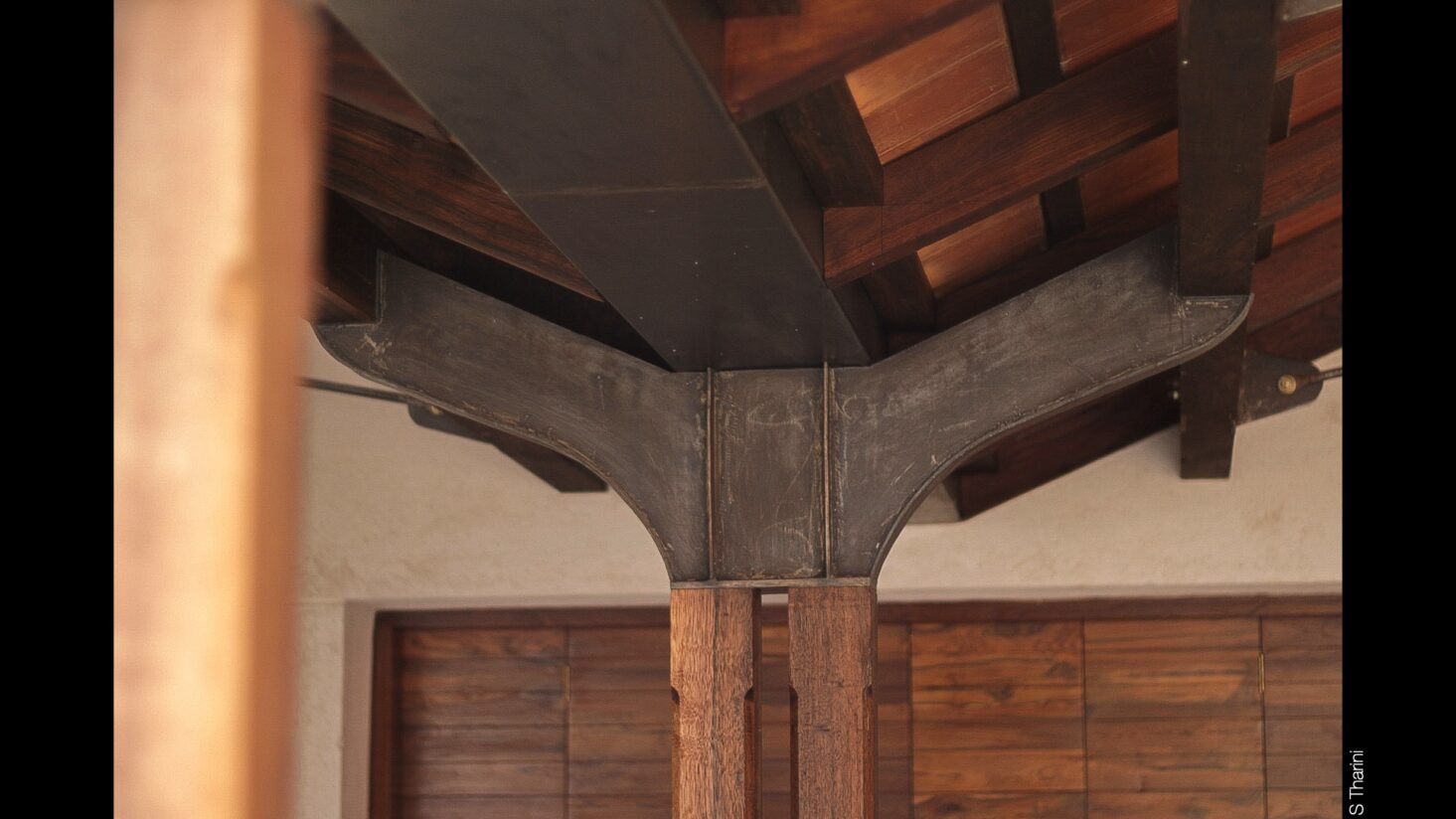
Sabha was a restoration project in which the architects worked closely with restoration experts.
Since we had no prior experience in conservation, we worked closely with experts. A conservator guided us through the process, helping us understand the protocols of restoration. We also collaborated with highly skilled craftsmen, including carpenters who reconstructed large timber roofs with remarkable precision.
In many ways, Sabha felt like a perfect project. Everything aligned. A strong brief, a supportive client, skilled collaborators, and a meaningful building. It has now become an important public institution in the city, which makes the process even more rewarding.
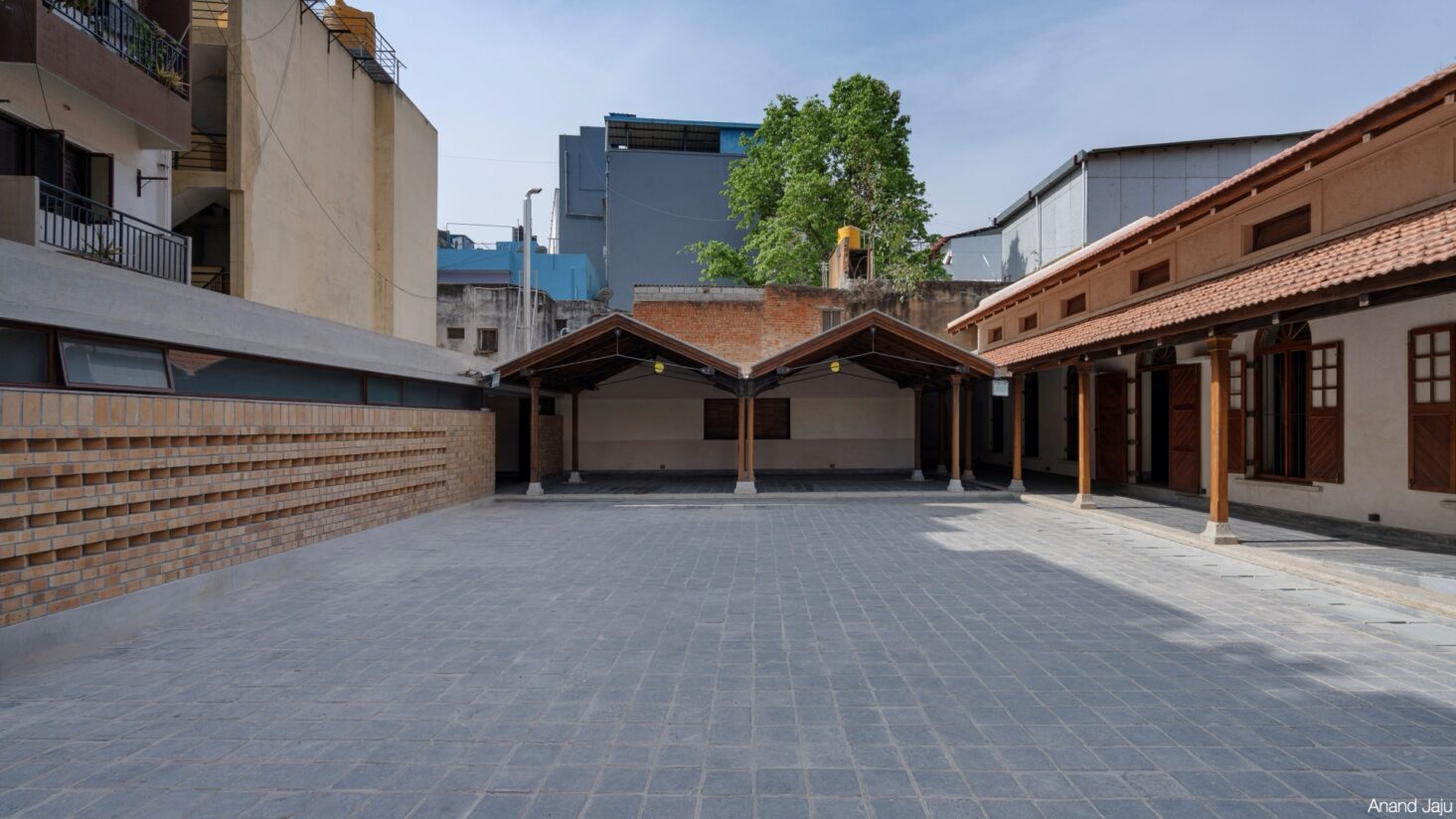
Images from Sabha.
SCALE: And which project would you describe as the most challenging?
Bijoy Ramachandran: The hotel project was certainly challenging, but another project that stands out is the Neev Primary School.
The client, Kavita Gupta Sabharwal, had a very evolved and clear vision of education. She wanted a school where more than half the learning happens outside the classroom, creating a fluid and interactive environment for children. Translating that vision into architecture was both exciting and demanding. The timeline made it even more intense. We had just six months to design and build the project. At one point, we had already finalised a scheme and were ready to proceed when something unexpected shifted the direction of the project.
Around that time, Charles Correa visited the office. On my table was a book discussing the idea of the “mat building,” a concept explored by Allies and Morrison, a British architectural practice. and Peter Smithson. It proposes a framework where circulation and services form a primary grid, and programmatic spaces are then plugged into it, allowing flexibility and growth.
Correa immediately connected with the idea. He spoke about how similar principles informed projects like the Berlin Free University, and even his own work, such as the Gandhi Smarak Sangrahalaya. He became very animated, almost rediscovering a line of thought he had long been engaged with.
That conversation stayed with me. The next day, I revisited our plan and realised that it could evolve into a similar system. Instead of a fixed layout, it could become a more open framework where circulation becomes the organising spine and spaces attach to it.
We were already short on time, and this meant rethinking everything. I went back to the client and suggested we change direction. It was a risk, but she was open to it. We took a couple of weeks to rework the scheme, and the result was a much stronger project.
That shift did not just improve the school. It also shaped how we think about planning. We have continued to explore similar ideas in later projects, where circulation acts as the primary driver of spatial organisation.
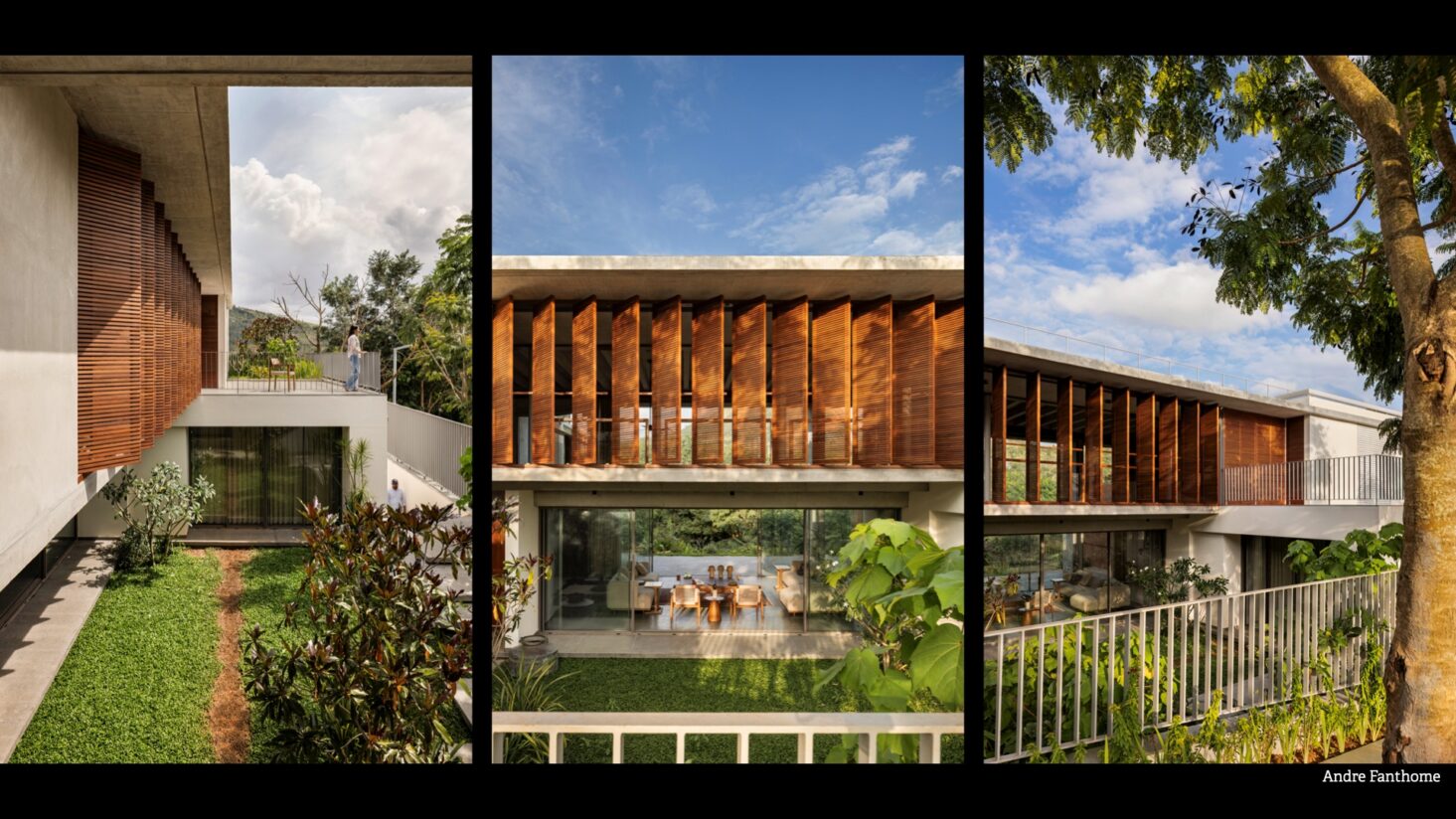
Gimpses from Kanasu Project.
SCALE: How do you view the way cities like Bangalore are developing today?
Bijoy Ramachandran: There is a larger structural issue in how cities are approached today. Increasingly, the city is seen as an instrument for generating revenue. This is not limited to any one political party. It is a broader condition.
Development and infrastructure are often driven by short-term gains. The question becomes what can be achieved within a five-year cycle that will generate enough returns to sustain the next phase of power. In that context, it becomes very difficult to have meaningful conversations about long-term well-being or the larger public good.
When the underlying intent is driven by expediency, design inevitably takes a back seat. The deeper questions about how a city should grow, how it should nurture its people, or how it should sustain its identity, become secondary.
I remember when Charles Correa visited, he was deeply disturbed by the way the metro infrastructure had been implemented, especially along MG Road. That stretch, historically known as South Parade, was once one of the defining public spaces of the city, with a beautiful tree-lined promenade.
The introduction of the elevated metro fundamentally altered that character. It was done in a way that felt insensitive to the existing urban fabric. His question was simple and difficult at the same time. Why did architects not intervene? Why was there no collective resistance?
It is not easy to answer that. In many ways, we are all implicated in how our cities have transformed.
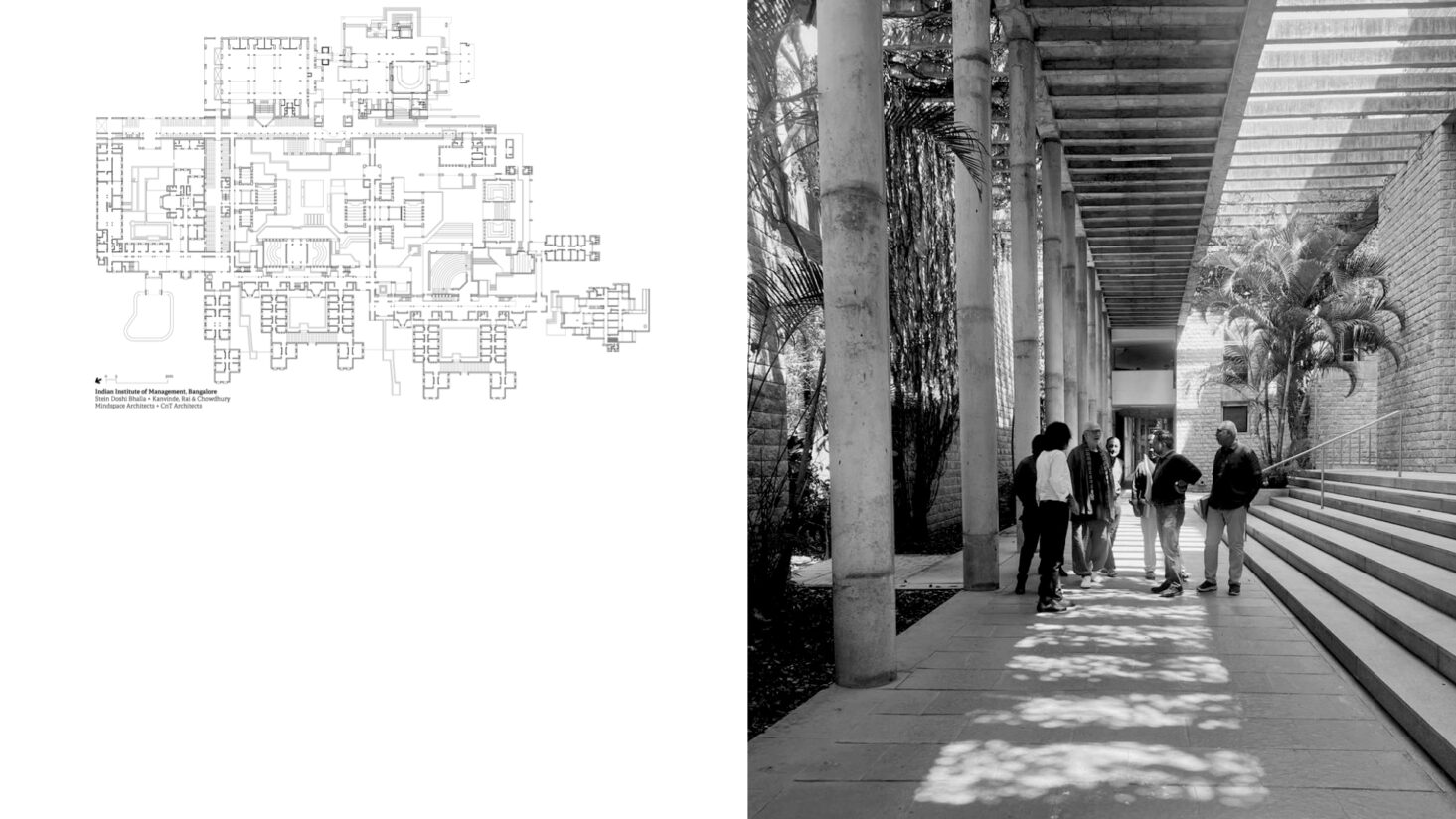
Taking visiting Pritzker-winning architect, Peter Zumthor through IIM, Bangalore.
SCALE: What, in your view, makes a building timeless?
Bijoy Ramachandran: That is a difficult question. If I truly knew the answer, I suppose I would be producing timeless buildings all the time.
But I remember something B. V. Doshi once said when he was asked a similar question around the time of his Pritzker lecture. His response stayed with me.
He said that when you are in a place where everything feels right, the breeze, the light, the atmosphere, and even when you know you are running late, you still choose to stay a little longer, that is timelessness.
There is something very profound in that idea. Buildings that make you pause, that invite you to linger, that allow you to feel completely at ease, those are the ones that begin to approach timelessness.
I often think of a temple at the foothills of Nandi Hills. There is a stepped tank, a kalyani, behind it. Whenever visitors come, we take them there. What is remarkable is how people respond to that space. They may be talking, moving around, asking questions, but the moment they arrive at the kalyani, something shifts. They become quiet. They sit. Time seems to slow down.. It creates a sense of stillness that is difficult to describe. Perhaps that is what timelessness is. The ability of a space to hold you, to make you forget time, even if only for a moment.
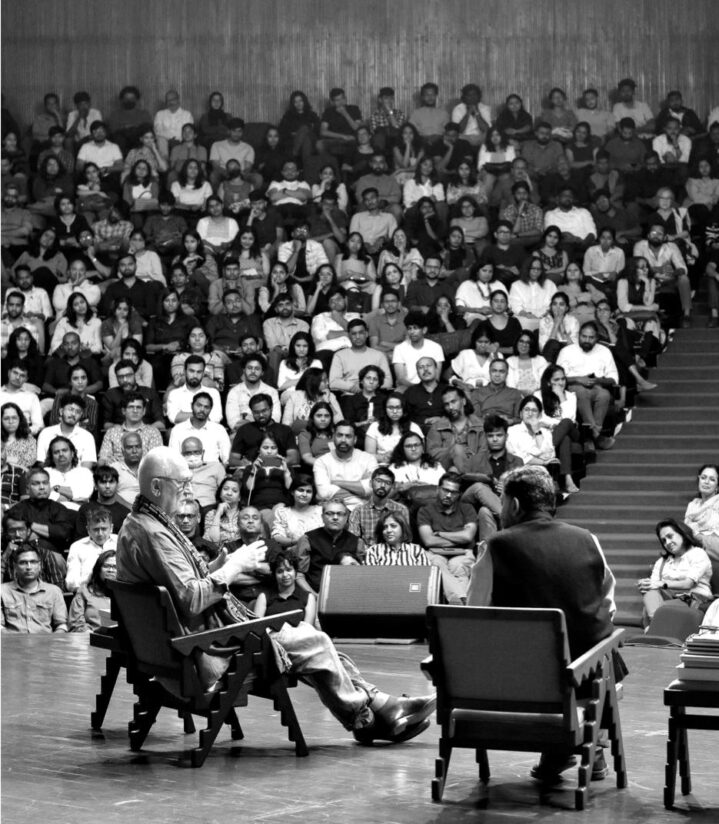
Swiss architect and Pritzker Prize Winner Peter Zumthor in conversation with Bijoy Ramachandran.
SCALE: Do you have a favourite material or building approach that you are particularly drawn to?
Bijoy Ramachandran: I am consistently drawn to brick, whether it is stabilised earth blocks or fired brick, because of the sense of grounding it brings to a building. At the same time, we have worked extensively with concrete and continue to value its versatility, though I believe our dependence on it needs to be reconsidered, given its environmental impact. There are encouraging developments in places like Australia, where lower embodied energy alternatives using materials like fly ash are being explored, and one hopes companies such as UltraTech Cement will move in a similar direction.
What keeps me interested in concrete, however, is its tactile and human quality, the way it carries the marks of its making through stains, imperfections, and traces of labour. I am reminded of something Peter Zumthor once shared, where he chose to retain a visible stain on a concrete wall, seeing it not as a flaw but as evidence of the human hand, something that made the building feel more real.
SCALE: Could you suggest three books that every architecture student should read?
Bijoy Ramachandran: I would suggest starting with the writings of Juhani Pallasmaa, especially The Thinking Hand and The Eyes of the Skin, which are both accessible and deeply insightful in the way they explore the relationship between thinking, making, and the body. In Praise of Shadows by Junichiro Tanizaki is another important read, offering a thoughtful meditation on light, materiality, and cultural perception, while showing how modernity can remain rooted in tradition. I would also recommend A Place in the Shade by Charles Correa, a collection of essays that reflects on architecture, cities, and the role of design with a rare clarity and simplicity.
At the end of the conversation, a clear picture of Bijoy Ramachandran begins to emerge. His approach is not driven by the need for quick answers or bold gestures, but by a quiet, steady process of understanding, testing, and refining. It is shaped by people, by context, and by time, with a constant willingness to question and rework ideas until they feel right. This way of thinking carries through to the spaces he values, places that do not try to impress, but instead invite you to slow down, feel at ease, and stay a little longer.