

When Metal Learned to Breathe: Remembering Frank Gehry
Sometimes you walk past a shimmering building as the sun sets, the metal walls turning gold and copper in the light, and you stop. You do not know why, but you sense it is alive. That moment of breath, of wonder, was what Frank Gehry taught architecture to be. We celebrate the life of this visionary architect whose one among many gifts were his understanding of the human spirit and his ability to create spaces that inspire and build community.

Frank Gehry for Fondation Louis Vuitton ©2014 Todd Eberle
Gehry once said, “You kind of say, at least they are looking.” His work demanded our eyes. It pulled us from our everyday blindness and made us look, really look. He believed buildings could astonish, provoke, and shift the very air around us.
He was born Frank Owen Goldberg in Toronto on February 28, 1929, into a modest household. His parents, immigrants of Eastern European Jewish heritage, worked hard to build a life in a new land. His childhood memories are filled with the textures of his grandparents’ hardware store, piles of scrap wood, sheets of metal, bent wire, cardboard and plywood. With these raw materials and his imagination he built little cities on the floor. That was perhaps the first spark of his lifelong belief that ordinary materials could be extraordinary in the right hands.
As a teenager he moved with his family to Los Angeles where the bright California sky and sprawling landscape opened doors that Toronto never had. He eventually studied architecture at the University of Southern California and later took graduate classes at Harvard. His early professional years were not glamorous. He worked in a series of California firms, learning and absorbing. Then in the early 1960s he opened his own office. Nothing came easy but something important was forming within his vision.

The Santa Monica House remodelled by Gehry. Picture Credit @Pritzker
Gehry started small. A remodel of his own Santa Monica house in 1978 became an early manifesto of his rebellion against architectural expectations. He wrapped a simple suburban home in corrugated metal, glass and chain link, materials that others associated with warehouses and fencing rather than domestic living. His neighbors were confused. Critics were baffled. But Gehry did not flinch. He knew that architecture could provoke and still welcome, shock and still shelter, challenge and still comfort.
From those experimental beginnings he forged a style that would define him. For decades he stood firm against convention. He refused the strict boxes of modernism. He was not interested in symmetry or polish for the sake of tradition. He wanted to twist space, to let light dance, to make gravity feel optional, to build not from rules but from emotion. His buildings felt less like static structures and more like living sculptures breathing and shifting under sky and sun.
He took humble materials and made them sing, transforming the simple act of construction into a conversation between earth and sky. He proved that a building could hold emotion, that it could be vulnerable, joyful, monumental and playful all at once. His work was not about ego. It was about the experience of the people who moved through his spaces and the ways his buildings could transform the cities around them.
Gehry states, “I approach each building as a sculptural object, a spatial container, a space with light and air, a response to context and appropriateness of feeling and spirit. To this container, this sculpture, the user brings his baggage, his program, and interacts with it to accommodate his needs. If he can’t do that, I’ve failed.”
Designing Spaces that Live

Frank Gehry (1929-2025)
At the height of his career he became one of the most influential architects in the world. Yet he always resisted labels. People called him deconstructivist or postmodern or revolutionary, but he simply wanted to design spaces that felt alive, that felt human, that made people feel something. He believed architecture should rise beyond shelter. It should rise to art.
His work was not about ego… it was about the experience of the people… This philosophy found its most legendary and monumental expression in three works that defied expectation and redefined the very cities they occupied. There are many incredible works in his long career but three of them, perhaps more than any others, captured what Gehry stood for. They showed the power of his dreams and his insistence that buildings should breathe.

Guggenheim Museum Bilbao
The Guggenheim Museum Bilbao in Spain became his most legendary creation. It opened in 1997 in a former industrial port city struggling to reinvent itself. The museum did not just sit on the riverside. It leapt from it. Sheets of titanium curve and shift like waves or petals in the wind. The building catches sunlight and seems to ripple throughout the day, never quite looking the same twice.
 Inside the galleries unfold around a vast atrium filled with natural light. The building became more than a museum. It transformed Bilbao itself. The city went from fading steel industry to global cultural destination. Economists created a term because of it. They called it the Bilbao effect. Architecture had never before revitalised a city with such speed and conviction. Gehry knew the risks when he designed it, but in the end he proved that architecture could change not only skylines but a city’s soul.
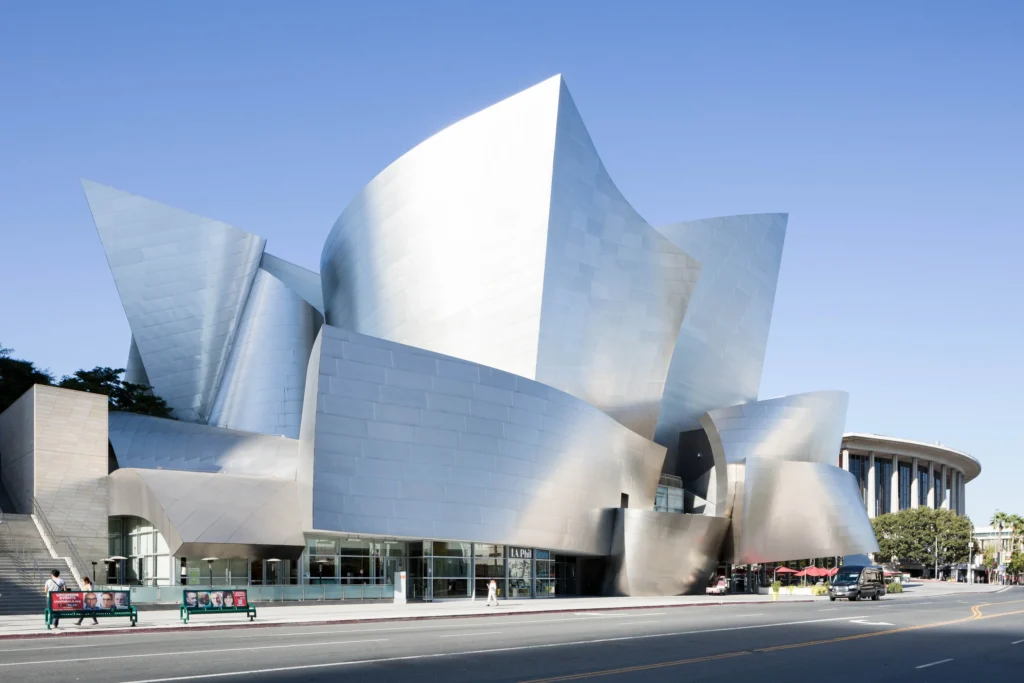
Walt Disney Concert Hall
The Walt Disney Concert Hall in Los Angeles is another creation that people do not simply admire. They feel it. Completed in 2003, the building seems to float in downtown Los Angeles like a ship made of music. The stainless steel exterior curves and folds like giant sails catching the wind.
 It draws people in before they even hear a single note. Inside, the concert hall is wrapped in warm wood that cradles the audience in an embrace. The acoustics are world renowned. Sound feels close, immediate, intimate. Musicians often say the building listens to them. Gehry designed it as a home for music and community more than a monument. He wanted people to feel the power of art together and that is exactly what the building offers, night after night.

Iwan Baan or Fondation Louis Vuitton ©Iwan_Baan_2014
Fondation Louis Vuitton in Paris showcased another vision entirely. If Disney Hall is sound made physical, Fondation Louis Vuitton is light made architectural. Opened in 2014, the building appears to float in a park surrounded by water and trees. Its immense curved glass panels form what Gehry called sails. They catch reflections of the sky, clouds and sun, making the building seem as though it is always moving. Inside, sunlight travels across walls and galleries in shifting patterns that change with the time of day and season. It is an experience of movement without chaos, freedom without disorder, emotion without noise. Even late in his career when many would have slowed down or repeated old formulas, Gehry continued to dream with fearless scale and imagination.

Vitra Museum By Gehry
His influence reached far beyond these famous works. He designed theaters, learning centers, offices, towers, parks and even furniture. He brought digital modeling technology into architectural practice long before it was common. This was one of the most important parts of his legacy. He pioneered the use of advanced aerospace design software which eventually evolved into what the world now knows as Building Information Modeling. These digital tools allowed his team and structural engineers to precisely measure and fabricate double curved forms and intricate surfaces that had previously been considered impossible to build. With code, computation and engineering accuracy he proved that the wildest architectural dreams could be translated into reality. He was not only a poetic dreamer of forms. He was a technical revolutionary who changed how architecture is made.

DZ BANK building in Berlin
Gehry reshaped how the public sees architecture. Before him most people looked at buildings without much feeling. After him millions looked at museums, concert halls and even sidewalks differently. His buildings taught people that architecture can be emotional, that it can reflect imagination, that it can surprise us and stir something inside the way music or painting can.
Now he is gone at the age of 96. The silence he leaves is not cold. It is full of echoes, of metal walls shimmering, of light dancing, of footsteps moving through halls built by his hands. His presence remains not on paper but in space itself. As long as people walk into museums and concert halls and towers that tilt toward the sky with daring, Gehry’s voice will be there. He taught architecture to breathe.
Frank Gehry was not just an architect; he was a sculptor who taught space to sing, and a poet who gave steel a soul. His structures do more than stand; they live, breathe, and endlessly invite us to look.


