
Zaha Hadid Architects Designs Ethiopia’s Bishoftu Airport
Now under construction south of Addis Ababa, the $12.5-billion project by Zaha Hadid Architects signals a major shift in the geography of global air travel, positioning Ethiopia as a central connector between Africa, Asia, and the Middle East.
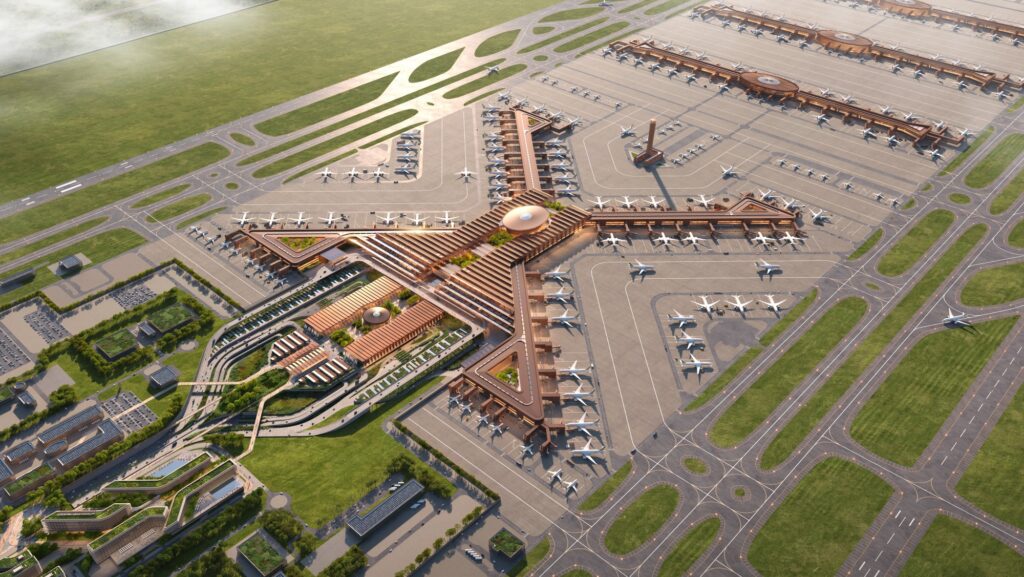 Construction is underway on the Bishoftu International Airport (BIA), a vast new aviation complex designed by Zaha Hadid Architects for Ethiopian Airlines. Located approximately 40 kilometres south of Addis Ababa, the project is conceived as a long-term replacement for the capital’s existing Bole International Airport, which is expected to reach capacity within the next few years. When completed, BIA will become the largest airport infrastructure project in Africa, with an initial capacity of 60 million passengers annually and plans to expand to 110 million in subsequent phases.
The scale reflects Ethiopia’s ambition to consolidate its role as a global transit hub. Ethiopian Airlines already operates one of the continent’s most extensive networks, and forecasts indicate strong growth in passenger demand across East Africa. The new airport is intended to accommodate that expansion while strengthening the country’s strategic position at the intersection of major intercontinental routes.
Designed Around Transit Efficiency
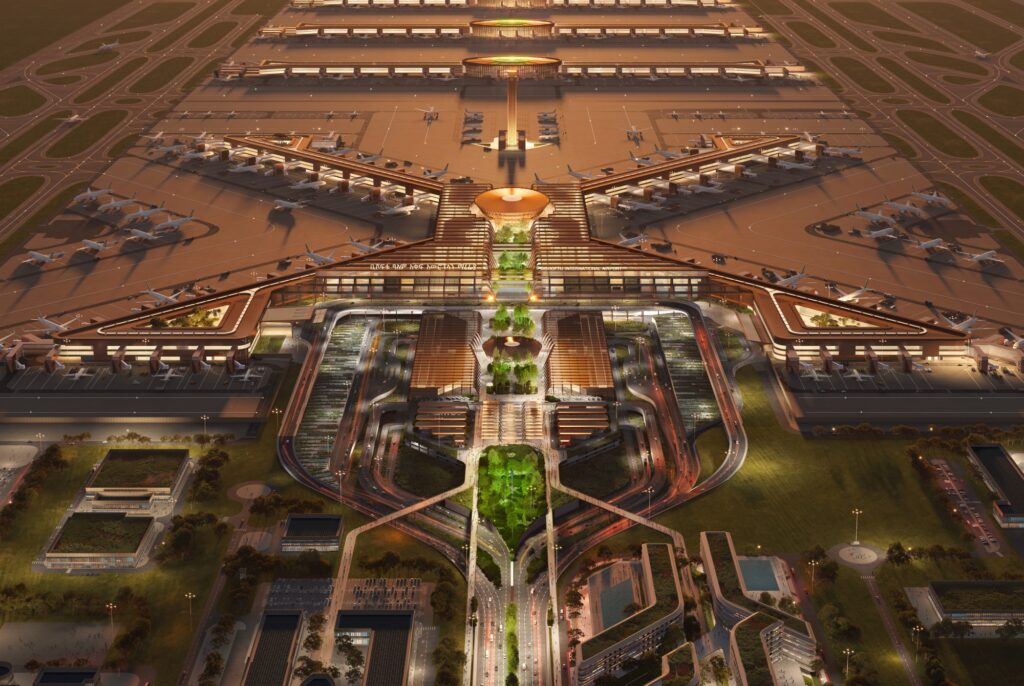 Unlike many international airports built primarily for origin-destination travel, Bishoftu is planned chiefly for transfer passengers. As many as 80 percent of travellers are expected to transit between flights without entering the country. The terminal layout therefore prioritises direct connections and reduced walking distances.
At the heart of the design is a single central spine, a linear circulation system inspired by the nearby Great Rift Valley — that links all functional zones and aircraft piers. This arrangement allows passengers to move between gates quickly while maintaining clear orientation within an extremely large building.
 Each pier is differentiated through distinct materials and colour palettes referencing Ethiopia’s regional diversity, an approach that introduces visual identity into a structure typically defined by repetition. Amenities for long layovers include a 350-room airside hotel, dining and entertainment areas, and landscaped courtyards and gardens accessible without leaving the secure zone.
Infrastructure Built for Performance
 Site selection also plays a critical operational role. The new airport sits nearly 400 metres lower in elevation than Addis Ababa’s existing airport, allowing aircraft to achieve greater take-off performance. Combined with longer runways, this enables heavier payloads and more efficient long-distance flights, reducing fuel consumption while extending route possibilities.
The first construction phase includes two independent Code 4E parallel runways and a terminal spanning roughly 660,000 square metres. Future expansion will add two more runways and parking capacity for up to 270 aircraft, placing BIA among the world’s largest airport complexes.
Climate-Responsive and Resource-Conscious
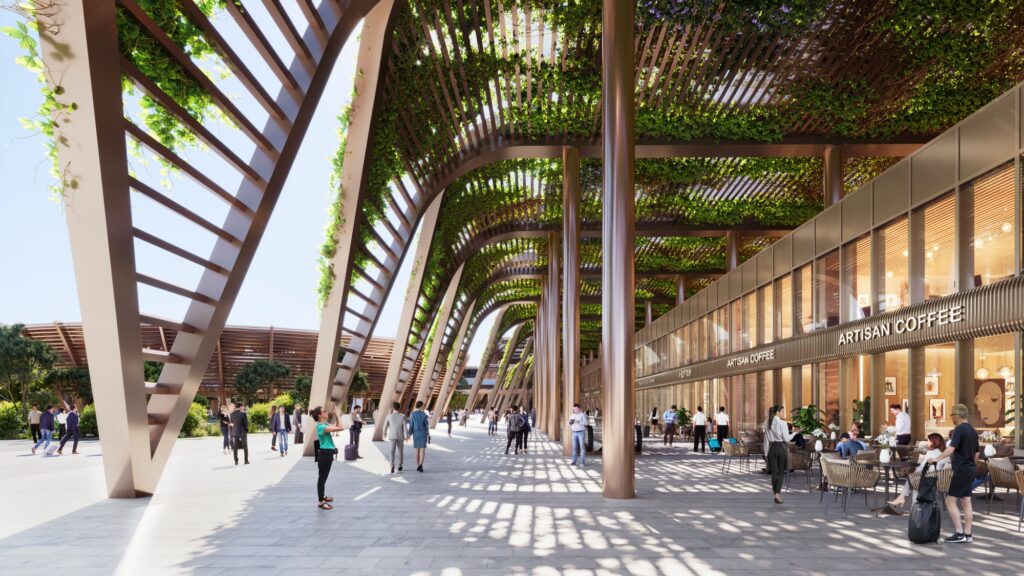
 Environmental considerations are integrated into the design by Zaha Hadid Architects particularly given the region’s temperate highland climate. The terminal is planned to achieve LEED Gold certification through natural ventilation strategies, solar shading, and semi-enclosed spaces that allow passengers to experience outdoor conditions during transfers.
Water management systems will collect stormwater from roofs and paved surfaces and channel it into wetlands and bioswales for storage, reuse, and ecological enhancement. Photovoltaic installations across the site will contribute to on-site energy generation, while landscaping will rely on drought-resistant native planting and relocated trees.
Local sourcing of materials, including concrete, aggregates, and steel, is intended to reduce environmental impact while supporting regional industry. Modular construction methods are expected to improve efficiency and allow phased expansion as passenger demand grows.
Airport as Urban Development Engine
 Beyond aviation, Bishoftu International Airport is envisioned as the anchor for a new Airport City incorporating mixed-use development and employment infrastructure. A high-speed rail connection to Addis Ababa and the existing Bole Airport will integrate the complex into a broader regional transport network.
The project is designed for continuous 24-hour operation without curfew restrictions and is expected to generate jobs for an estimated population of 80,000, reinforcing its role as a major economic catalyst.
Lead planning and engineering responsibilities are held by Dar Al-Handasah, with Zaha Hadid Architects serving as terminal design architect.
A Strategic Shift in African Aviation
 Scheduled to open around 2030, Bishoftu International Airport represents more than a replacement facility. Its scale, capacity, and transit-oriented design signal a deliberate effort to reshape air connectivity across the continent and beyond.
If realised as planned, the project will position Ethiopia as one of the world’s major aviation crossroads, a role traditionally dominated by hubs in Europe, the Gulf, and East Asia, while setting a new benchmark for infrastructure development in Africa.