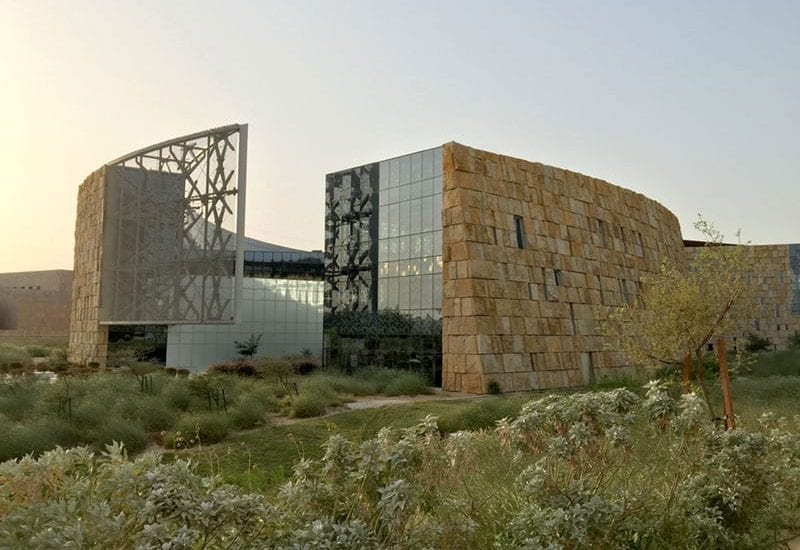

NU-Q’s “What’s between, between?” Opens to the Public
With numerous events takings place across Doha, why should Northwestern University in Qatar’s (NU-Q) new exhibition “What’s between, between?” be on the must-see list of people who call Qatar, or this region, home? Mary Joseph weighs in.
The answer, in brief, is because it slices through the surface of regional events, societal practices, and personal habituations to reveal layers of influences that shaped our understanding of them. In doing so, it shuffles, loosens, if you will, our fixed interpretations, inviting us to imagine the future of this region through new angles.

Alfredo Cramerotti, Director of Media Majlis, Marwan M. Kraidy, Dean and CEO of NUQ, Jack Thomas Taylor, Curator of Art, Media & Technology, Amal Zeyad Ali, Assistant Curator at the opening press conference.
The exhibition’s curators, Jack Thomas Taylor, Curator of Art, Media & Technology, and Amal Zeyad Ali, Assistant Curator, at NU-Q, conceived the theme to explore ‘Gulf Futurisms’, a term coined by Qatari artist Sophia Al-Maria.
The exhibition views the Gulf’s rapid development as the sum of its histories and aspirations, resulting in a geographical region that can be seen as a unique study, or balance, of contrasts shaped by tradition and hypermodernity, heritage and innovation, human and machine.

NU-Q’s Media Majlis, with its focus on the future of this region, is renowned for its use of evidence-based storytelling and cutting-edge technology in exhibitions such as “What’s between, between?”.
At a press conference held prior to the launch of the exhibition, Marwan M. Kraidy, Dean and CEO of NUQ, talked about the context in which it was taking place. He said, “One of the most important things we can do at a time of acceleration, be it social, technological or historical, is to slow down, look at things deeply and think what they mean. It is only when you figure that out that you can thoughtfully envision the future.”

“What’s between, between?” offers viewers a chance to press ‘pause’ and reexamine the familiar through different lenses.
He added, “Futurism is a movement that began a long time ago, originally in Italy, and it is closely associated with media and technology. Humans often imagine the future as the control of space and time through technology. The future can make us anxious because it is unknown and uncontrollable, so we project technologically as a way to understand it, imagine it, and shape it.
“The future should not be us running away from something that we’ve identified. The future should be us running towards something we’ve identified. So, it is not an escape, but a future that is purposeful and intentional.”

The exhibition, as the title suggests, peels back our surface-level understandings of the happenings, traditions and trends in this region to reveal the layers sandwiched between.
More than 20 artists drawn from across the Gulf have contributed to this exhibition that consists of new commissions, loaned work and digital media. Themes are at once thought-provoking and stimulating and are guaranteed to touch a chord with every person, resident or citizen, living in the Gulf region.
Salt is Key

“What’s between, between?” uses salt, a substance that possesses ancient and universal relevance, as metaphor.
The level of thoughtfulness that has gone into ensuring that the exhibition holds universal appeal is evident. The curators have intentionally selected salt as a central metaphor. Here, salt, a substance that commands both ancient and universal recognition across cultures, links histories of trade, labour, ecology, and extraction, with contemporary conditions brought about by rapid change.
As Taylor explained, “Salt is something everyone can relate to. We use it to preserve things, but we also use it to dissolve things. It is something that is very close to us geographically and culturally; it is present in the desert and the sea, and is associated with the history of the region. So, we wanted artists to use that as material that they would explore in their artworks.”

In Faisal S. Al Zahrani’s installation “Salt Codes”, salt is used to present multidimensional symbols and shapes which belong to no known language, thereby defying translation but staying open to interpretation.
Indeed, the exhibition uses salt to dramatically bring lived experiences to life, at times with poignant depth. For instance, one of the installations uses crystal salt placed within a space that resembles an elongated blacked out photobooth. The crystals have been laid out to represent a constellation of stars, and are lit up from below.
The effect, mirroring a clear night sky, is stunning. The brilliant simplicity of the concept is sharpened when placed against the complexity of the real-life situation it represents, as per the artist’s statement, “But in Gaza, even star gazing has been militarised, with the telescope deemed a threat.”

Installations, such as this interactive one, challenge our perceptions of both the everyday and the unusual in the world around us.
According to Ali, oftentimes the Gulf is referred to through stereotypical imagery. She said, “There is not a singular future; different people imagine the future in different ways. This exhibition leaves it to the audience to answer the questions it raises, to use these questions to critically debate among themselves. They could be conversation starters. And it’s important to keep those conversations going, to not accept things as they are.”
Some of the artworks in the exhibition illustrate Ali’s point, subtly unpacking the notion of how development is perceived. One such artwork is a canvas depicting a male person dressed in a white thobe, with a high-speed bullet train in the background. The backdrop is beige, representing the desert.

The exhibition encourages us to step out of our stereotypical understanding of what the Gulf region’s present is, and what the region’s future should look like. Shown here is the work of Ahaad Alamoudi, “Winning Eagle”.
It is an image that prompts one to critically revisit popular assumptions about infrastructure development in the GCC with the question: if the visual of a high-speed bullet train in Switzerland or Japan does not raise eyebrows, why is it often considered to be at odds with the Gulf region?

“ ‘What’s between, between?’ pushes beyond the trappings of Gulf Futurism, which have caused us to get stuck before having a chance to evolve.”
“What’s between, between?” is chockfull of such installations that stir our perceptions of the world around us, separating them into strands of thought that swirl around in our minds, as we apply our own interpretation of what we have just seen, before settling down again in new patterns of understanding.

Artworks, such as this one by Maktoum Al Maktoum, a Dubai-based multidisciplinary artist and curator whose practice explores the intricacies of the human condition, provoke questions of what is and what could be.
The experience stays true to what Alfredo Cramerotti, Director of Media Majlis, said prior to the opening: “This exhibition embraces the in-between, not as ambiguity to be resolved, but as a condition to be explored. It asks whose futures are being imagined, and who get to participate in them.”

As one leaves the exhibition, one can’t help but wonder “…whose futures are being imagined, and who gets to participate in them?”
“What’s between, between?” is also listed as part of Art Basel Qatar’s, that runs from February 5 to 7, 2026, line up of events; the exhibition’s focus on Gulf Futurisms complements Art Basel Qatar’s theme “Becoming”. The publication of a book containing contributions from various experts, artists and thought leaders exploring the future of the region will take place during Art Basel Qatar.
“What’s between, between?” runs until May 14. The public can view the exhibition free of charge, Sunday to Thursday, between 10 am and 8 pm at NU-Q’s Media Majlis in Education City.