

The Seduction of the Manganiyars: A Night at Katara
It was a magical night at Katara’s open-air theatre, moonless sky and a glowing red Jaipur-jharooka-like stage forming the perfect backdrop. Visitors, fresh from the visceral experience of M.F. Husain’s The Rooted Nomad, settled into the amphitheatre, a light wind brushing across the steps, almost in anticipation of what was to unfold. As the first startling-red curtain lifted, a Manganiyar musician appeared with his kamaicha, a bowed string instrument carved of mango wood and covered in goatskin. The opening notes were haunting and quiet, as the main Manganiyar lead the repertoire through his swaying movements and beats, gradually spiraling into ecstatic rhythms. Soon, the amphitheatre was filled with haunting music, raw and powerful, immersive and euphoric. It was a night when music seemed to reverberate through Katara, carrying the audience into timeless desert traditions. By Sindhu Nair
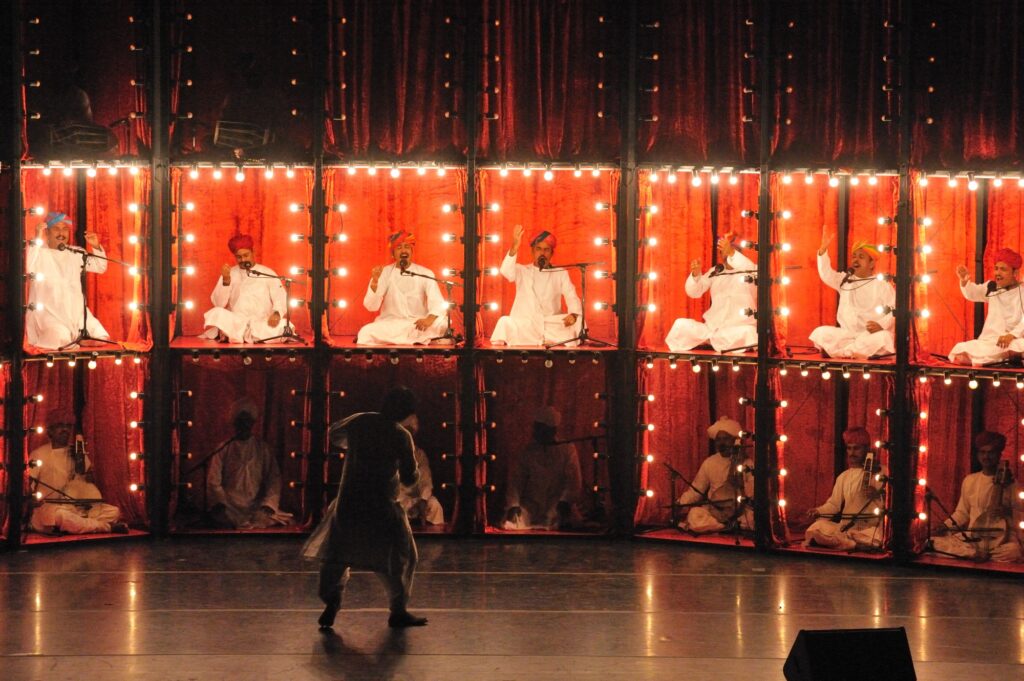
The Manganiyar Selection. Picture Courtesy @Qatar Museums
The Manganiyars: Custodians of the Desert’s Music
The Manganiyars are a hereditary community of musicians from Rajasthan’s Barmer and Jaisalmer districts, and from across the border in Sindh, Pakistan. Their very name, meaning “those who beg alms”, recalls their historic role: musicians who performed for Rajput rulers and wealthy patrons who supported them across generations.
Muslim by faith, their repertoire reaches beyond religious boundaries. Their songs are layered with Hindu devotional traditions, Sufi mysticism, desert folklore, and oral histories. This interfaith and intercultural blending is what makes their music unique, carrying the shared memory of desert communities.
Royston Abel: The Seduction of Manganiyar Music
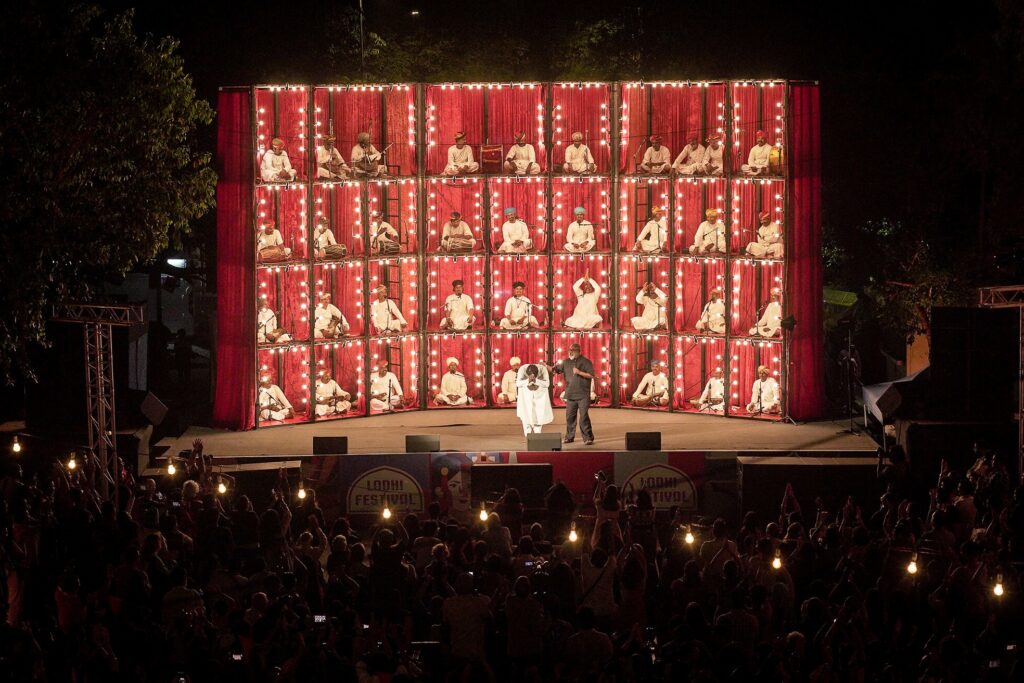
The Manganiyar Seduction by Roysten Abel at the Lodhi Art Festival, New Delhi (19th March 2023) Image Credits: Kiran Nadar Museum of Art (KNMA)
The Manganiyars have been celebrated within their villages for centuries, but it took an unforeseen encounter with Indian theatre director Royston Abel to bring them to the world stage.
It began in Delhi’s Shadipur settlement, once home to over 1,500 artisan families, acrobats, puppeteers, magicians, musicians. Abel was immersed in India’s performance traditions when two Manganiyar musicians were introduced to his troupe as replacements. Their ancestral craft of over 400 years would transform his journey as much as his work would transform theirs.
Later, in Segovia, Spain, Royston awoke to what he thought was a dream: haunting voices drifting into his room. It was the Manganiyar singers performing just outside his door. For two weeks, they sang daily, at dawn, after meals, late into the night.
“I realized I had been emotionally and physiologically moved by that experience,” he recalls. “Even after leaving, I found myself calling them just to hear their voices over the phone.”
From Discovery to The Manganiyar Seduction

The Manganiyar Selection. Picture Courtesy @Qatar Museums
When the Osian’s Film Festival invited Abel to create an opening act, he proposed a Manganiyar production. Back in Rajasthan, he auditioned hundreds, eventually thousands, of musicians. The challenge was to shape their unbroken songs into a theatrical structure with a beginning, middle, and end, something entirely new to them.
“At first, they couldn’t understand why I was stopping them mid-song,” he remembers. “But slowly, over a year, they began to trust the process. Today, they don’t just perform they act out a musical story.”
The result was The Manganiyar Seduction, a global phenomenon that has captivated audiences for over a decade.
Global Recognition
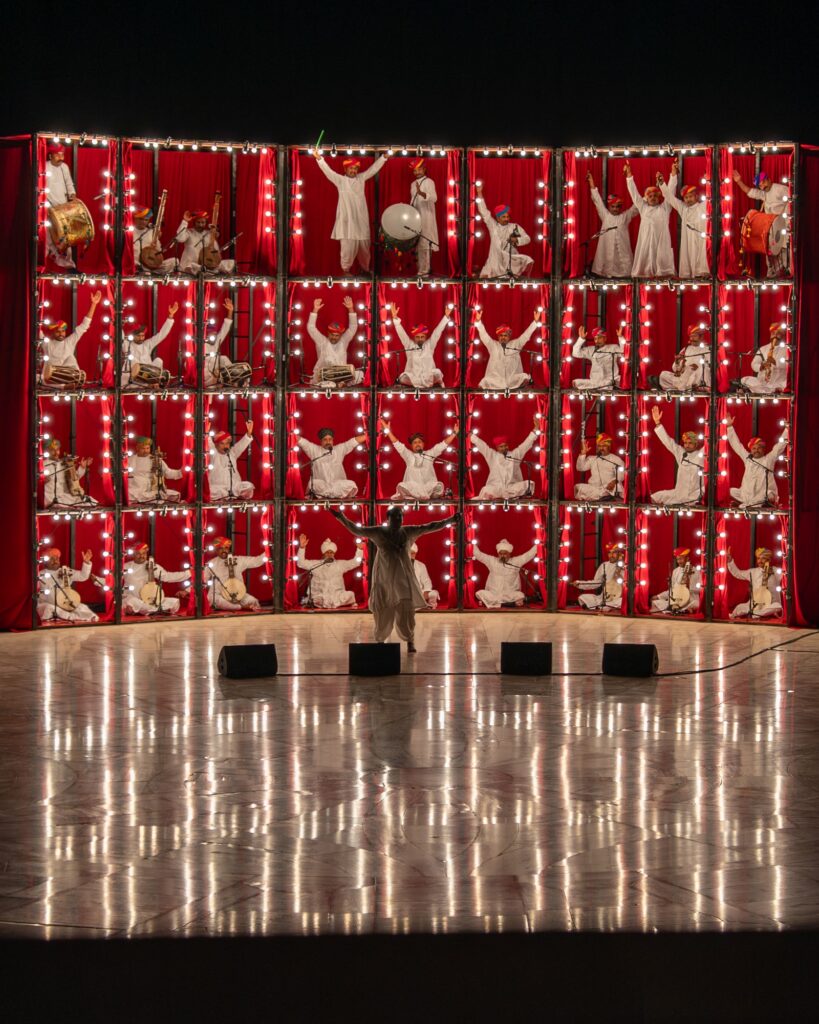
The Manganiyar Selection. Picture Courtesy @Qatar Museums
From Lincoln Center in New York to the Kennedy Center in Washington D.C., from The Barbican in London to festivals across Europe, Australia, and Asia, The Manganiyar Seduction has brought the desert’s soundscape to audiences of tens of thousands.
At India’s NH7 Weekender, among rock, EDM, and hip-hop acts, the Manganiyars astonished a young crowd.
“I thought we’d be drowned out,” Royston recalls, “but instead we headlined. Thousands of 17- to 25-year-olds were on their feet, ecstatic. That’s when I knew this music wasn’t a relic, it’s alive and universal.”
Doha’s Encounter: The Manganiyar Selection
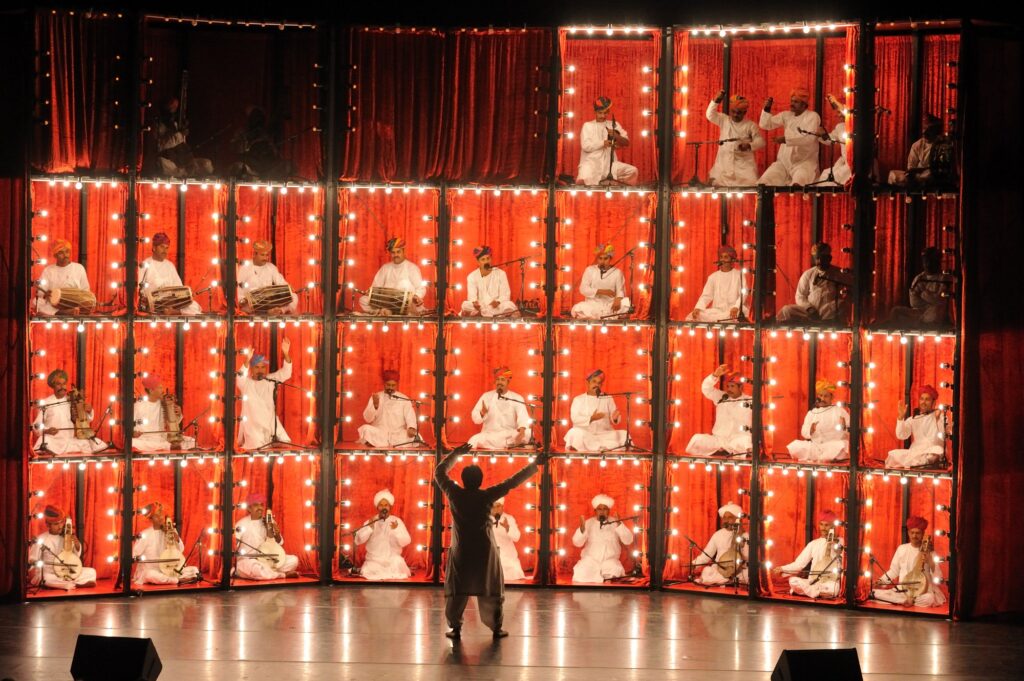
The Manganiyar Selection. Picture Courtesy @Qatar Museums
On 26 October 2025, Doha became part of this journey. Presented by Qatar Creates and the Kiran Nadar Museum of Art, The Manganiyar Selection unfolded at Katara Amphitheatre as part of the Rooted Nomad celebrations.
If the music seduced the ear, the stage seduced the eye. Inspired both by Amsterdam’s red-light district with its curtained cubicles and Jaipur’s Hawa Mahal with its glowing jharookhas, Abel designed a façade of illuminated red boxes.
“To me, the Manganiyars were gems,” he says. “I wanted to showcase them like precious stones, framed individually but dazzling as a whole.”
The effect was hypnotic, a magic of vision and sound, part Mughal palace, part modern spectacle, where theatre and folk tradition merged into something timeless.
Audiences witnessed not just a concert but an immersive theatre of music and light. The glowing red cubicles revealed one musician after another until the entire stage pulsed with rhythm, voice, and visual spectacle. It was both performance and cultural bridge, linking Rajasthan’s deserts with Doha’s cultural ambitions, Husain’s nomadic spirit with Sufi sound.
The Seduction Continues
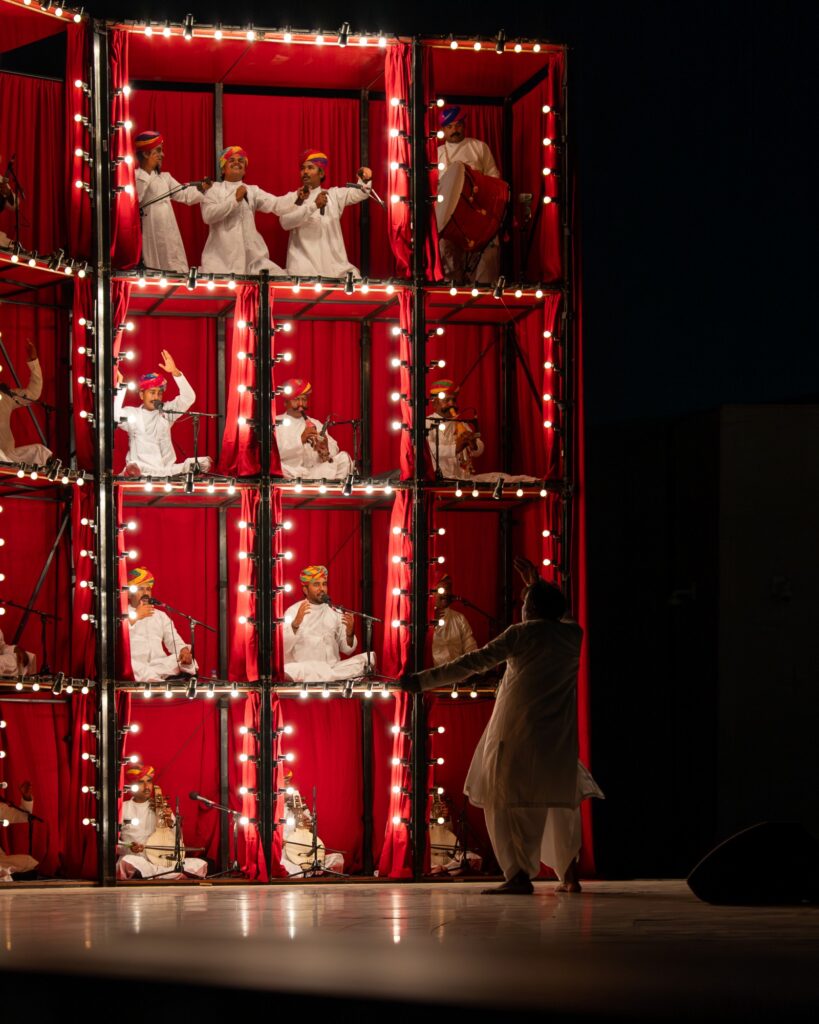
The Manganiyar Selection. Picture Courtesy @Qatar Museums
For Royston Abel, this journey is ongoing. “Manganiyars are custodians of a sound that has survived for centuries. My role is to frame that music, to give it a stage where the world can experience its seduction.”
That night in Katara, as the final notes of the kamaicha faded into the desert wind, the audience sat in euphoria, proof that the music of the Manganiyars continues to seduce across borders, faiths, and time.


