A Place to Pause: B. V. Doshi’s Final Work at the Vitra Campus
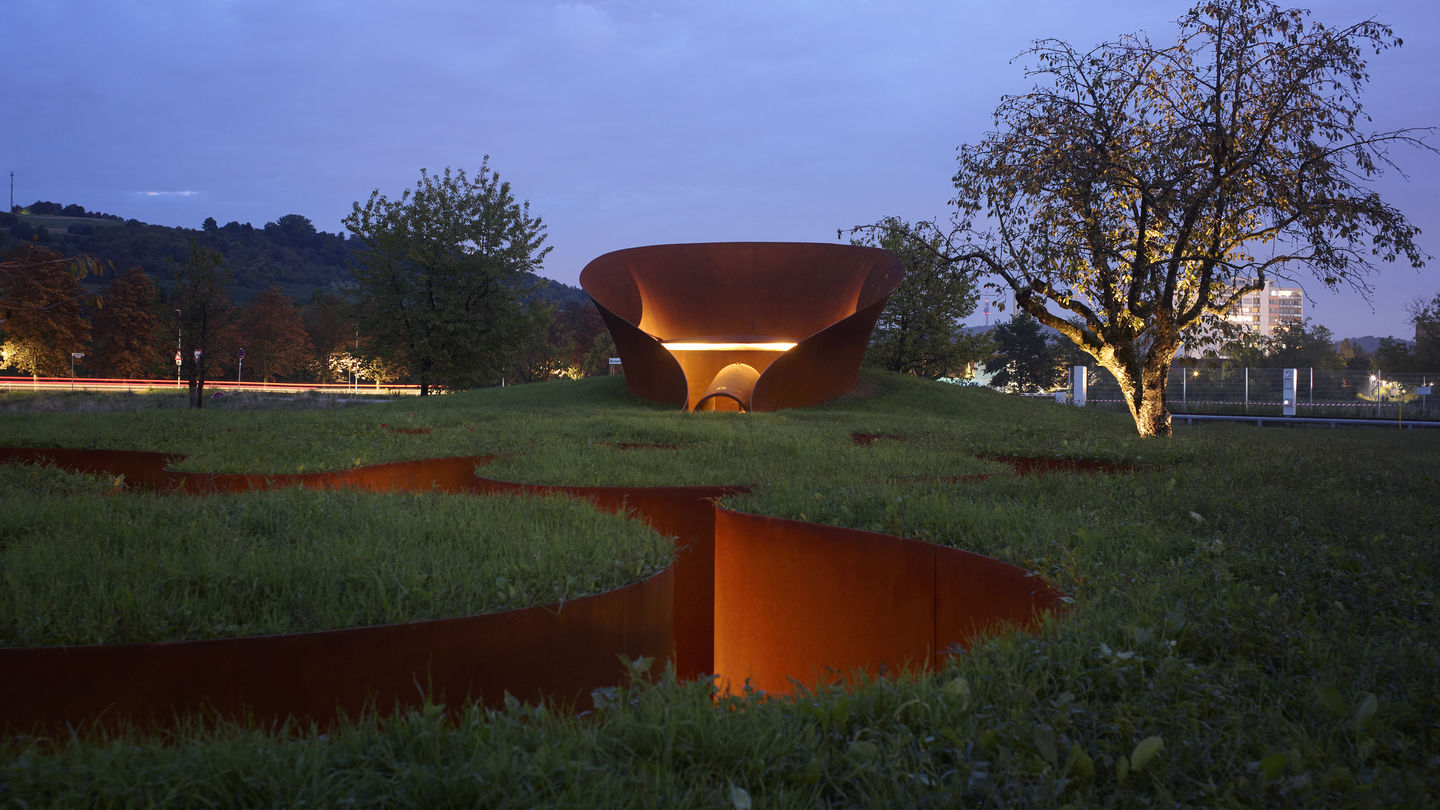
Within the landscaped grounds of the Vitra Campus in Weil am Rhein stands a quiet structure that seems to grow out of the earth itself. A curved line of rust-colored steel rises gently from the grass and leads visitors along a slow and winding path. This is Doshi’s Retreat, the final work conceived by Balkrishna Vithaldas Doshi together with Khushnu Panthaki Hoof and Sönke Hoof of Studio Sangath. It is the only project by Doshi built outside India and carries the calm wisdom of a lifetime devoted to understanding space, light, and the human spirit.
 The idea for the retreat began in 2019, when Rolf Fehlbaum, chairman emeritus of Vitra, visited the Modhera Sun Temple in Gujarat with Doshi. The experience of that ancient place left a deep impression on both of them. The temple, built a thousand years ago, is a place where architecture and sunlight are woven together with extraordinary precision. Its steps descend toward a water tank, its surfaces catch the changing light, and its form embodies a sense of quiet power. After visiting Modhera, Fehlbaum and Doshi began to imagine creating a contemplative structure for the Vitra Campus, a space that would invite reflection rather than display.
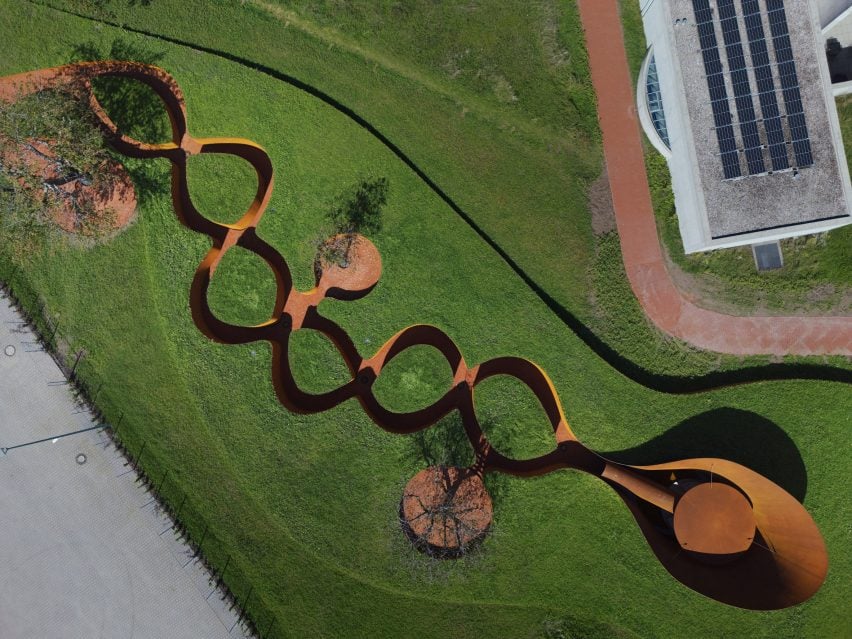
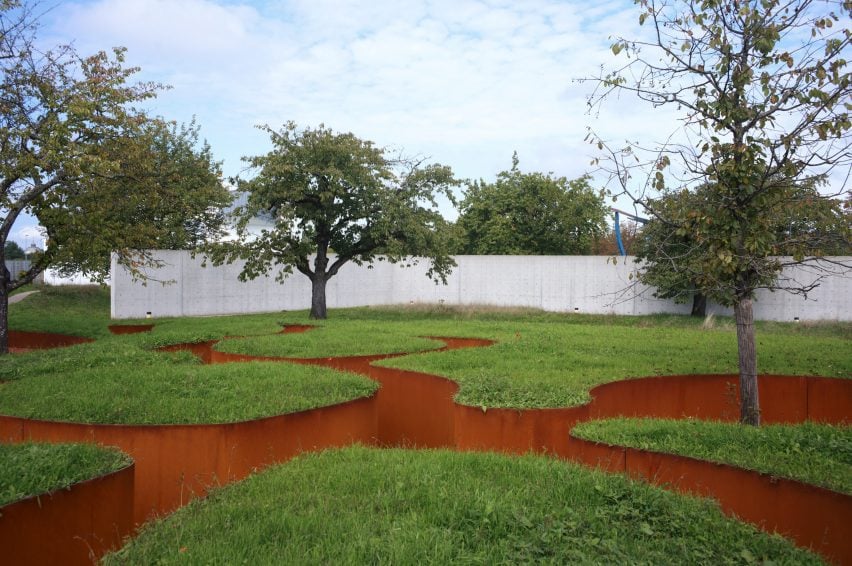 For Doshi, this was not to be another architectural gesture. It was to be a pause, a place where people could slow down and feel the world with all their senses. He wanted to make a work that expressed stillness as a kind of strength. Not long after that visit, Doshi shared a dream he had of two intertwining cobras. In his telling, the serpents symbolised rebirth and the merging of dual energies. Their coiled movement became a metaphor for life’s continuous renewal, for the interplay between motion and rest. This image took root as the guiding idea for the retreat. The form of the structure would follow a sinuous curve that echoed this coiling energy, leading visitors along a slow path toward an open, circular chamber at the end. The retreat would be a journey from movement to stillness, from the outer world to the inner one.
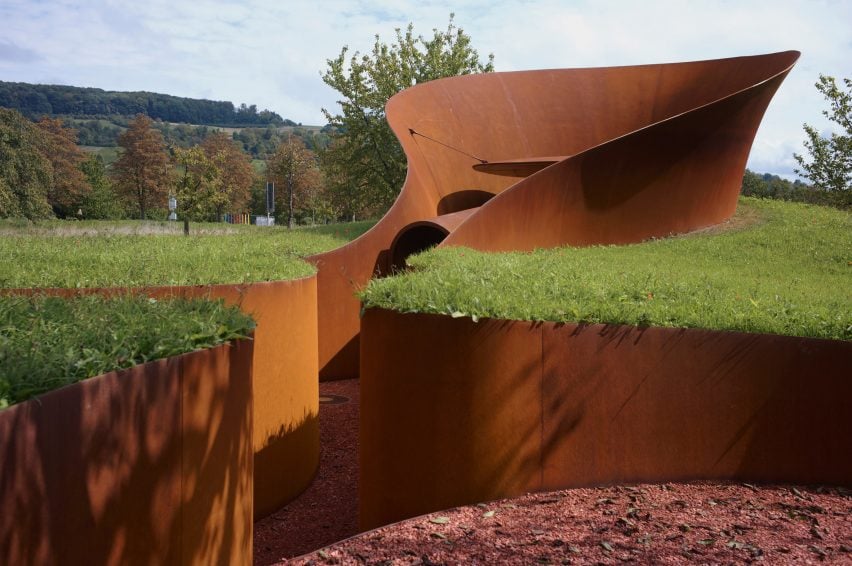
 The experience begins simply, with a walk. A low wall of warm, rusted steel curves through the meadow, marking a gentle path that dips gradually below the surface of the grass.
The steel, forged from ArcelorMittal XCarb, has been chosen not only for its strength but also for its sustainability. It is made using renewable energy and recycled materials, minimising carbon emissions. Its surface, left untreated, will continue to age and change with time, developing a natural patina that deepens in colour and texture.
“The walls of the Doshi Retreat are recycled and forged with renewable energy, generously donated by ArcelorMittal. Its surface changes with light and weather. It’s not static; it ages and becomes part of nature. Even the foundations are screwed rather than poured, so the structure could in theory be removed without a trace. That fits Vitra’s circular approach, nothing is wasted, nothing fixed forever,” explains Sönke Hoof of the materiality of the project.
The path itself is made of crushed brick that blends with the tone of the earth. The descent is almost imperceptible, yet it changes the way you move. The world begins to feel quieter. The sound of footsteps softens, and the air grows cooler as the walls rise slightly on either side.
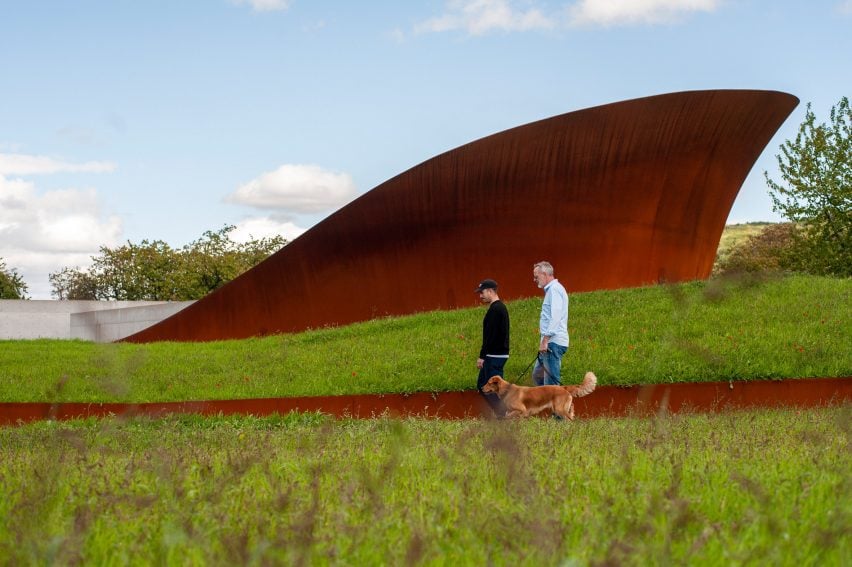 A sound composition accompanies the walk, blending the tones of a gong and a ceramic flute. The music, created for the retreat, is meant to guide visitors gently inward. The sounds seem to emerge from the landscape itself, growing softer as you move deeper along the path. By the time you reach the heart of the retreat, they have faded entirely, leaving you in near silence. Doshi often said that the approach to a building should be an experience of its own. Movement through space, he believed, could prepare the mind for stillness. Just as in his works in India, such as Sangath Studio in Ahmedabad or the Indian Institute of Management in Bangalore, space unfolds gradually here, encouraging awareness of light, texture, and time.
Spaces that create calm
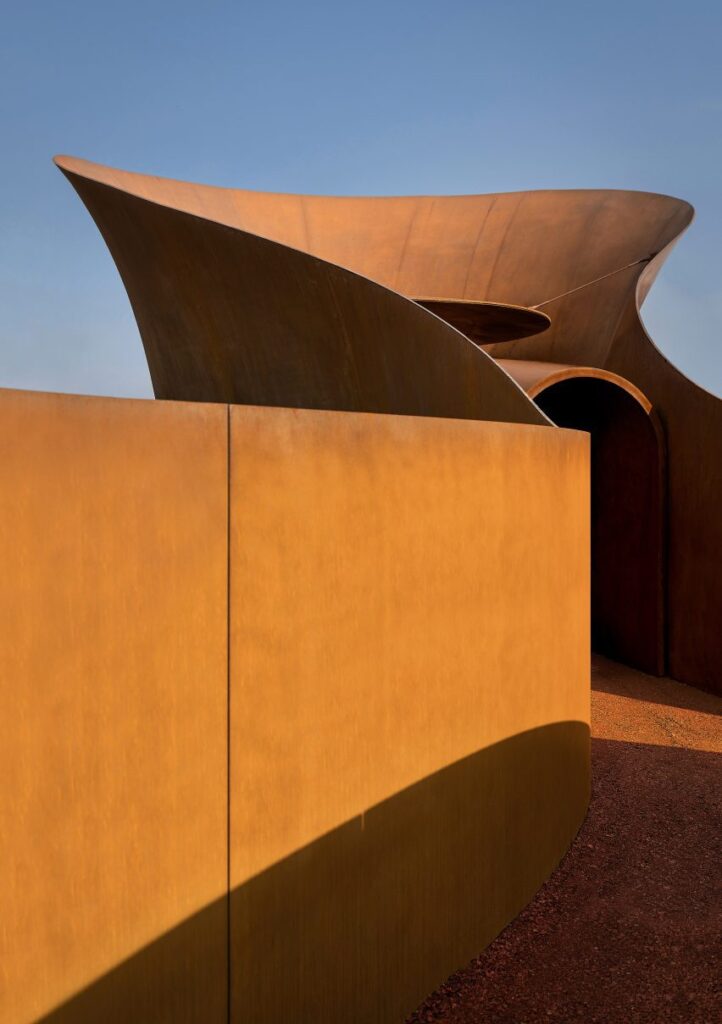 The path leads finally to a circular chamber that forms the center of the retreat. The curved wall opens inward, and the ground becomes level once again. The space is open to the sky. At its center lies a shallow basin that collects rainwater, reflecting the light above and the rust-red steel that surrounds it. Suspended in the skylight’s oculus is a hand-hammered brass mandala that catches and refracts sunlight, scattering small ripples of gold across the curved walls.
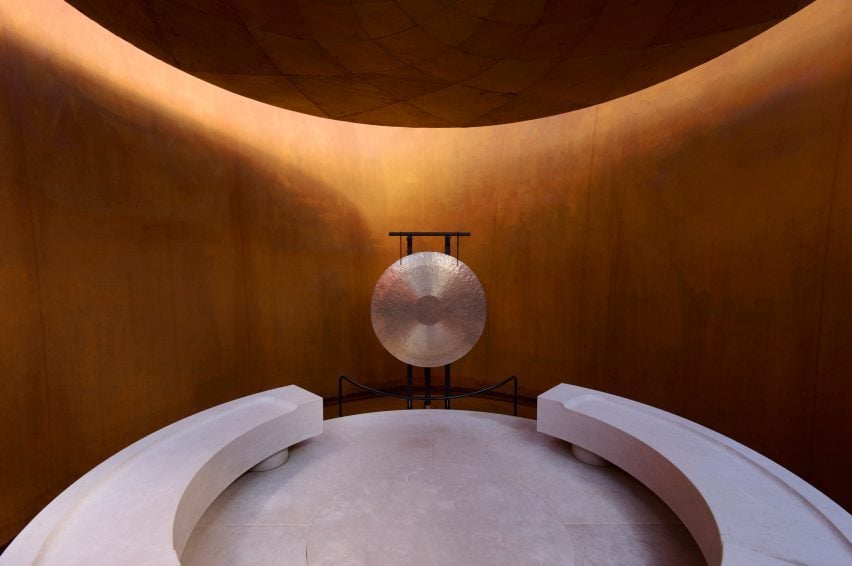 Two semicircular stone benches are placed along the perimeter, inviting visitors to sit and rest. The sound of the outside world falls away. The air feels still, and the light seems to move more slowly. Nothing in this space is superfluous. Every surface, every curve, every shadow exists to create calm.
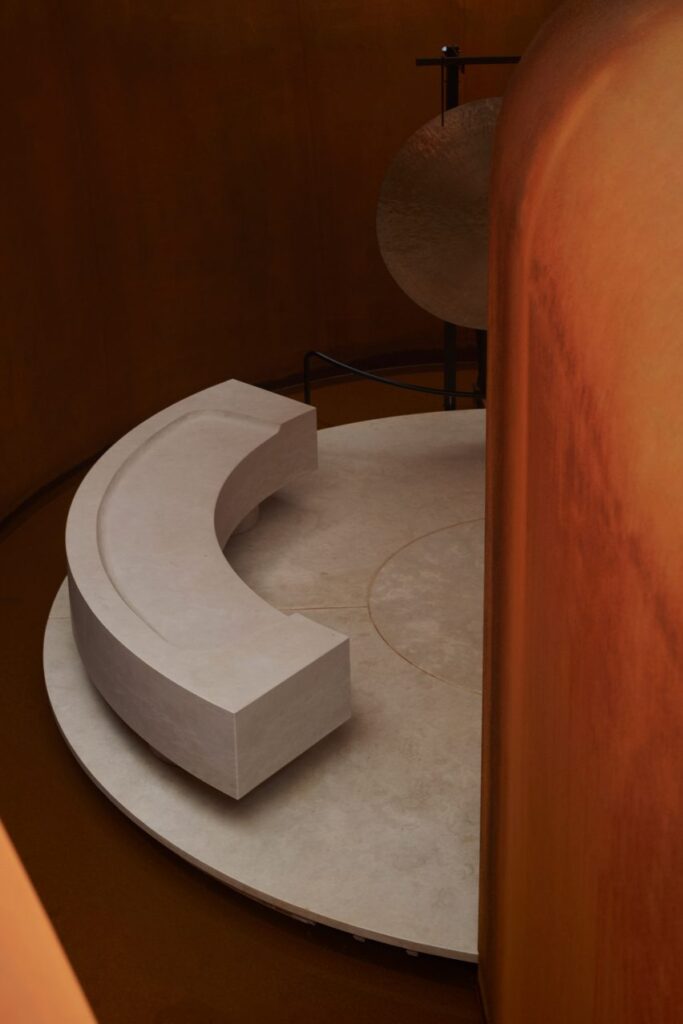 In this circular chamber, Doshi’s philosophy of architecture becomes visible. He believed that buildings should nurture both the outer and inner life. For him, silence was not emptiness but a form of presence. The Doshi Retreat makes this belief tangible. It is not a space designed for activity. It is a space designed for being. The journey from the open meadow to the enclosed circle mirrors an inward passage, an act of quiet reflection that draws visitors toward themselves.
The retreat’s form and symbolism are deeply rooted in Indian thought. The coiling path evokes the image of Kundalini energy, described in ancient philosophy as a serpent rising through the body toward awakening. In the retreat, this energy takes the form of the curved wall that rises from the ground, guiding movement in a slow ascent from motion toward stillness. The circular chamber recalls the stepwells and temple courtyards of India, where light, water, and community converge. Yet nothing in the retreat imitates those forms. Doshi was never interested in reproduction. He sought translation. The retreat transforms the spirit of those traditional spaces into a modern context, using simple materials and pure geometry to express timeless ideas.
 The material choices and methods of construction reflect Doshi’s lifelong respect for nature. The use of ArcelorMittal XCarb steel reduces the environmental impact of the building. The foundation was designed to disturb the ground as little as possible, avoiding heavy concrete. Existing trees and contours were preserved, and the surrounding landscape was shaped to flow naturally into the structure. The crushed brick paths, made from recycled materials, guide water gently into the soil. The retreat sits lightly on the land, as if it had grown there rather than been placed upon it. This sensitivity continues Doshi’s belief that architecture should exist in harmony with its environment, not in opposition to it.
When Stillness is a form of creativity
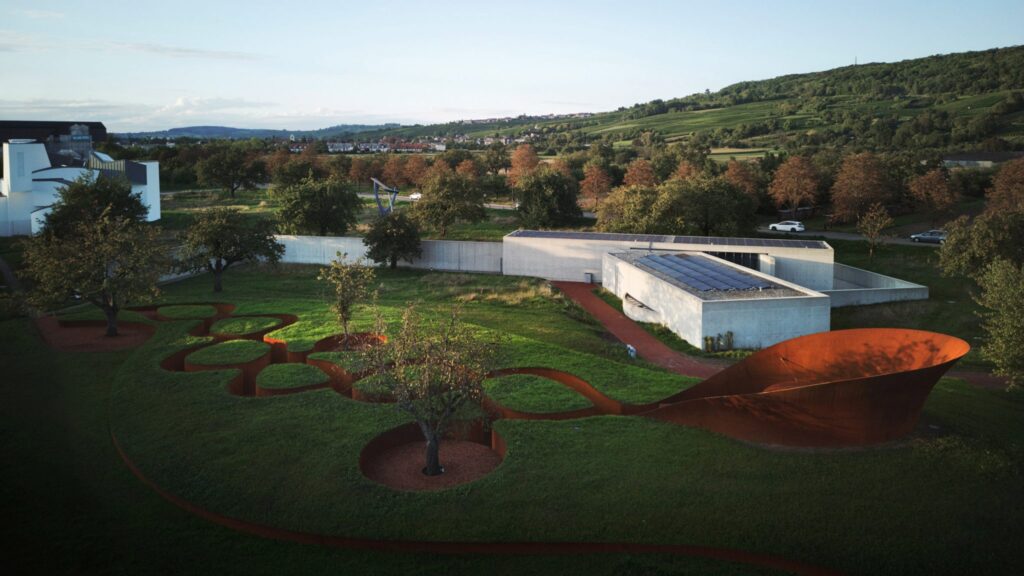 The retreat’s setting on the Vitra Campus gives it another layer of meaning. It stands on the southern edge of the site, in the meadow near Tadao Ando’s Conference Pavilion. Around it rise some of the most expressive works of contemporary architecture: Frank Gehry’s sculptural volumes, Zaha Hadid’s dynamic forms, Herzog and de Meuron’s precise geometries. Among these bold and visible creations, the Doshi Retreat feels profoundly different. It does not seek attention. It offers quiet. Its gentle curve and low height seem to invite the eye downward rather than upward. Within a campus known for its architectural innovation, the retreat shifts the rhythm of experience. It reminds visitors that stillness, too, is a form of creativity.
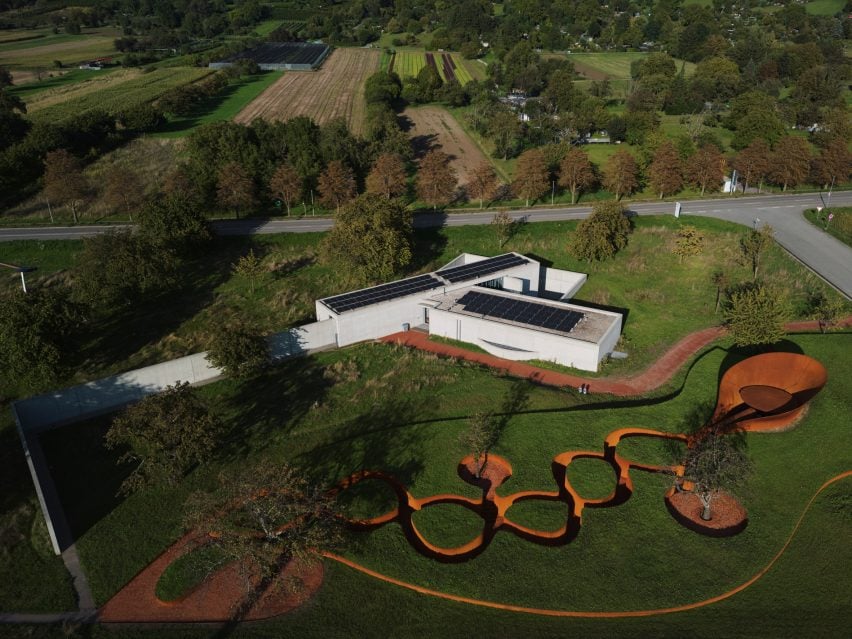 The retreat opened to the public on 25 October 2025 during the Vitra Campus Fall Festival. Access is through guided tours organized by the Vitra Design Museum, allowing visitors to experience the space in small groups and without distraction. There are no scheduled events or performances. The retreat was never meant to be a pavilion for activity. Its purpose is contemplative. It is a place to pause between buildings, to breathe, and to listen. Since its opening, visitors have described it as a space that changes one’s sense of time. Many linger longer than they expect, drawn by the quiet rhythm of light and shadow. The experience leaves a lasting impression not through spectacle but through simplicity.
Every part of the retreat reflects the ideas that guided Doshi throughout his long career. The path slows the step. The circle gathers the body and mind. The water and light remind us of the passage of time. These elements, arranged with great restraint, express an understanding of life that is both humble and profound. Doshi often spoke of architecture as a living organism, something that grows from the relationship between people, place, and purpose. The Doshi Retreat embodies this thought completely. It is small in scale but large in spirit. It speaks softly but carries deep meaning.
The stamp of legacy
 After Doshi passed away in 2023, Studio Sangath completed the project with great care. His granddaughter Khushnu and her husband Sönke Hoof worked closely with Vitra to bring his vision to life.
“My grandfather called and invited Sönke and me to participate. I recall him saying: ‘Let’s not think of it as a project with expectations. Let’s just enjoy the journey of discovery.’ His philosophy was that life and architecture are both journeys. There was no brief, no programme – only a feeling. The question we asked ourselves wasn’t what to build, but what did we want people to feel?,” explains Khushnu Panthaki Hoof, about the process of design with Doshi.
They approached the project not as a monument but as a continuation of his ideas. The result is a structure that feels like a conversation between generations. It honours Doshi’s legacy without trying to imitate him. In their hands, the retreat became an act of continuity, expressing the humility and grace that defined his approach to design.
Within the larger context of the Vitra Campus, the Doshi Retreat serves as a counterpoint to the language of innovation that defines so much of contemporary architecture. It is not concerned with form as display or technology as achievement. Instead, it reminds us that architecture can also be an act of listening. It listens to the land, to the weather, to the rhythm of footsteps and the movement of light. It listens to the need for pause that exists in every creative journey.
 Visitors who follow its curved path often find themselves moving more slowly as they go. The sound of the gong fades. The light shifts. By the time they reach the circular chamber, their own thoughts have become quieter. The retreat asks for nothing in return. It offers only space, and in that space, something within begins to settle. The building does not proclaim meaning. It allows meaning to appear.
The Doshi Retreat stands as a quiet tribute to a man who built with empathy and imagination. Throughout his life, Doshi sought to bring together the precision of modern architecture and the depth of traditional wisdom. From his mentors, Le Corbusier and Louis Kahn, he learned the discipline of structure and proportion. From his homeland, he absorbed the poetry of daily life and the spiritual connection between people and nature. In his final work, these influences come together with rare clarity.
Doshi’s Retreat carries within it the same warmth and humanity that filled all of Balkrishna Doshi’s buildings. It feels less like an ending and more like a beginning, a quiet threshold that opens into reflection. Here, the dialogue he began continues through stillness and simplicity. Its curved wall, open sky, and still water remind us that architecture is not only about structure, but about relationships: between people, between nature, and between moments in time.
 “The Doshi Retreat doesn’t tell you what to do. It simply invites you to walk, to pause and to listen – and in that moment, you become part of it,” says Khushnu Panthaki Hoof.
As Doshi himself once said: “Architecture is not about design, it is about the story of life. It is about the joy of being, the joy of belonging, and the joy of understanding.”
These words resonate through the retreat, a space that listens more than it speaks. It stands not as a monument to its maker but as an invitation to awareness, humility, and peace, a place where the essence of Doshi’s philosophy quietly endures.
All Images Courtesy Julian Lanoo