
Ismaili Center: Where Faith Meets the City
Located on Allen Parkway in Houston, the Ismaili Center is a civic and spiritual complex commissioned by His Highness the Aga Khan for the Shia Ismaili Muslim community. Designed by architect Farshid Moussavi with landscape by Thomas Woltz, Principal of Nelson Byrd Woltz Landscape Architects, and the firm’s team of landscape designers, it avoids monumentality in favour of restraint, clarity, and openness. Courtyards, filtered light, and shaded gardens respond to Houston’s climate while creating a gradual transition from city to sanctuary. The result is a place of worship that also functions as a calm, welcoming civic presence. By Arya Nair

The North Eivan (veranda) that can accommodate up to 800 people for lectures or receptions and up to 600 for banquets. @Iwan Baan
Sacred architecture often works by altering pace rather than persuading belief, tuning the body before the mind is asked to respond. In a city shaped by speed, the Ismaili Center Houston chooses contemplation. Arrival is stretched across open ground and quiet paths, where the city’s urgency loosens its grip. Light is filtered, and proportion steadies attention. The building stays legible to its surroundings while holding a calm that feels deliberately protected, suggesting a form of civic generosity that is offered through patience, composure, and the careful shaping of time.

An aerial view of the 11-acre site of the Ismaili Center, Houston. @Iwan Baan
Situated on Allen Parkway and Montrose Boulevard, the Ismaili Center Houston enters Houston’s urban condition with composure. Commissioned by Aga Khan, spiritual leader of the Shia Ismaili Muslims and founder and chairman of the Aga Khan Development Network, the building does not seek dominance despite its prominent site. Its presence is patient rather than emphatic. Meaning unfolds gradually through movement, light, and carefully shaped thresholds, offering experience instead of proclamation.
Religious buildings and urban withdrawal

The eivans of the Ismaili Center create indoor/outdoor connections while providing covered space for year-round social and cultural gatherings. @Iwan Baan
Many contemporary religious buildings retreat from their urban contexts. High walls and sealed interiors protect ritual life but often sever connection with the surrounding city. The result can be a sense of separation that reinforces misunderstanding or isolation.

Natural light flows into the Central Atrium through the windows of the North Eivan and the oculus (skylight) at the top. @Iwan Baan
The Ismaili Center adopts a more delicate position. It remains visibly present without asserting dominance. Its exterior is composed and legible, suggesting care rather than control. Sacred space is not broadcast outward, but neither is it hidden. The building maintains a calm reserve, allowing interior life to remain intact while still acknowledging the city beyond its edges.
Urban presence here is not achieved through transparency alone, but through continuity of ground and horizon. Streets remain perceptible. The city does not disappear. What changes is the rhythm of movement, as if the building gently retunes the surrounding tempo.
The Project: What this building gives up and gives back

Wide pathways throughout the Ismaili Center allow for people to walk side by side. @Iwan Baan
This quiet presence did not arrive without intention. In March 2018, the decision to establish the Ismaili Center Houston was publicly confirmed, situating the project within a longer civic and cultural horizon rather than a singular architectural moment. A year later, the selection of Farshid Moussavi as architect and Thomas Woltz as landscape architect signaled a shared commitment to precision, restraint, and the shaping of experience over display. From its inception, the project was framed less as an object to be unveiled than as an environment to be cultivated over time.

Indoor and outdoor spaces throughout the Ismaili Center foster dialogue and connection for all visitors. @Iwan Baan
Moussavi, also known for designing the Museum of Contemporary Art in Cleveland, has spoken of the challenge posed by the rigorous standards associated with the Aga Khan’s architectural patronage. The building engages Islamic design philosophy without imitation, allowing historical principles to converse with contemporary form. What is deliberately avoided is as significant as what is included. Monumentality is refused. Symbolic excess is restrained. By giving up spectacle, the building gives back focus. Meaning is allowed to gather slowly.
Restraint shapes the project more than any single gesture. There is a clear refusal of excess. Materials are limited and handled with precision. Forms remain disciplined. Decoration is present but never insistent. This is an architecture defined by what it avoids.
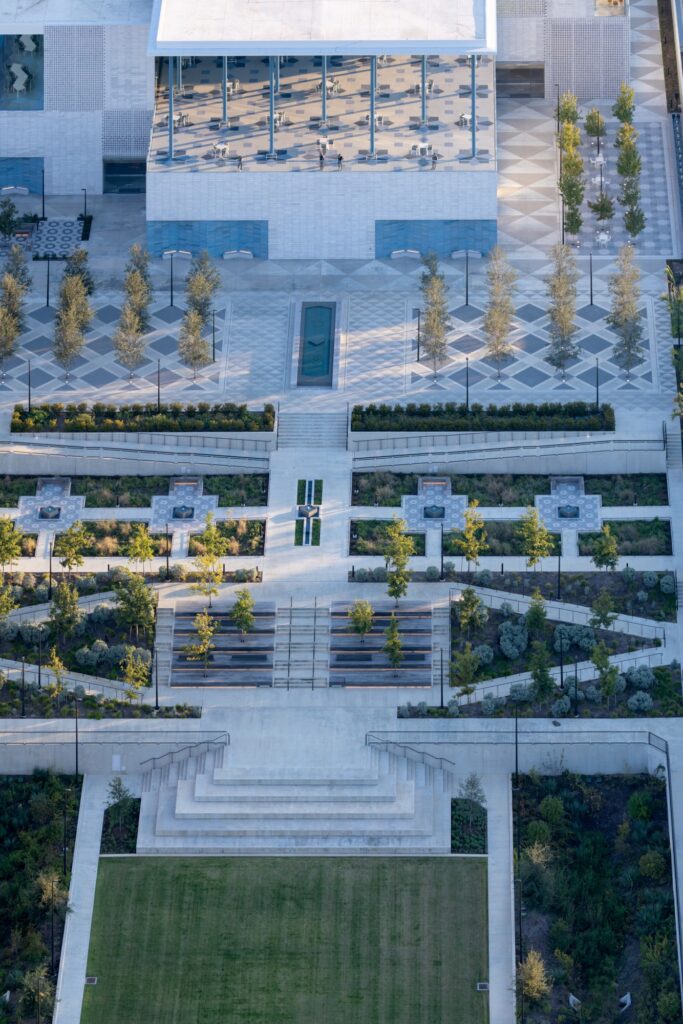
A series of terraced gardens, each planted with native species from a distinct eco-region of Texas, gracefully elevates the building of the Ismaili Center, Houston. @Iwan Baan
By giving up monumentality, the building gives back focus. By resisting symbolic overload, it allows meaning to emerge gradually. Proportion does the work of orientation. Circulation is intuitive. Transitions are clear. The eye is not overwhelmed, and the body is not hurried.
This restraint strengthens the religious atmosphere rather than diminishing it. Simplicity becomes a form of welcome. Clarity becomes a form of hospitality. The building does not instruct visitors how to behave. It creates conditions in which attentiveness feels natural.
Generosity at the scale of the city

The Ismaili Center’s façade and Reflecting Fountain, as seen in the evening. @Iwan Baan
Approach is essential to the experience. The landscape is not a decorative surround but a spatial sequence that prepares the body. Paths extend gently across the site, encouraging slower movement. Plantings soften the ground plane. Open areas allow light and air to circulate.
The landscape functions as a threshold that is both civic and contemplative. It belongs to the city as much as to the center. Movement through it is gradual. The sound of traffic fades by degree. Attention shifts from destination to passage.
Gardens here are not ornamental pauses but active components of the architecture. They slow the body and quiet the mind. By the time the building is reached, a subtle recalibration has already taken place. Generosity unfolds at the scale of the city itself.

Throughout the Ismaili Center, screens shift from triangular apertures to subtle scallops to widen seated views while maintaining structural integrity. @Iwan Baan
Inside, light is filtered and patient. Shadows move slowly across surfaces. Materials register touch, weight, and distance. Acoustics encourage softer voices without demanding silence. Waiting feels intentional rather than residual.

An up close of the stonework on the façade and the blue soffits of the Ismaili Center, Houston.
Hospitality is spatial rather than symbolic. Seating appears where pause feels natural. Circulation allows for gathering and withdrawal without hierarchy. One can be present without being exposed, or observant without intrusion. Time stretches. Stillness feels shared.
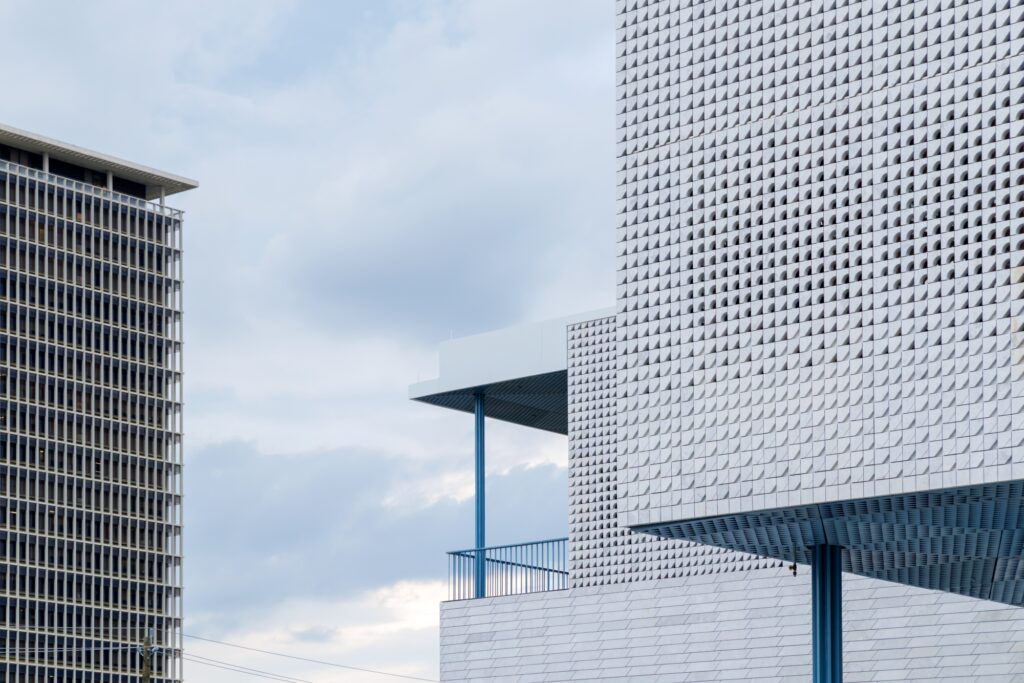
An up close of the stonework on the exterior of the Ismaili Center, Houston. @I wan Baan
Nothing urges movement forward. The building accommodates lingering, conversation, and quiet observation. Hospitality is not announced. It is enacted through proportion, light, and rhythm.
A model for future civic religious architecture
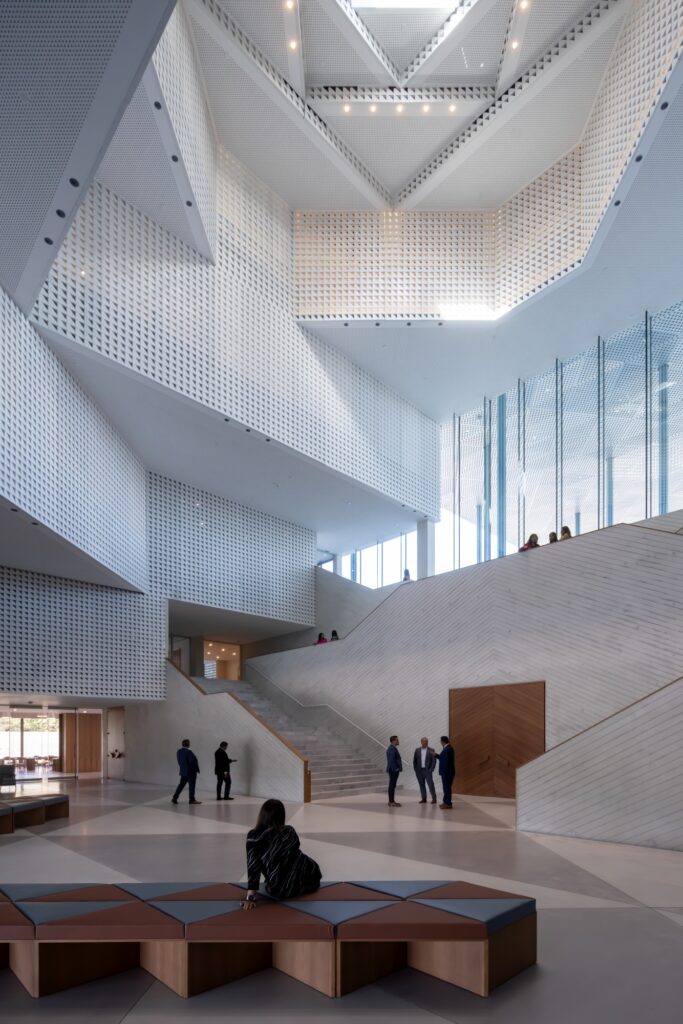
The Central Atrium is the heart of the center – it rises over 70 feet and is made of stepped screens.
The Ismaili Center Houston does not argue for the relevance of religious architecture. It simply occupies the city with steadiness and care. Its influence lies less in what it represents than in what it permits: unhurried movement, shared quiet, a temporary release from urgency. In doing so, it raises a larger question about the future of civic space.
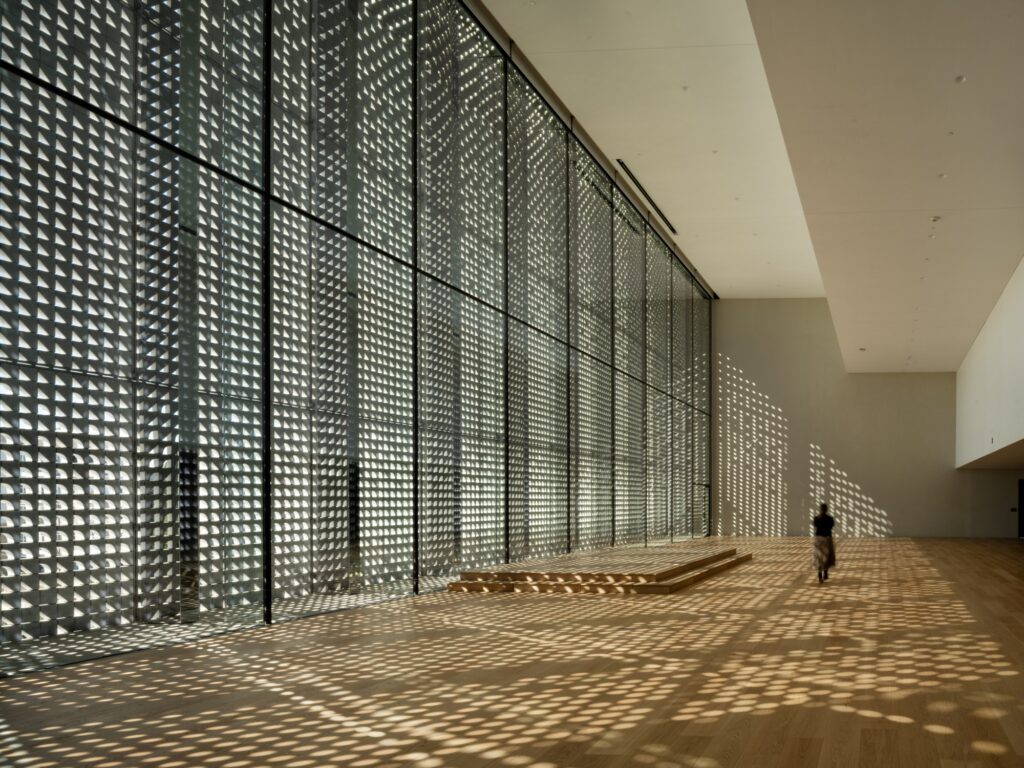
Natural light filters into the Social Hall through the expansive stone screen of the Ismaili Center’s façade. @Iwan Baan
If buildings can offer attention instead of instruction, and calm instead of spectacle, then the value of sacred architecture may no longer rest in belief alone, but in its ability to teach the city how to pause without withdrawing from itself.
All Images Courtesy @Iwan Baan