
Rajshree Rajmohan: An Ethical Life in Architecture
Architect Rajshree Rajmohan does not speak about architecture as something that begins with a site or ends with a building. For her, architecture begins much earlier, in listening, in reading, in travel, and in the ability to recognise another human being. Her journey moves across cities, classrooms, courtrooms, studios, and homes, refusing to separate practice from ethics or design from life. In this conversation with SCALE, she reflects on learning as a lifelong process, on cities as moral landscapes, and on why architecture, at its core, must remain an ethical act. By Arya Nair

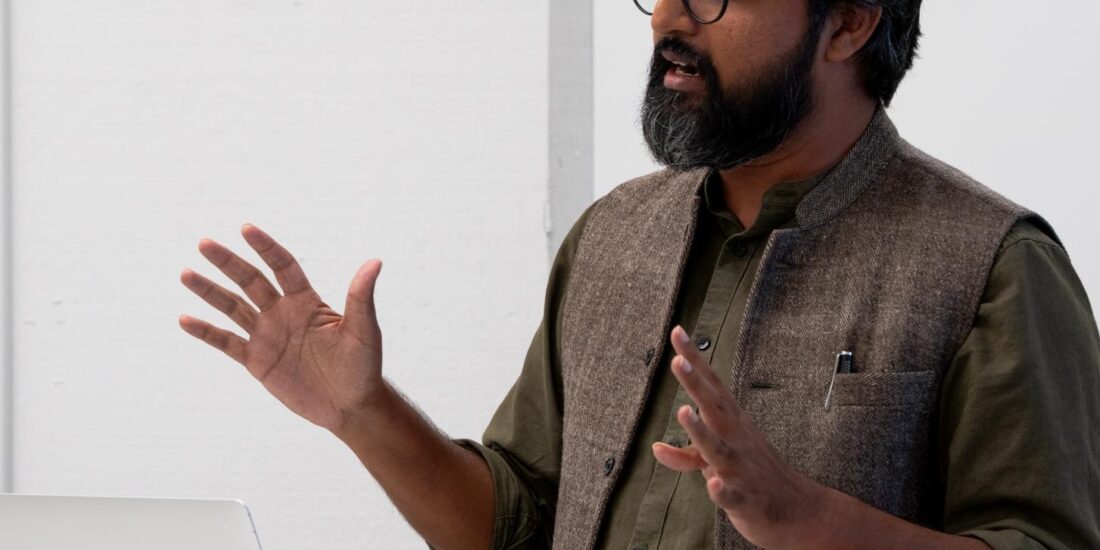
Speaker at ‘Future of Gender Inclusive Spaces’at IIA & IIID design festival, ‘Infinity 2.’ Surat, Nov 22.
An architect, academician, and independent researcher, Rajshree understands architecture as an ethical practice rather than a neutral professional act. Long before a drawing reaches a site, and long after construction is complete, architecture continues to shape lives, landscapes, and relationships. Every decision carries weight, and with it, responsibility.
Her thinking has been shaped far beyond the studio. Years of rigorous architectural education, feminist research, and sustained human rights work in rural and remote contexts have deeply influenced how she approaches design today. Travel and exposure to unequal realities have sharpened her sensitivity to context, making care and restraint central to her practice. These experiences did not exist alongside architecture. They transformed it.
Listening lies at the heart of her work as an academician. In classrooms, public reading spaces, and research initiatives, she treats knowledge as something that moves in many directions. Teaching, for her, is not authority but exchange. As she puts it, “Teaching is disguised learning. I learn far more from my students than they learn from me.”
She is equally clear about the limits of architecture. Design alone cannot undo hatred or repair deep social fractures. These are questions of policy, education, and collective values. “You cannot design humanity into people. Architecture alone cannot eliminate hatred.”
What architecture can do, she believes, is refuse indifference. It can remain attentive, ethical, and humane.
The conversation that follows traces Rajshree’s journey across cities, institutions, and ways of practising. It reveals a life shaped by curiosity, responsibility, and a commitment to learning, listening, and living carefully within the contexts architecture helps shape.

On site, Residence for Dr. Susha & Dr. Pramod. 2022. Photograph by Prahlad Gopakumar.
SCALE: Can we begin with your early life. Your roots, childhood, schooling, and how architecture entered your life.
Rajshree: I was born in Calicut in 1971. But I did not really grow up there. Almost immediately after that my parents moved to Gujarat. They were based in Vadodara, what we earlier called Baroda. That is where I did my primary schooling. Later, when I was about ten years old, we shifted to Ahmedabad.
What really mattered was the environment at home. My uncle, my father’s younger brother, K Chandramohan, is an architect. By the time I was born, he had just finished his graduation and had joined the National Institute of Design. In the 1970s NID was doing a lot of design consultation work along with product design. He was part of their design consultation team.
As he stayed with us, I constantly watched him sketch. Drawing was just part of life. There was also a lot of music at home. My parents loved music. We listened to classical music, heavy rock, all kinds of music. On the dining table, conversations were about design, textiles, colours. All of this seeps into you when you are a child. You do not realise it then. You absorb it unconsciously.
SCALE:When did you first encounter architecture as a space, as an environment?

Sketch of traditional blade grinder by Rajshree .
Rajshree: The first time I went to the NID and CEPT campuses, I must have been ten or eleven. I still remember that feeling. I saw people drawing, making models, working with their hands. I saw spaces being talked about differently. I found it so exciting.
Somewhere deep down, I already knew. I knew who I wanted to be. There was no dramatic moment. It was very quiet. But it was very clear.
SCALE: Architecture was not a common choice then.
Rajshree: Not at all. At that time, the general thinking was very simple. You either become a doctor or an engineer. Nothing else was really considered. My family also wanted me to do medicine or engineering.
But I decided to do architecture. I cleared the entrance tests and the interviews. I knew exactly what I was getting into.
In my mind, I was choosing between fine arts and architecture. Then I read Victor Papanek’s book Design for the Real World. That book changed everything for me. The way I looked at design, society, responsibility. When I closed that book, I knew. Architecture it had to be. I hold that book completely responsible for my decision.
SCALE: How did CEPT shape you as a thinker?
Rajshree: CEPT was gruelling. There is no other word for its academic rigor. But it was also deeply stimulating. It was an autonomous institution. There were no textbooks which implied one should read everything.
We were constantly pushed to think. To question. To read. To introspect. We were not bogged down by building rules or codes. That was not the emphasis. The emphasis was on developing ideas. On ideation. On asking how one reads and understands people, spaces, settlements, culture and history.
History was not only about memorising timelines. It was about understanding design philosophies, movements, intentions. That way of thinking stayed with me.
I was very fortunate with teachers. Professor Kurula Varkey, Balkrishna Doshi, Prof Neelkanth Chhaya, Prof Miki Desai, Prof Anant Raje, Prof Vasavada, Walter D’Souza and many others. Eminent artists Walter and Piraji Sagara opened up a different way of seeing and understanding art. Simultaneously, they were also actively contributing to architectural pedagogy. I was so fortunate to have the best of mentors.
SCALE: Your dissertation on gendered spaces is often spoken about.

Sketch inside Suchindram Temple.
Rajshree: Yes. My UG dissertation was on gendered spaces. I was looking at the relationship between gender and spatial organisation in vernacular settlements guided by Prof Neelkanth Chhaya. How social structures actually affect house forms.
I studied three settlements using analytical diagrams generated from Henri Lefebvre’s primary theory, ‘production of space’. The first settlement was the patriarchal Banni houses in Kutch, second was the matrilineal Nair taravad house in Kerala and the third was the matriarchal Khasi settlement.
SCALE: This was also the period when you entered human rights work.
Rajshree: Yes. During my dissertation, I became involved in human rights activities. Ahmedabad was constantly on edge. Communal tensions, riots, violence. Even though the institute felt insulated, the city outside was often burning.
I joined the People’s Union for Civil Liberties. Ashim Roy, an eminent trade unionist, became a mentor to me. We worked with lawyers, social activists, and social scientists and engaged actively in fact finding missions to collate background research for legal cases. We fought several cases successfully against prominent establishments who had been flouting human rights in Gujarat. Meticulous research, empathy, local support and faith in the cause helped immensely.
SCALE: How did you manage practice alongside this?

The Black and White House. Gayatri and Nidhi’s residence. Photograph by Prahlad Gopakumar.
Rajshree: I worked part time at NID as a junior architect on a two year contract. Human rights work was voluntary and it did take up a lot of my time. Court visits, fieldwork, research, data collection. After eight years I slowly drifted back to taking up small architectural commission projects in Ahmedabad and Surat, primarily to sustain myself.
SCALE: What made you move to Trivandrum?

With Rajshree’s uncle K. Chandramohan, 2015. Photograph by Sivan Sir.
Rajshree: Motherhood. When my son was born, I began questioning everything. Ahmedabad was becoming increasingly polarised. Communities living in segregated ghettos divided by religion, caste, class. I wanted my children to grow up as kind loving human beings. Early years are critical. I did not want them to learn discrimination as normal. Kerala felt healthier, safer and a relatively more progressive space for my children to grow.
My uncle K Chandramohan had been practising in Trivandrum since the 1980s. During the long summer vacations in CEPT, I would come to Trivandrum and work in his design studio. He gave me my first real project, a small house in PTP Nagar, Trivandrum. By the time I moved to Trivandrum in 2008, my daughter was also born. Both children started school here. I am very glad I made that decision. I restarted my engagement with architecture in his design studio and I continue to do so.
SCALE: How was starting over in a new city?

Presenting at Pecha Kucha event, IIA Kannur. 2025.
Rajshree: Leaving Ahmedabad after 36 years was very difficult. Trivandrum, despite being my ancestral home, was new to me. The fact that I did not know the language well enough was yet another drawback. I joined my uncle’s design practice and I continue to be mentored by him. My friends eventually coaxed me to lecture and teach. The Indian Institute of Architects IIA Trivandrum chapter invited me to present my first public lecture on gendered spaces in 2011.
SCALE: This was also when Vaayanashala and Trivandrum Talkies began.
Rajshree: Yes. Vaayanashala was a monthly reading space carved into the courtyard of my uncle’s beautiful studio space. Every month we chose one book. Professor Oommen and I led discussions on architectural texts. A simple, intense reading and thinking together about architecture with fellow architects and students. We continued these sessions for two and a half years thanks to the fraternity of architects, IIA and students who supported it wholeheartedly.
Then I started ‘Trivandrum Talkies’ with a progressive group of thinkers, Open Space. These monthly sessions were a meeting place to share and document the oral histories of the city. We shared and listened to experts and the public speak about theatres, libraries, bakeries, music, etc. Sessions were held at the Women’s Hall in Kowdiar, a building designed by Laurie Baker. Anyone could walk in. No fee. Just stories and warm reflections on memories of the city.
SCALE: You have lived and worked in many cities, and when you speak about Trivandrum, there is a very deep engagement with the city. How has moving across places and finally settling here shaped the core philosophies you stand for today?
Rajshree: Going to different cities actually sensitises you. Very deeply.
For example, during my human rights work earlier in my career , I was in rural areas and remote places, and in very difficult circumstances. You see the other side of life. The life devoid of privileges.
If I spend some money on a book today, I know very well that for somebody else, that could be their entire income for the month. They have to survive on that. When you see that, you cannot unsee it. You get another perspective.
Travel does that. It humanises you. It makes you look at how others are living, what issues they are facing. And then when you come back to your drawing board, when you draw that line with far more care. You start looking at context very differently.
For me, context has now become the most important thing. Especially today, when all of us are dealing with parcels of land. We are trying to design into them. The question I keep asking myself is, am I doing damage to an already damaged land. I pause and think better. How can I give back to the land?

Inside the Black and White House. Photograph by Prahlad Gopakumar.
Many of the housing projects we do in our office are quite large. So the larger question always is, how do you make the space you are designing accommodate somebody else’s aspiration and dream. One is seemingly designing for an unknown but humanity offers insight.
Take Trivandrum itself. Many people living here are not originally from here. Historically, they have migrated from different districts. So now they are first or second generation residents of the city. That layering is important to understand.
Travel equips you with different kinds of design problems. It helps you anticipate issues people might have. It also gives you so much more to share with your students.
Reading, travel, and teaching are three things I feel are absolutely essential for anyone. Just reading is not enough. One must travel. You have to explore. Standing in front of a Van Gogh painting and looking at it in a book are two completely different experiences. You see the colour as it really is. In print, the colour has already changed. The scheme has mutated.
I cannot imagine a life without reading and travelling. I genuinely cannot.
SCALE: You spoke earlier about ghettos, segregation, and denial of access to public space. How do you see this issue today? Is this only a social problem or also an architectural one?
Rajshree: Honestly, I do not think it is an architectural problem alone. It is a policy problem rooted in the lack of altruism. It is the state government that has ensured that these kinds of ghettos exist. And they have done nothing to mitigate it.
Let me give you a very recent example. This is 2025. Garba in Ahmedabad. Traditionally, Garba is a simple festive folk dance, to honour goddess Amba. Men and women dance in a circle around the goddess for ten nights during Navratri. Anyone could join in. In housing societies, people of all ages would come together and dance. That was it. Simple. Joyful act of togetherness.
Now, it has become commercialised and communalised. A mega event with ticketing. In many places, tickets are sold only to Hindus. Now see what is happening. First there is class segregation because tickets are expensive. Then there is religious segregation. Such filters were unheard of earlier. And this is happening today.
Another example. Suppose you have crores of rupees and you want to buy an apartment in a building where only one community lives. Even if you offer more money, they will not sell it to you if you do not belong to the same caste and religion. Why? Because of intolerance. This is why I say a feminist movement is necessary. Feminism is not only about women. It is about seeing the other as a human being. Not as a caste, class, religious or gendered entity.
A human being should have the right to access any space. Why should that be denied?
SCALE: So where does architecture stand in all this?

Conceptual sketch of the Black and White House.
Rajshree: Honestly. Architects cannot do much about this. If I am a horrible human being, if I am cruel, no matter how beautifully you design, I will still remain cruel. You cannot teach civic sense through design.
I can design the best roads, the best pedestrian paths, the most beautiful public spaces. But I cannot ensure people will not spit there. I cannot ensure they will not violate its sanctity. I cannot change people.
You can influence people partially, yes. But when hatred is so deeply seeped into the heart and soul, architecture cannot solve it. That is why sensitisation has to happen much earlier.
This is also one of the reasons I chose to move my children to Trivandrum. And I am so glad I did. My children are kind and loving. They do not put people into boxes of caste or class or religion. They are fluid in their understanding of people.
That, for me, is the most important education. Maths and science can happen. But humanity has to come first.
SCALE: Looking back at everything you have done, practice, research, teaching, activism, how do you see yourself today.
Rajshree: I do not see myself as working. Honestly. I feel unemployed and absolutely free.
I go to the studio and draw. Read, think, draw, share, build, and cook . This is my everyday life. And I am deeply in love with this beautiful loop despite the complexities each of these trajectories imbibe. This year, I founded ARA, Architecture and Research Atelier. It aspires to be a common ground for architectural research, documentation and design. The intent is to push the boundaries of architectural, art discourse and practice to serve those who need it the most.
People ask me what I would have done if I was not an architect. I genuinely do not know. This is the only thing that fascinates me. I cannot imagine doing anything else.
This is not work for me. This is simply how I live.
What happens when an architect treats learning as the central project of her life? Rajshree’s journey suggests that architecture becomes less about control, and more about listening. What stays with this conversation is not a sense of arrival, but a way of living. For Rajshree, architecture is an ethical practice that unfolds through everyday choices, through learning without certainty, listening without authority, and engaging honestly with context. It asks for awareness of both the power and the limits of design, and for restraint in a world that often rewards excess. In insisting that architecture cannot manufacture humanity but must remain humane, the way she lives offers a quiet but demanding reminder that architecture is not only something one does, but something one inhabits with responsibility.
All Images Courtesy Rajshree Rajmohan.