Haitham Al Busafi Curates the Oman Pavilion at Venice Biennale
At the 61st International Art Exhibition of La Biennale di Venezia, the Sultanate of Oman presents “Zīnah” (Adornment), an installation that oscillates between architecture and celebrates the local culture, curated and conceived by Haitham Al Busafi.
 Located within the Artiglierie section of the Arsenale, the pavilion marks a continued evolution of Oman’s participation at the Biennale, building on its earlier presence since 2022. Commissioned by the Ministry of Culture, Sports and Youth, the project positions itself not as a static exhibition but as a spatial experience shaped by the visitor’s participation, movement, and time.
Curated and conceived by Haitham Al Busafi, Zīnah draws from the Omani tradition of silver horse adornment, known as Al-zaanah, translating it into an immersive, kinetic environment composed of sand, suspended metal, and sound.
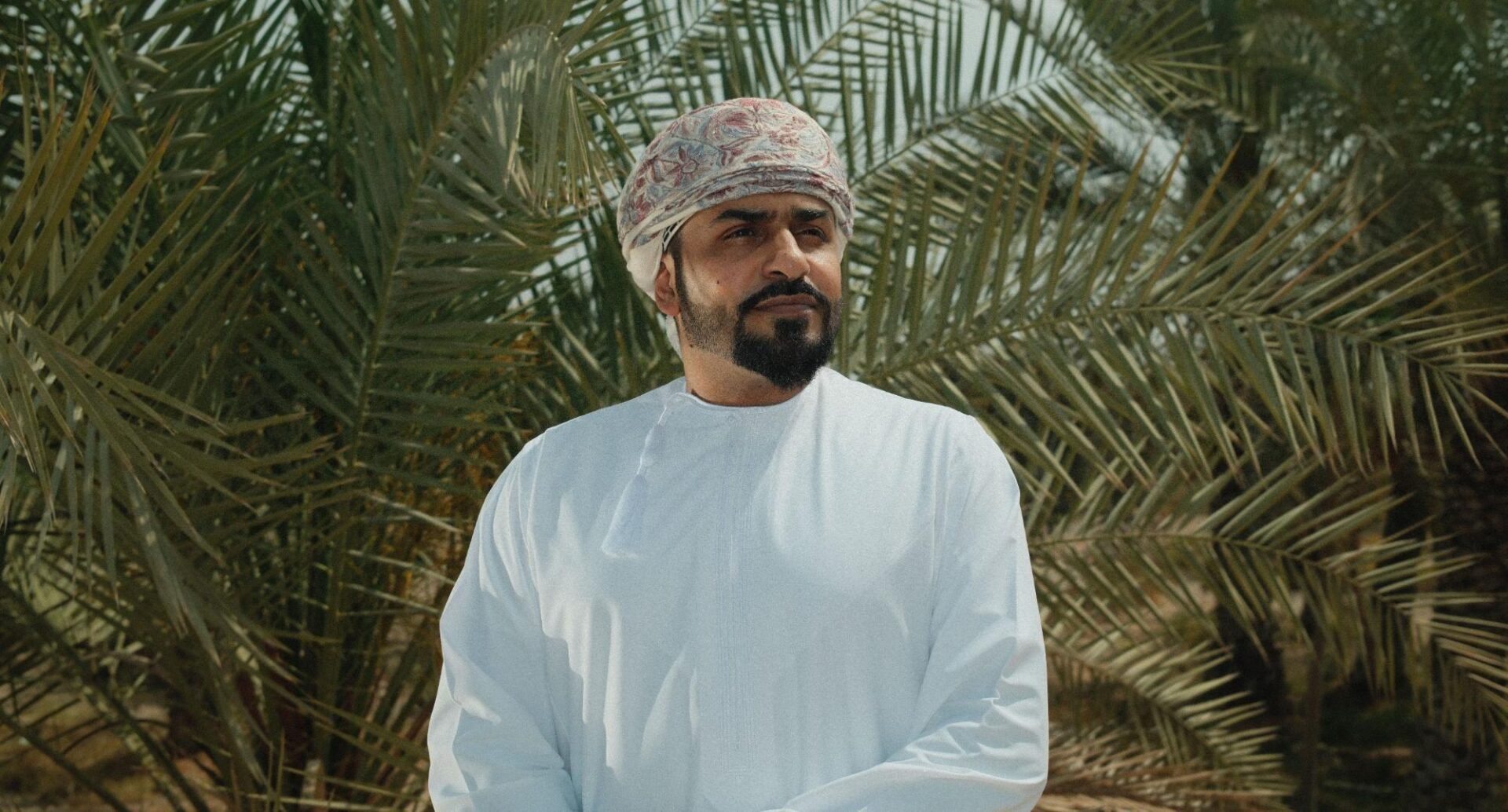
Born in Muscat in 1985, Haitham Al Busafi works across disciplines, working at the intersection of architecture, art, and technology. Educated at the University of Applied Arts Vienna, his work consistently explores how cultural narratives can be translated into spatial and immersive experiences. His projects have been exhibited internationally, including at earlier editions of the Venice Biennale and the London Design Biennale 2025, where his project Memory Grid for Oman’s inaugural pavilion received the Best Design Medal.

Haitham Al Busafi, Oman Pavilion, London Design Biennale 2025. Mixed media immersive installation. Photo Muhanna-Al-Siyabi.
With Zīnah, this line of inquiry deepens for him as it moves beyond earlier participatory frameworks, and the installation introduces a fully kinetic and sonic environment, where spatial experience is inseparable from bodily presence.
Introducing Tradition in the Spatial Experience

Haitham Al Busafi, Oman Pavilion, London Design Biennale 2025. Mixed media immersive installation. Photo Muhanna-Al-Siyabi.
At the core of Zīnah is Al-zaanah, a form of adornment historically used in Omani equestrian culture. These silver elements are both decorative and functional, designed to respond to movement and weight, allowing rider and horse to move as one. The installation repositions this tradition from object to environment. Rather than displaying artefacts, it reconstructs the underlying logic of adornment as a spatial condition. In Omani culture, adornment is not hierarchical, and the horse is not treated as an instrument but as an equal participant, reflecting a broader ethic of mutual recognition.
This idea becomes the conceptual framework for the pavilion. Adornment is no longer something external, and it becomes something one enters and activates.
The Spatial Construction of Zīnah
The installation is designed to be experienced as a carefully calibrated environment. A sand floor anchors the space, referencing the Omani desert as both a material and a cultural ground, while above, a dense constellation of suspended silver forms creates a shifting canopy. Movement is central to how the space operates. As visitors walk across the sand, their footsteps reshape the terrain, causing suspended elements to sway and produce sound, resulting in an evolving acoustic field where each presence contributes to the spatial condition.
Collective Authorship and Temporal Change
A defining aspect of Zīnah is its approach to authorship. The work is shaped not only by the artist but also through a series of participatory processes. In a workshop held in Muscat, artists, students, and members of the public inscribed marks into the silver elements, embedding individual gestures into the material fabric of the installation. This process continues during the exhibition. Over the seven-month duration, each visitor contributes to the evolving condition of the space, altering the sand, generating sound, and leaving traces of presence. The pavilion thus operates as a temporal environment, and accumulates change and recording use. The desert, referenced both materially and conceptually, becomes a framework for this logic of erosion and renewal.
Beyond its spatial strategies, Zīnah engages with a broader conceptual position as it proposes adornment as an ethical act, one that recognises relationships between human and non-human entities. This position extends into questions of empathy, value, and coexistence. By placing the visitor within the system of adornment, the installation shifts perception from observation to participation, from object to experience.
As Al Busafi explains, “The Al-zaanah taught me that adornment is not about possession or display, it is about recognition. A culture that adorns its horses is a culture that refuses to treat any companion as a mere instrument, but as an extension of the self. When I began to imagine what it would mean to bring this principle into the space of an exhibition, the question became: what happens when the visitor is no longer looking at an adornment, but standing inside it? When their weight, their movement, their breath becomes the thing that activates the silver above them? Zīnah does not explain this tradition. It places you within it. You walk, and the room responds. You are, for the duration of your crossing, the being deemed worthy of beauty.”
Within the Biennale
The pavilion is presented in alignment with the curatorial vision of Koyo Kouoh for the 2026 Biennale, titled In Minor Keys. Her framework calls for works that prioritise sensory engagement over spectacle, and resonance over didactic interpretation, and Zīnah responds directly to this position. It avoids explanatory narratives, instead offering an environment that must be experienced physically. The pavilion is also presented in Kouoh’s memory, acknowledging her emphasis on practices that foreground cultural specificity and embodied knowledge.
Oman’s Continuing Presence

Haitham Al Busafi, Oman Pavilion, London Design Biennale 2025. Mixed media immersive installation. Photo Muhanna-Al-Siyabi.
Oman’s participation in the Biennale has developed steadily over recent editions, contributing to international discourse through focused, research-driven projects.
As H.E. Sayyid Saeed bin Sultan Al Busaidi notes, “The Sultanate of Oman’s participation in Biennale Arte 2026 marks a new chapter in our country’s cultural engagement with the world. Since our first participation at the 59th International Art Exhibition of La Biennale di Venezia in 2022, Oman has contributed to the global conversation through the depth of our cultural knowledge. Zīnah is rooted in a tradition that has never separated beauty from function, or adornment from ethics. We present it in Venice as an offering, to the memory of Koyo Kouoh, whose vision honours precisely these values, and to every visitor who enters the space.”