Subodh Kerkar: The Doctor Who Found His Calling in the Ocean
Skill, by itself, isn’t art. That’s the perspective of Subodh Kerkar, a doctor-turned-artist who is using the ocean as his canvas and the waves to make his mark on the art world. In an interview with SCALE, he explained how this simple idea reveals a profound truth about his work. By Arya Nair
 From the moment he finished his 12th-standard exams, Subodh Kerkar’s life has been a fascinating journey of creative exploration and bold career changes. He began his artistic career as a cartoonist for a newspaper in Goa, a job he landed at a remarkably young age. Despite his early success, he pursued a career in medicine, becoming a doctor. For seven years, he balanced his medical practice with his love for art, showing his paintings in hospital rooms. It was here he realized he could make a living from his art and, driven by his passion, he made the audacious decision to leave medicine and become a full-time artist.
The Realization That Skill Isn’t Art

Maze of maize, in wood, art by Subodh Kekar.
Subodh’s transition wasn’t without its challenges. Initially, he focused on creating landscapes and figurative works, relying on his technical skills. However, a profound realization changed his artistic path forever: “skill is not art”. He came to understand that art requires something more: a message, a conviction, a voice. In his own words, “Skill is kind of a grammar of art.” Just as knowing grammar doesn’t make you a writer, being a skilled painter doesn’t make you an artist. This epiphany sparked a new quest for meaning in his work.
Subodh’s pursuit of a deeper understanding of art led him to Europe, where he worked as an illustrator and cartoonist in Germany. This experience allowed him to immerse himself in the world of contemporary art, with museums and galleries becoming his “teachers.” He began to see art as a serious study, not just a hobby, and this period shaped his unique artistic voice, which is deeply rooted in his personal experiences and beliefs.
An artist’s inner world

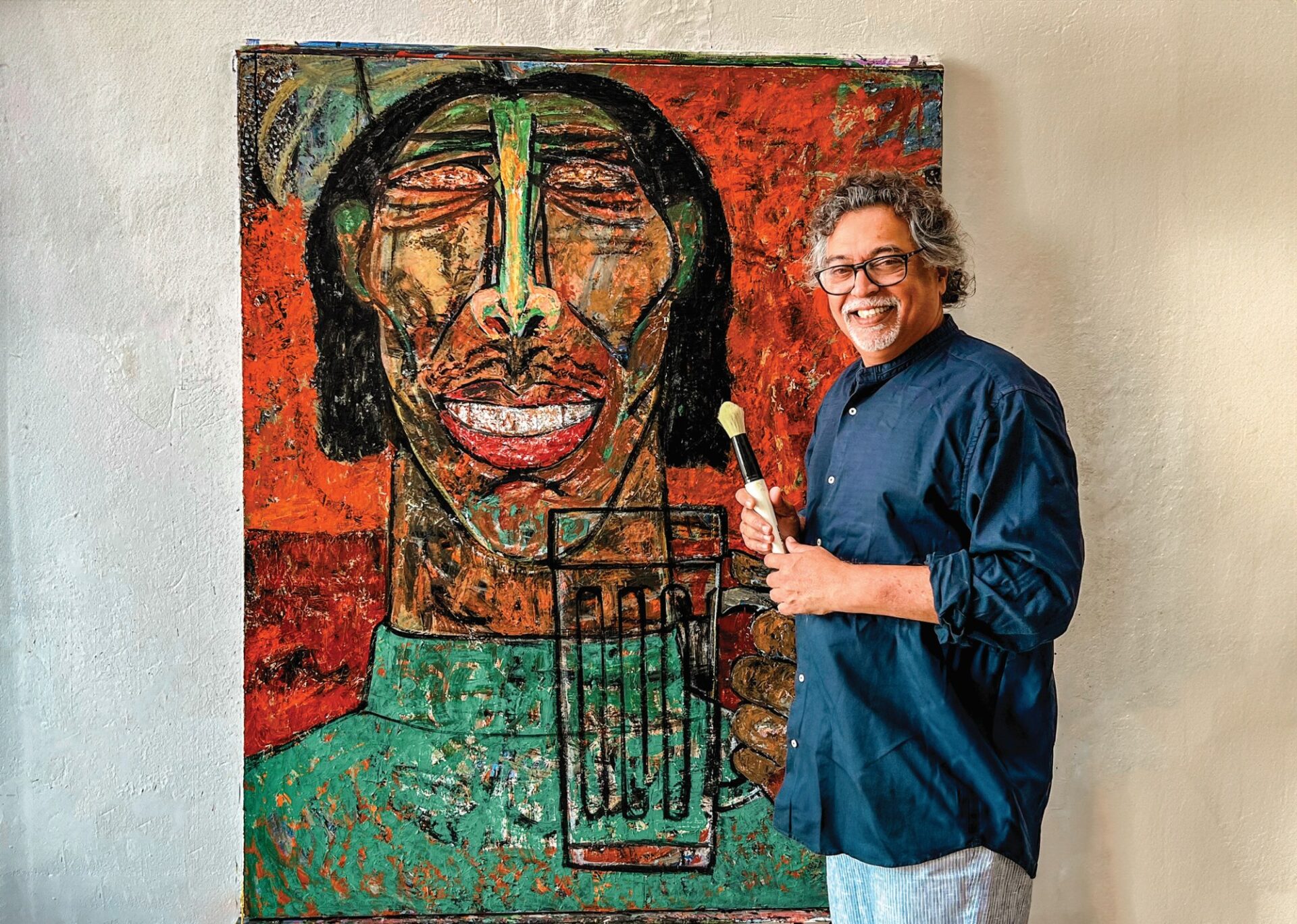
Man with fish; Acrylic on canvas
Hailing from a family of artists, Subodh Kerkar understands firsthand the deep connection between personal experience and creative expression. He reflects on how his father, an artist who struggled with depression, channeled his emotions into his work. Subodh believes that artists are among the select few who can fully express their inner world and what they’re experiencing at a given point in their lives through their profession.
Subodh describes artists as “sensors, receptors and transmitters of ideas in a society” and believes their personal pain or contemplation directly influences their art. He suggests that these profound emotions can manifest in the themes they explore, the colours they use, and even the textures they create. For him, every piece of art has a strong link to an artist’s personal beliefs and emotions. This makes art not just a profession, but a powerful, expressive outlet for the very depths of the human experience.
The Sea as a Muse and a Canvas

Sea Anemone, Marigold Circle, Performace Art.
Subodh’s work is intrinsically tied to the ocean, a connection that began in his childhood. Growing up in Goa, walking on the beach with his father was a daily ritual. His father taught him invaluable lessons, telling him to make his mind as open as the horizon. He also used the ocean as a powerful metaphor for creativity, urging his son to be like the rare wave that “wets new sand” instead of the many that simply cover the already wet sand. This early bond with the sea, and the wisdom imparted by his father, laid the foundation for Subodh’s identity as an “ocean artist.”
His art has evolved from painting seascapes to using the ocean itself as his canvas and medium. He creates stunning, temporary art installations on the beach using materials provided by the sea, such as shells. In these unique works, his inspiration, theme, canvas, and material are all given to him by the ocean. This process, where the tide eventually washes away his creations, is a fundamental part of the art itself. Subodh embraces this impermanence, seeing it as a reflection of life and quoting the poet Tagore, who wrote about waves “writing their poetry on the sand and not satisfied, wiping them off over and over again.”
Subodh considers the ocean as his master and his muse.
Performance Installation

Performance installations is a new genre of art ‘invented by Subodh Kerkar’. Subodh himself does not participate in the performance; however, he conceptualises and directs it. This genre of creation does not fall in the realm of traditional performance art, neither can they be considered as contemporary dance performances.
Subodh Kerkar’s “performance installations” are a deeply personal form of land art that blurs the lines between artist, community, and the environment. His work is not about creating permanent objects but rather about the very act of creation and its relationship with nature.
His initial inspiration for this work came from his years as a doctor, which gave him an intimate understanding of the lives of Goa’s fishermen, who were his patients and friends.

Fisherman and the ocean, is a performance installation that is inspired by Subodh Kerkar’s long relationship with the fisherfolk community. Initially they were his patients, when he practiced in the seaside village of Calangute.
He saw the inseparability of their lives from the ocean and felt a natural pull to express this bond through his art. Subodh’s installations often involve a collaboration with the local community. He initially worked with fishermen, but their busy schedules led him to hire labourers, many of whom were from Bengal and were also fishermen by nature. These individuals become an integral part of his art, their movements and presence on the beach symbolizing the deep connection between their lives and the sea.
The central idea of these performances is that the ocean is more than a body of water; it’s a force that creates civilizations and shapes cultures. This concept is beautifully expressed in a process where the art is temporary, created in public, and eventually reclaimed by the very ocean that inspired it. The fleeting nature of the work on the sand is a core element, as it emphasizes the beauty of impermanence and the continuous, cyclical relationship between humanity and the sea. As Subodh said, he wanted to “show the inseparability of the life of the fishermen and the ocean.”
Nature as a Collaborator

Lavina house; Acrylic on canvas.
Subodh Kerkar’s creative process is a dynamic collaboration with nature. He doesn’t just work on the beach; he works with it, allowing the sea, wind, and sun to become active participants in his art. This unique approach means his work is often subject to the whims of the elements, leading to unexpected and beautiful outcomes. He recalls a rainy day when he noticed all the elements were present on the beach: the sky, wind, water, and earth.
The only one missing was fire. Inspired, Subodh placed large, lit pots on the sand, creating a powerful “confluence of all elements.” This act of bringing all five together on a single-canvas highlights how his artistic vision is shaped by the very forces of nature, transforming his work from a simple creation into a powerful dialogue with the world.
Art for the Masses

Man and nature, Acrylic on canvas
One of Subodh’s core philosophies is to make art accessible to everyone. He calls himself the “Tukaram of contemporary art,” likening his mission to that of the saint poets who brought spiritual wisdom to the masses in simple language. He creates art that communicates with common people, not just critics in a gallery. His performance installations on the beach allow fishermen and tourists alike to experience his work firsthand.

Syncretism, Antique wood carving from a temple & antique wooden sculpture of Jesus Christ.
This commitment to accessibility is evident in his choice of materials, which often includes discarded objects like plastic bottles and old tires. While he acknowledges the sustainable angle, he primarily uses these materials because he finds them visually interesting. One of his most notable works, “Carpet of Joy,” was created with a lakh and a half plastic bottles, a clear and powerful message against littering.

Syncretism; Antique wood carving from a temple & antique wooden sculpture of Jesus Christ.
Through his art, Subodh challenges the commercialised view of art and seeks to use it as a tool for social change. He believes that engaging with art can make society more liberal and plural, as it “washes you of all fanaticism.” As he explains, he chooses to create “works which connect with common people… which the common people can understand and… speaks to the common people.” His work weaves together his personal convictions, his Goan roots, and his profound connection to the ocean, creating a beautiful and universal language that speaks to the shared humanity in all of us.
Subodh reflects, “All of us carry a bit of the ocean within us. Life began in the sea and later moved onto land, but the balance of sodium and potassium in our blood still mirrors that of the ocean.”
All images Courtesy Subodh Kerkar; Photography credits: Rohit Chawla