
What Not to Miss at the LATINOAMERICANO Exhibition
Qatar Museums in partnership with Museo de Arte Latinoamericano de Buenos Aires (Malba), opened LATINOAMERICANO, Modern and Contemporary Art from Malba and Eduardo Costantini Collections at the National Museum of Qatar (NMoQ). This is the first major exhibition of the WANA region dedicated to Latin America’s modern and contemporary art. On view till 19 July 2025, the expansive showcase highlights a dynamic cultural exchange between Qatar and Latin America and stands as a centrepiece of this year’s Qatar Argentina and Chile 2025 Year of Culture. We asked the most knowledgeable curator Issa AL Shirawi for some of his favourite pieces from the large collection at NMoQ and he takes us through the best of what is to offer at the exhibition.

HE Sheikha Mayassa, Chairperson of Qatar Museums with dignitaries and the curator Issa Al Shirawi at the opening of the exhibition.
LATINOAMERICANO brings together approximately 170 works by more than 100 pioneering and contemporary artists from across Argentina, Brazil, Chile, Colombia, Cuba, Mexico, Paraguay, Uruguay, and Venezuela. The exhibition offers a wide-ranging exploration of Latin American visual culture from the early 20th century to the present day, tracing how artists from across the continent have reflected, challenged, and reshaped social, political, and cultural realities through art.
 The exhibition is organised into six thematic sections that span artistic responses to urbanisation, identity, memory, and resistance, offering a nuanced perspective on the shared yet diverse experiences that define the region’s visual language.

One of the most prices works at LATIONOAMERICANO: Frida Kahlo Autorretrato con chango y loro (Self-Portrait with Monkey and Parrot), 1942, Malba Collection, Eduardo F. Costantini Donation, 2001
Visitors to LATINOAMERICANO encounter iconic works such as Frida Kahlo’s Autorretrato con chango y loro (1942), Diego Rivera’s Baile en Tehuantepec (1928), Fernando Botero’s El viudo (1968), and Wifredo Lam’s Omi Obini (1943), among other masterworks.

Fernando Botero, El viudo (The Widower), 1968, oil on canvas. Malba Collection. Eduardo F. Costantini Donation, 2003. © The Fernando Botero Foundation, 2025.
These are presented alongside lesser-seen gems and contemporary voices, including newly acquired pieces from Malba making their public debut, and significant works from Mathaf: Arab Museum of Modern Art and the future Art Mill Museum.
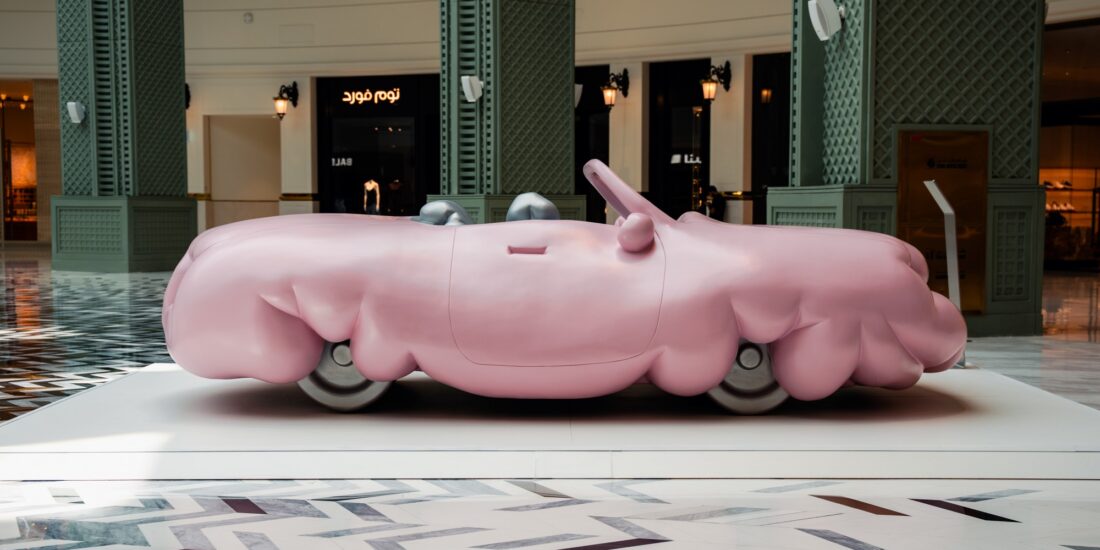
 Extending the exhibition into the outdoor spaces of the National Museum of Qatar, Marta Minujín’s large-scale installation Sculpture of Dreams (2023), a whimsical, inflatable structure first seen in New York’s Times Square that offers visitors a sensory expression of the playfulness and imagination found throughout Latin American art.

Marta Minujín’s large-scale installation Sculpture of Dreams (2023)
Shared Passion through Cultural Exchange

Issa Al Shirawi of Qatar Museums and María Amalia García of Malba with the invited press.
The concept of the Qatar Year of Culture shines powerfully through the LatinoAmericano exhibition, particularly in the shared passion, mutual respect, and curatorial collaboration between Issa Al Shirawi of Qatar Museums and María Amalia García of Malba. This partnership exemplifies the Year of Culture’s mission—to build enduring cultural bridges through artistic and intellectual exchange.
The two curators’ deep knowledge and camaraderie was a highlight for the press, symbolising a true spirit of intercultural dialogue. Their shared enthusiasm for the artworks, ranging from iconic pieces by Frida Kahlo and Diego Rivera to contemporary voices from Latin America, transformed the exhibition into more than a visual showcase; it became a testament to the values of mutual understanding and collaborative creativity that the Year of Culture promotes.
Through this dynamic curatorial partnership, LATINOAMERICANO did not merely display art, it invited audiences in Qatar to explore Latin American cultural heritage with empathy and curiosity, effectively collapsing geographic and cultural boundaries. The exhibition stands as a vivid embodiment of how art can foster genuine cross-cultural respect and intellectual connection, at the heart of Qatar’s cultural diplomacy efforts.
The Curator List:

Oscar Bony, Sinusoide o Estructura (Sinusoid or Structure), 1967 (Reproduced in 1994), wood and lacquered paint. Eduardo F. Costantini Collection. © 2025, Oscar Bony Estate. Photo: Courtesy of Eduardo F. Costantini
With a collection as rich and layered as LATINOAMERICANO, we turned to Issa Al Shirawi, Co-Curator and Head of International Exhibitions at Qatar Museums, for his personal highlights. His thoughtful selections reflect not only a curatorial eye but also a deep emotional and intellectual engagement with the works. As someone instrumental in shaping the exhibition, Al Shirawi’s insights offer a window into how Latin America’s artistic language resonates within the context of Qatar’s cultural landscape. From iconic masterpieces to hidden gems, each piece he chooses is a testament to the shared humanity and diverse histories that LATINOAMERICANO and the Year of Culture seeks to illuminate.
1, Francis Alÿs:

The two curators with the first installation of LATINOAMERICANO by Francis Alÿs behind them.
The exhibition opens with a video work by Mexican-Belgian artist Francis Alÿs, a piece that holds deep significance for both the artist and the museum. “This was the first work ever commissioned by Malba when it opened in 2001,” explains Al Shirawi. Known for his minimalist gestures that carry immense conceptual weight, Alÿs takes viewers on what Al Shirawi calls a “two-fold journey, one through history, and another metaphorical journey that we took inspiration from in shaping this curatorial narrative.” It is a subtle but powerful opening that sets the tone for the entire exhibition.
2. Antonio Berni – Monster Series Sculpture
 A crowd favourite in the exhibition is a striking sculpture from Argentinian figurative artist Antonio Berni, part of his iconic Monster Series. Constructed from everyday materials—wicker baskets, straw, and reused objects like a steering wheel and parts of a washing machine—the piece blurs the line between assemblage and narrative. Berni, a key figure in Nuevo Realismo (“New Realism”), used art to address social and political issues. “This work is both playful and profound,” says Al Shirawi. “It draws you in with its familiarity and then surprises you with its commentary.” He also adds, “This is one of María’s [María Amalia García, co-curator] favourite pieces in the show as well.”
3. Victor Brecheret – The Banjo Player
 Italian-Brazilian sculptor Victor Brecheret is represented through a small yet culturally weighty marble sculpture titled The Banjo Player. “Though compact in size, it holds immense significance,” says Al Shirawi.
 Brecheret merges European modernist techniques with visual elements inspired by Brazilian folk culture. “You see this synthesis in the physical characteristics of the figure and the local references—he successfully marries form and heritage in a way that is distinctly Brazilian yet globally resonant.”
4. Remedios Varo
 A standout among the paintings is a work by Spanish-Mexican surrealist Remedios Varo, a suggested self-portrait rich with esoteric symbolism. “In this painting, you can sense her deep interest in science, music, and the occult,” Al Shirawi notes. “But what truly caught my attention were the native plants depicted so clearly. It reflects how, despite her European roots, her work is deeply embedded in the flora and fauna of Mexico.” This botanical specificity grounds her surrealism in a real, local landscape.
5. Antonio Berni – Marketplace Fresco
Another powerful work by Antonio Berni at LATINOAMERICANO is a large wall fresco from the 1950s depicting a bustling Latin American marketplace. “This piece reflects how artists like Frida Kahlo, Miguel Covarrubias, and Diego Rivera were actively engaging with representations of Indigenous cultures,” says Al Shirawi. “You see it in the clothing, the familial structure, and the everyday life portrayed here.”
What makes this fresco particularly special is its journey: it was discovered in a house scheduled for demolition. The Malba team, upon learning of its existence, stepped in, acquired the work through funding, and preserved it. “This is the first time this monumental work, approximately 450 kg, is being exhibited outside of Mexico,” Al Shirawi shares. “It’s a remarkable feat, both logistically and culturally.”
6. Cecilia Vicuña – A Poem in Space
 The final highlight for Al Shirawi is the monumental and poetic installation by Chilean artist and poet Cecilia Vicuña. Her work reactivates indigenous and ancient practices of the Andean civilisation that developed the quipu—a system of knotted cords made of spun and plied wool or Ilama hair used for communication, memory, and storytelling. “Vicuña’s installation pairs ancient quipus with her contemporary interpretation using knotted wool and video projection,” explains Al Shirawi. “It speaks of loss, resilience, and the radical potential of remembering through non-verbal language.” For the artist, quipu is a poem in space, a way to remember, involving the body and the cosmos at onec.
 What moved him most was the emotional and political weight of the knots themselves: “Each one holds the memory of a people, of a culture silenced by colonisation—and yet, here they are, speaking again. The quipu is a way of honouring that long lost tradition, but also in a way of talking about the loss of indigenous lives through the colonial conquest and, dictatorships,” says Al Shirawi.
7. Constellations by Gyula Kosice

Gyula Kosice, Constelaciones (Constellations), ca. 1972, painted acrylic, wood, photographs, and light bulbs. Malba Collection. Acquired thanks to the contribution of the Acquisitions Committee, 2024. © Gyula Kosice, 2025. Photo: © Santiago Orti, courtesy of Malba.
What is most interesting about this artwork is that it explores ideas about space, water, and what it means to be human at a time when no other artist had dwelt about this topic. As Al Shirawi says, “These pieces show Kosice’s vision for the future of our planet and humanity’s potential in space.” Made with materials like acrylic, Plexiglas, paint, and light, the artwork is, in Shirawi’s words, “a work of brilliance” and a favourite of both him and Maria.
“These pieces, created in the 1970s,” Shirawi explains, “came at a time when not many people were thinking about the damage being done to the planet.” That makes Kosice’s work even more powerful—both a warning about environmental problems and a hopeful message about new futures for people on Earth and beyond.