
The Mindcraft Exhibition 2025: Nature, Design & Craft
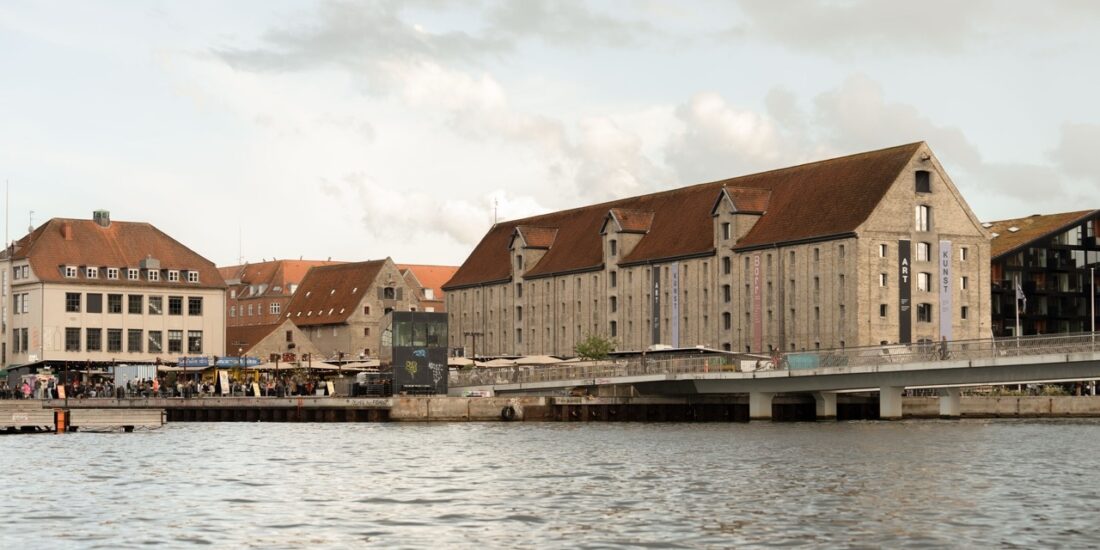
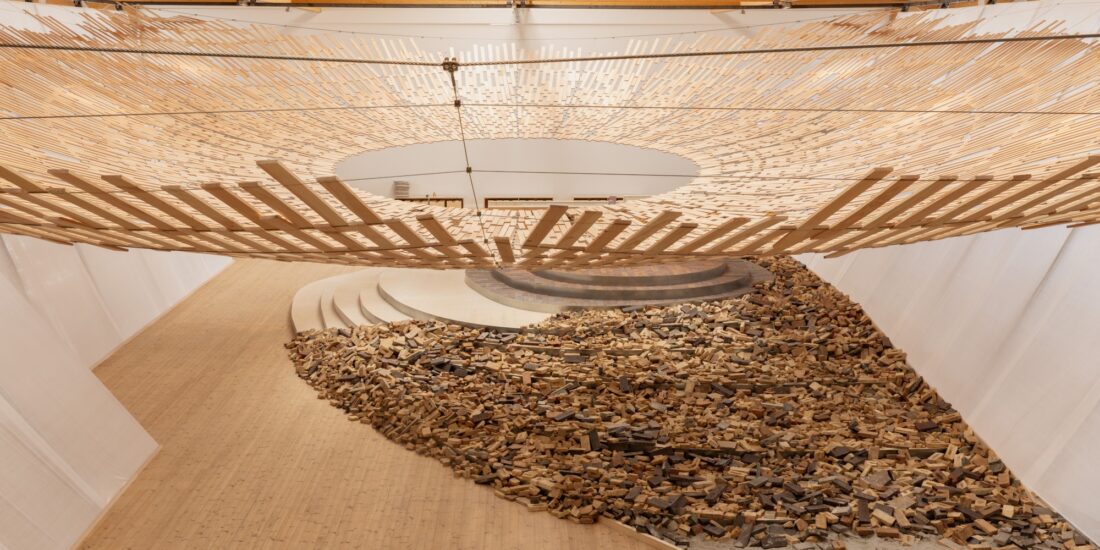
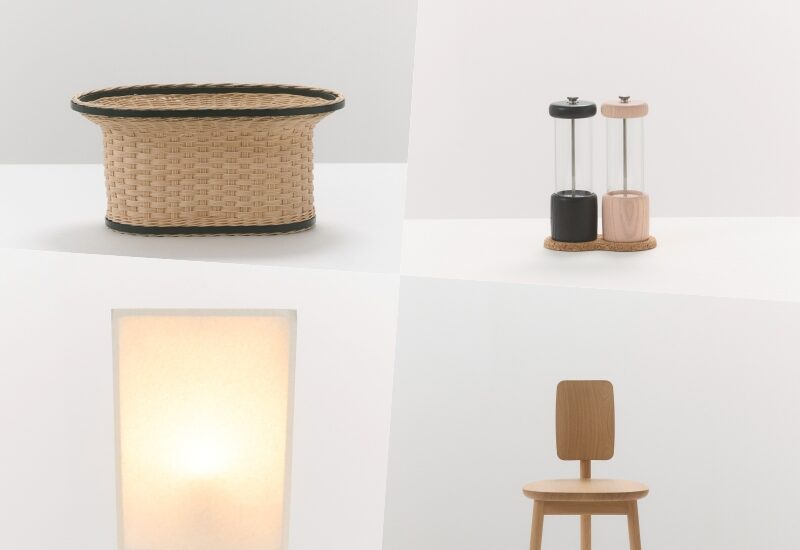
This autumn, The Mindcraft Project presented The Mindcraft Exhibition 2025, a celebration of Danish design and craft inspired by systems and patterns found in nature. It opened on October 2, 2025 at The Lab in Copenhagen and the exhibition explored how natural forms, materials and processes influenced the way designers think, create and innovate.
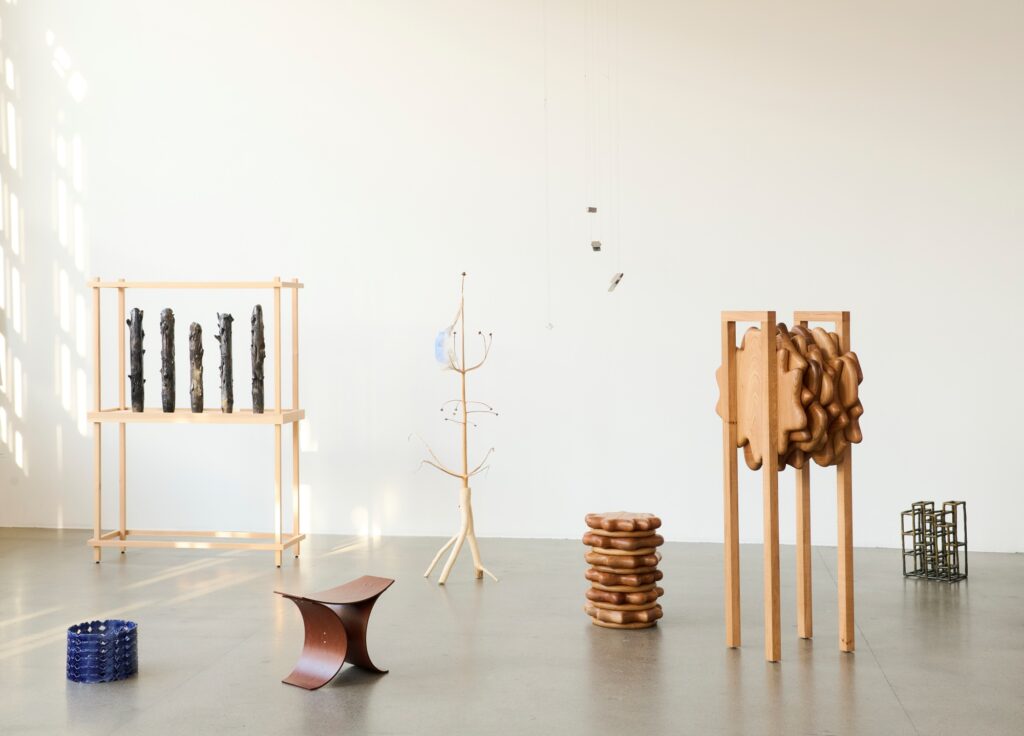
Mindcraft Exhibition 2025. photo-Benjamin-Lund
Curated by Pil Bredahl, this year’s edition brought together ten contemporary Danish designers and studios, each interpreting the geometry, structure and wisdom of nature in their own unique way.
The exhibition was available both physically in Copenhagen and digitally at mindcraftproject.com, from October 2 to October 5, 2025, with free admission for all visitors.
A Meeting of Mind and Craft
The Mindcraft Project, directed by Copenhagen Design Agency (CDA), has been a global platform for Danish design and craftsmanship since 2008. By combining experimental thinking with deep material knowledge, The Mindcraft Project has highlighted how design can respond to future challenges and inspire new ways of living.
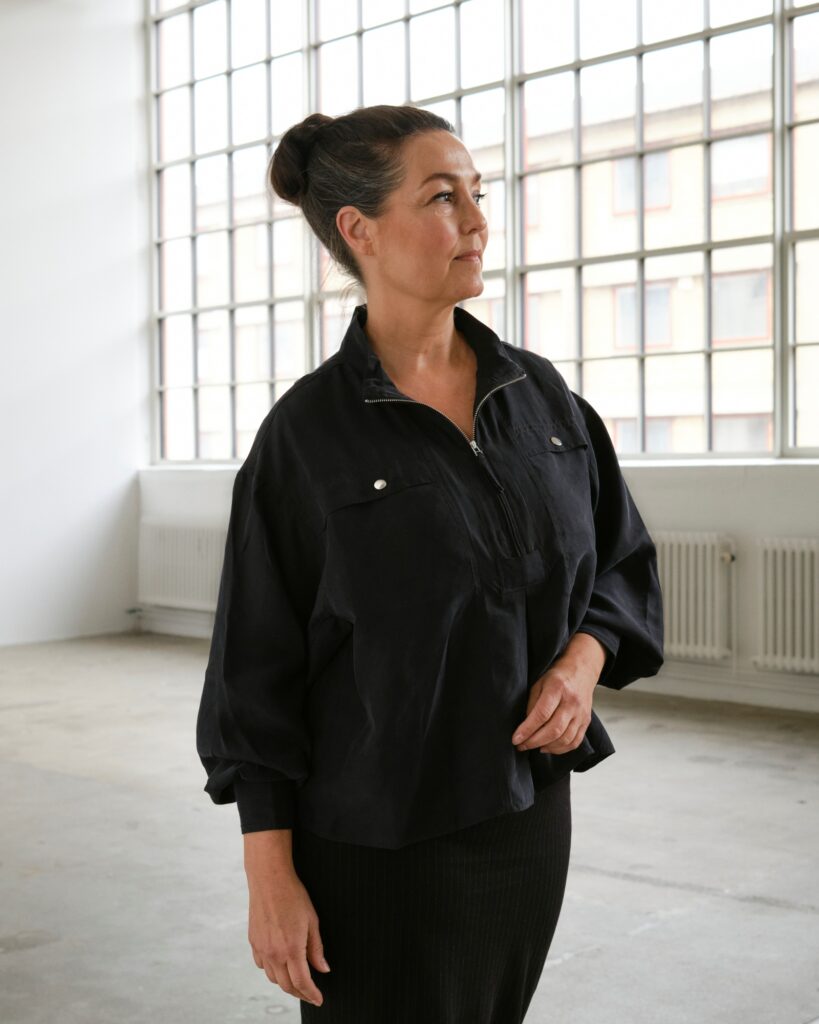
Pil Bredahl, Curator Mindcraft Exhibition 2025, photo-Benjamin-Lund
Curator Pil Bredahl brought a lifetime of experience within design, craft and cultural communication. She believed that design and craft are not just about beauty or function, but about learning from nature’s own logic.
“Craft and design have the potential to explain and teach us about our world,” said Pil Bredahl. “In a digital age, it is important to remember that many of the answers to our questions are already found in the logic of nature.”
Design Inspired by Natural Systems
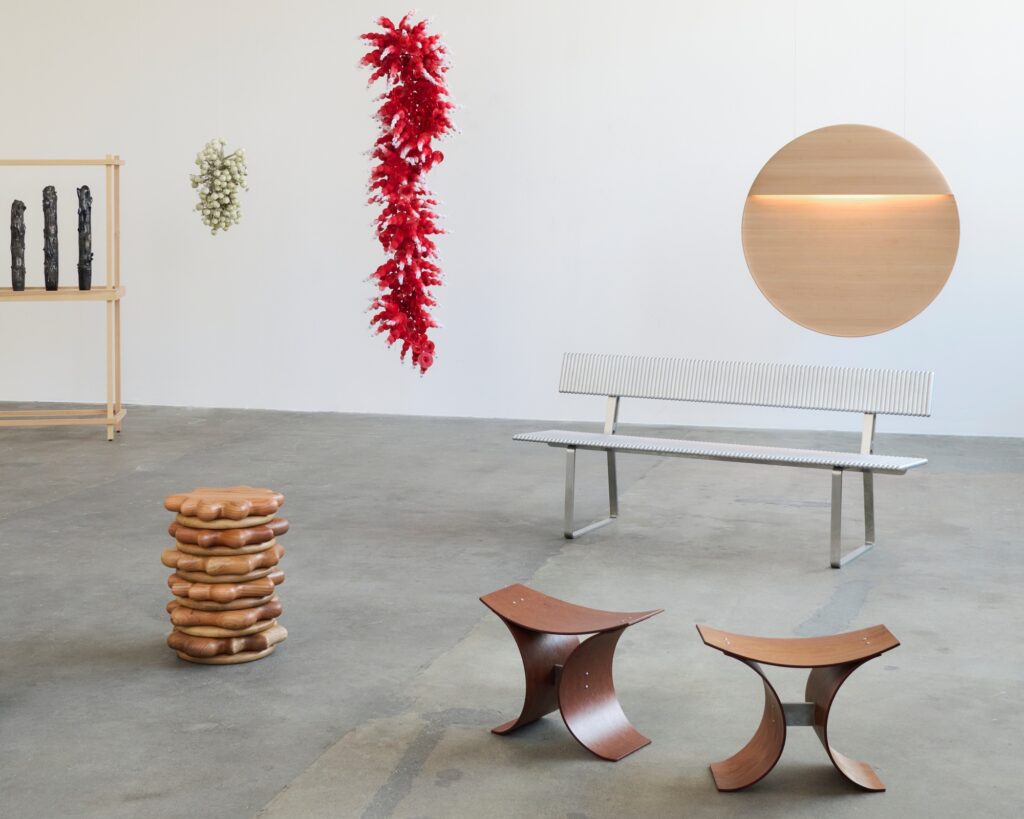
Mindcraft Exhibition 2025. photo-Benjamin-Lund
Throughout the exhibition, visitors noticed recurring ideas of modularity, balance and natural order. The designers drew from organic growth, geological formations and the physics of gravity to create works that were both educational and poetic.
Each piece explored the relationship between human touch and natural material, moving from the rawness of stone and glass to the softness of textiles and the precision of metal. The results were thoughtful and innovative objects that celebrated both the strength and fragility of the materials they were made from.
“The depth of Pil’s experience made her the perfect curator,” said Anders Kongskov and Kristian Kastoft, founders of CDA. “She connected Denmark’s long tradition of craft with innovation and radical thinking as a force for change.”
The Designers of The Mindcraft Exhibition 2025
The ten selected designers and studios were:
Ahm x Lund, Anne Brandhøj, Anne Dorthe Vester, Bendixen & Baruël, Hilda Piazzolla, Jeppe Søndergaard, Kasper Kjeldgaard, Kasper Kyster, Lærke Lillelund, and Morten Klitgaard.
Each presented a project that bridged art, craft and design in a dialogue between nature and human creativity.
Highlights from the Exhibition
Kasper Kjeldgaard – The Bench and Small Ones
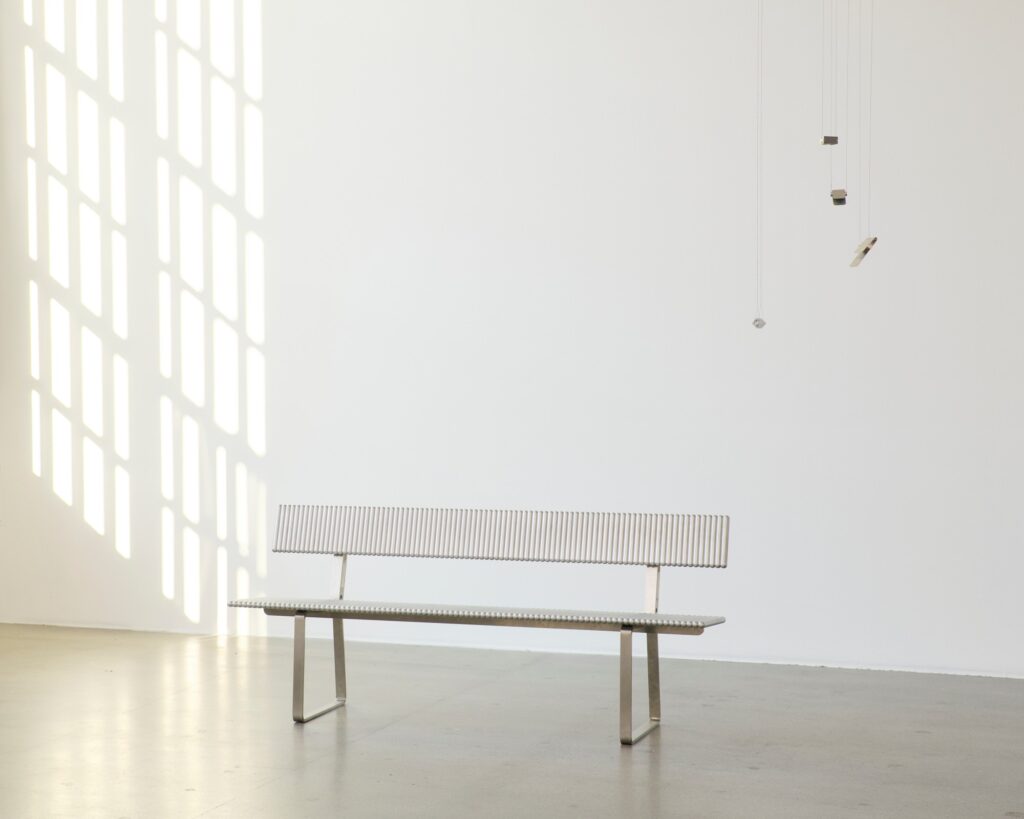
KASPER KJELDGAARD, photo-Benjamin-Lund
Kasper Kjeldgaard presented two works united by their sense of balance and poetry. The Bench was built from milled solid aluminium rods, creating a modular structure that could shift and adapt to different spaces. Small Ones was an installation of delicate aluminium light elements suspended from thin steel wire, appearing to float effortlessly.
Both pieces grew out of Kjeldgaard’s fascination with the mobilé, exploring gravity and motion through functional design. His process combined precision craftsmanship with an abstract search for beauty.
“The fundamental rules of our physical world are a poetic reflection on what design is,” he explained.

KASPER KJELDGAARD in his studio, photo-Benjamin-Lund
Kjeldgaard worked primarily with metal, using a lathe and milling machine to shape simple cubes and tubes into elegant compositions. His work has been shown internationally, including in Los Angeles, Milan and New York, and he has received numerous grants and awards from the Danish Arts Foundation and other cultural institutions.
Kasper Kyster – Strata

KASPER KYSTER, photo-Benjamin-Lund
Designer Kasper Kyster explored modularity through Strata, a lighting collection made from just three components: a steel bracket, a frosted acrylic diffuser and an LED light source. From these simple parts, Strata could grow across multiple directions, transforming from a floor lamp to a pendant light.
“Repeating the same component can result in very different outcomes,” he said. “My role as a designer is to guide the balance between function and aesthetics.”
Working from The Factory for Art and Design in Copenhagen, Kyster was known for his experimental approach to materials and collaboration. His curiosity and openness led to exhibitions, curatorial work and awards from the Danish Arts Foundation and the Design Awards Denmark.
Lærke Lillelund – FIG 02 and FIG 03
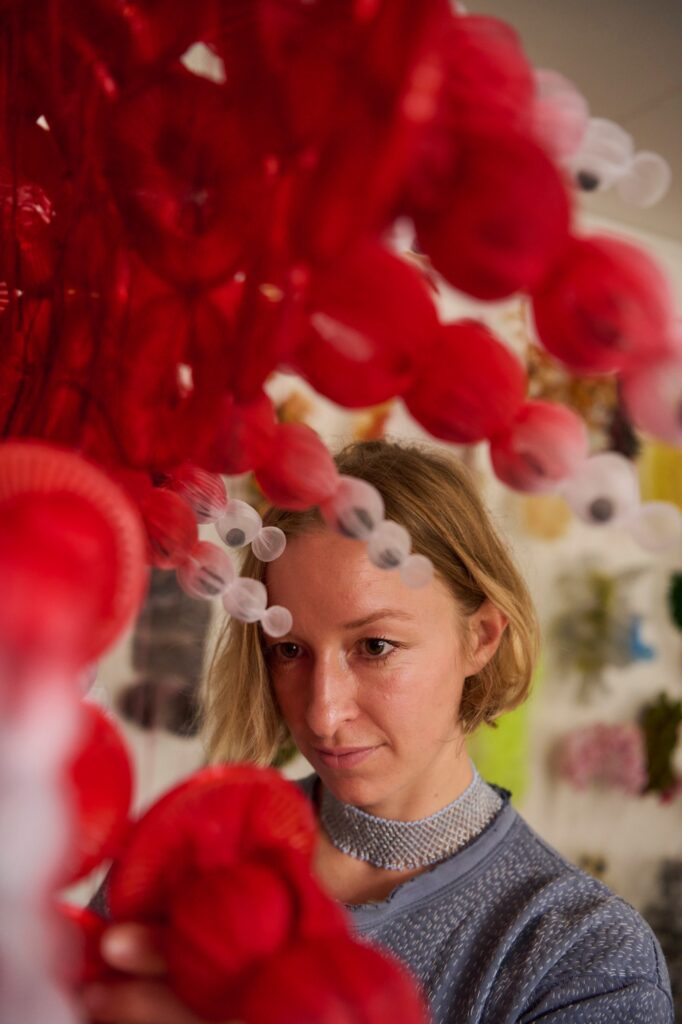
LÆRKE LILLELUND, photo-Benjamin-Lund
Textile artist Lærke Lillelund explored movement and mystery in two suspended sculptures, FIG 02 and FIG 03. Both pieces used traditional Japanese shibori techniques to shape fabric into three-dimensional forms.

LÆRKE LILLELUND, photo-Benjamin-Lund
FIG 02, made from polyester organza, held its shape through heat treatment, while FIG 03, crafted from silk and steel wire, changed with its environment. Using digital printing and 3D-printed connectors, Lillelund combined soft textiles with structural precision, creating forms that appeared alive and organic.
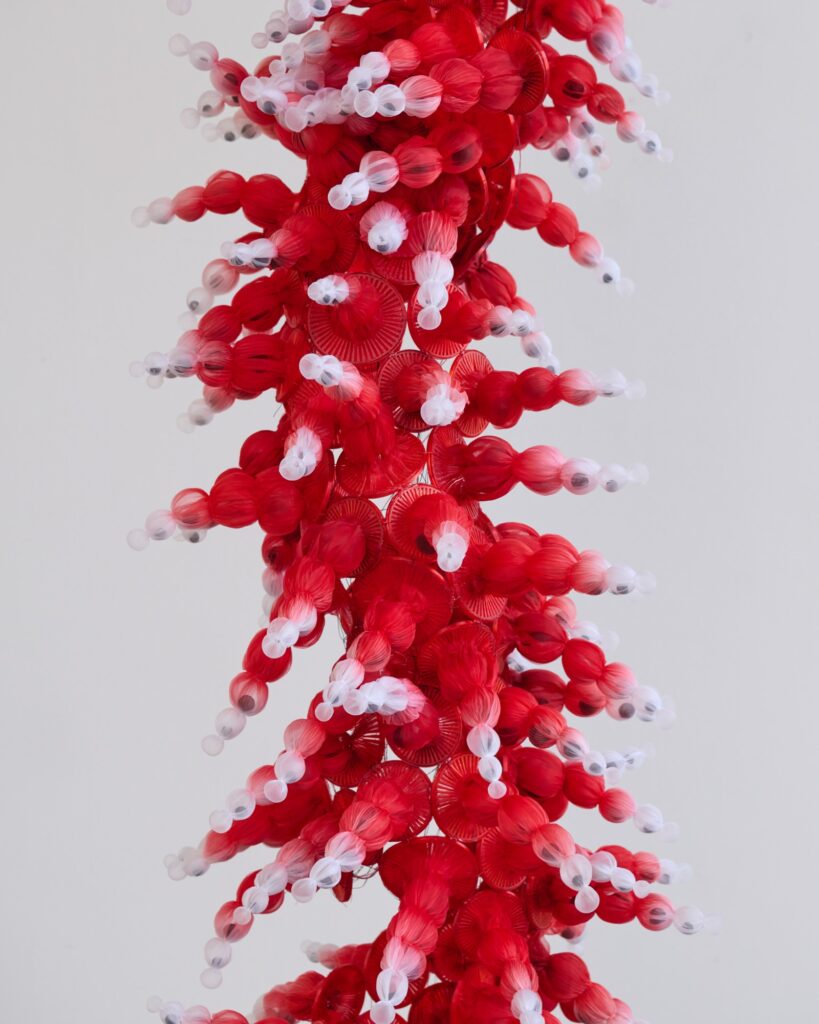
LÆRKE LILLELUND, photo-Benjamin-Lund
“I hope visitors were able to explore these pieces and learn about the techniques and materials I used,” she said.
Lillelund’s work blended traditional textile craft with modern technology, creating colourful, fluid structures that seemed to breathe. Her projects have been exhibited in Denmark, Japan, France, and the United States, supported by multiple residencies and grants from the Danish Arts Foundation.
Morten Klitgaard – Aragonit
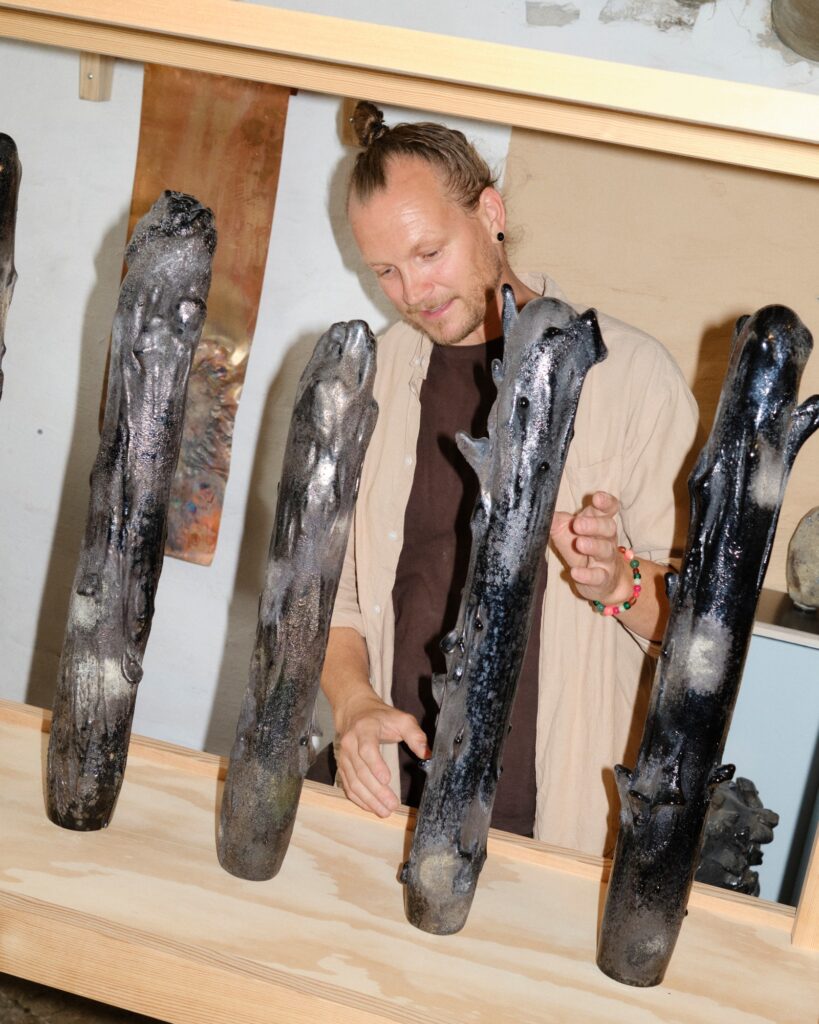
MORTEN KLITGAARD, photo-Benjamin-Lund
Glass artist Morten Klitgaard presented Aragonit, a poetic exploration of how we frame and control nature. Five sculptural glass objects rose like branches inside an open pine wood cabinet. Without any protective glass, viewers could touch and experience the rough surfaces, made with crushed local stone fused into molten glass.
“This work drew on the tradition of cabinets of curiosities,” said Klitgaard. “It commented on how we still view nature as something exotic and mysterious.”
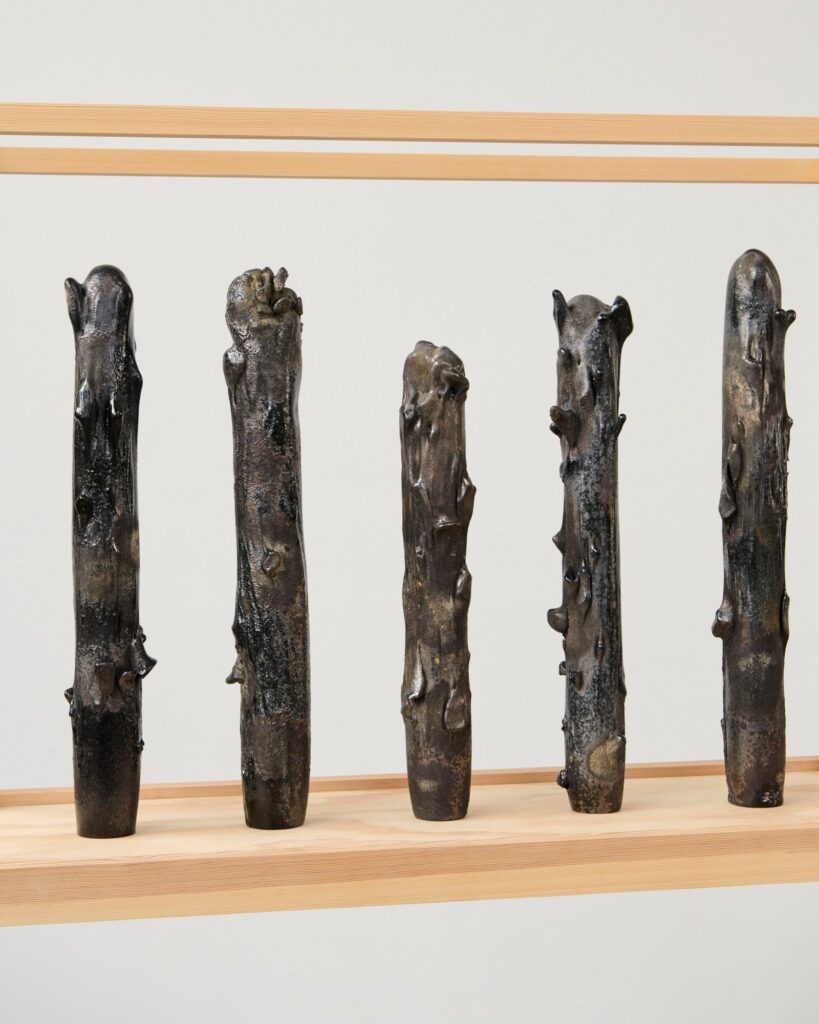
MORTEN KLITGAARD, photo-Benjamin-Lund
Inspired by the stones of Bornholm, Klitgaard transformed their quiet complexity into textured glass forms. His work reflects both strength and fragility, showing how beauty could be found in rawness and imperfection.
His career spans many exhibitions and residencies, including in Iceland, the United States and Denmark. He continues to receive long-term support from the Danish Arts Foundation for his deep, experimental approach to glass.
Anne Brandhøj – Veins & Grains
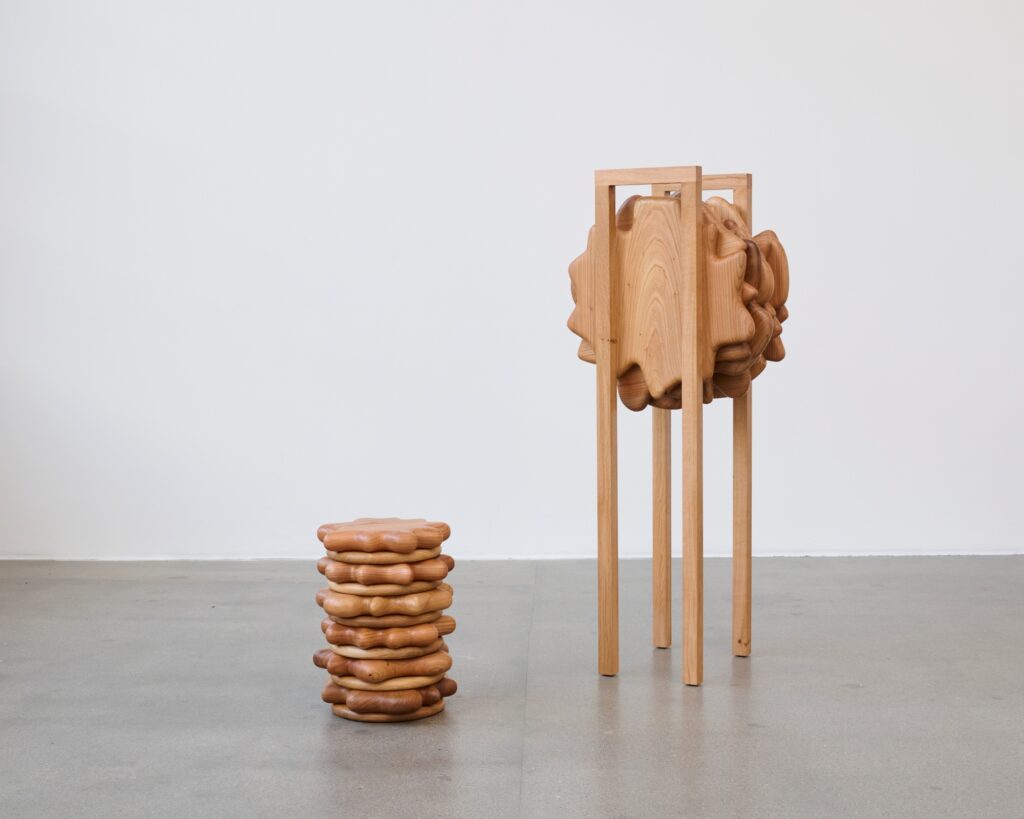
Anne Brandhøj, Photo by Benjamin Lund
Veins & Grains by Copenhagen-based designer Anne Brandhøj pairs oak’s structural precision with elm’s hand-carved organic forms, through a poetic interplay of stacked forms. While oak has been used as the anchoring material for both pieces, highlighted through precise circular and architectural shapes that mirror its consistent grain structure and density, elm is presented as a series of hand-crafted organic leaflike formations that demonstrate the expressive qualities of the timber. Explored through two formations – a lower seating unit and higher, eye-level console – the collection invites interaction through sight and touch, whether seated or moving around each object.

Anne Brandhøj; photo Benjamin Lund
“Working with solid wood brings both constraints and possibilities that I thrive on,” she says.
Known for her sculptural practice in timber and her work with Bly Studio on circular design solutions, Brandhøj describes her approach simply: “I am always really curious to explore… adding skill and knowledge to my practice along the way.”
Her work often begins with freshly felled timber, where cracks, knots, and growth rings become celebrated details, revealing the raw character of the material. Balancing a deeply hands-on process in her Søborg workshop with innovative industrial design projects, Brandhøj pushes the boundaries of how furniture can function as both sculpture and sustainable design.
Hilda Piazzolla – Infill Works
Hilda Piazzollais, photo Benjamin Lund
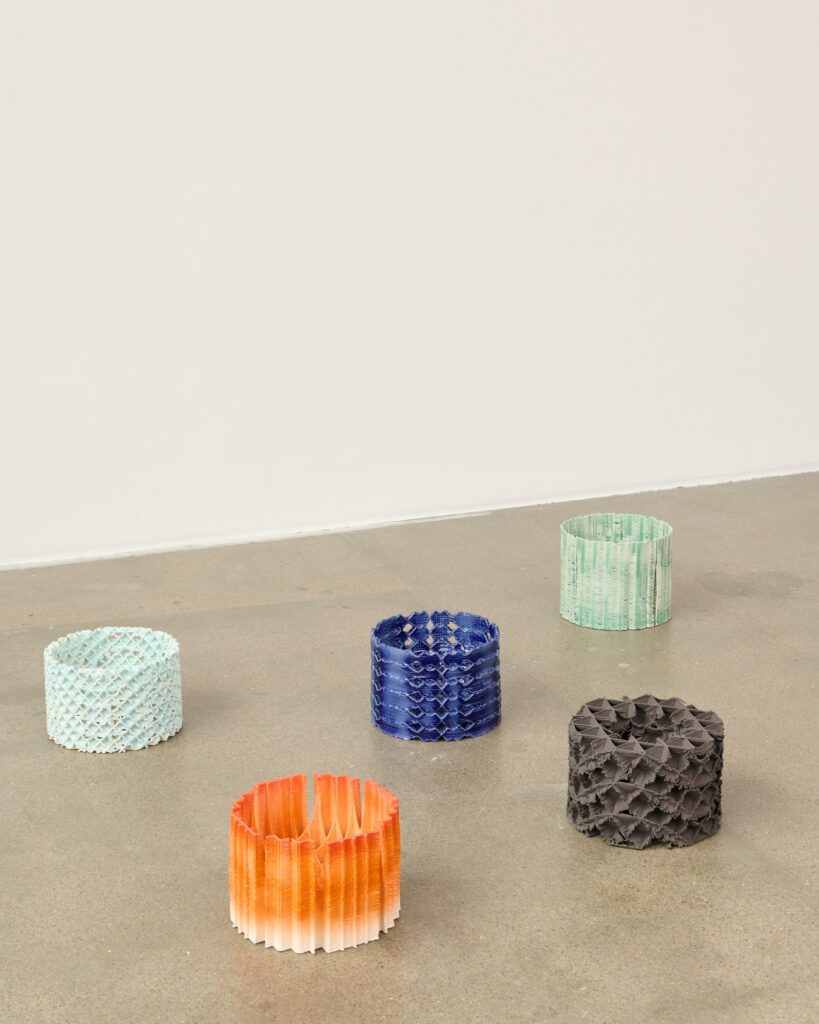
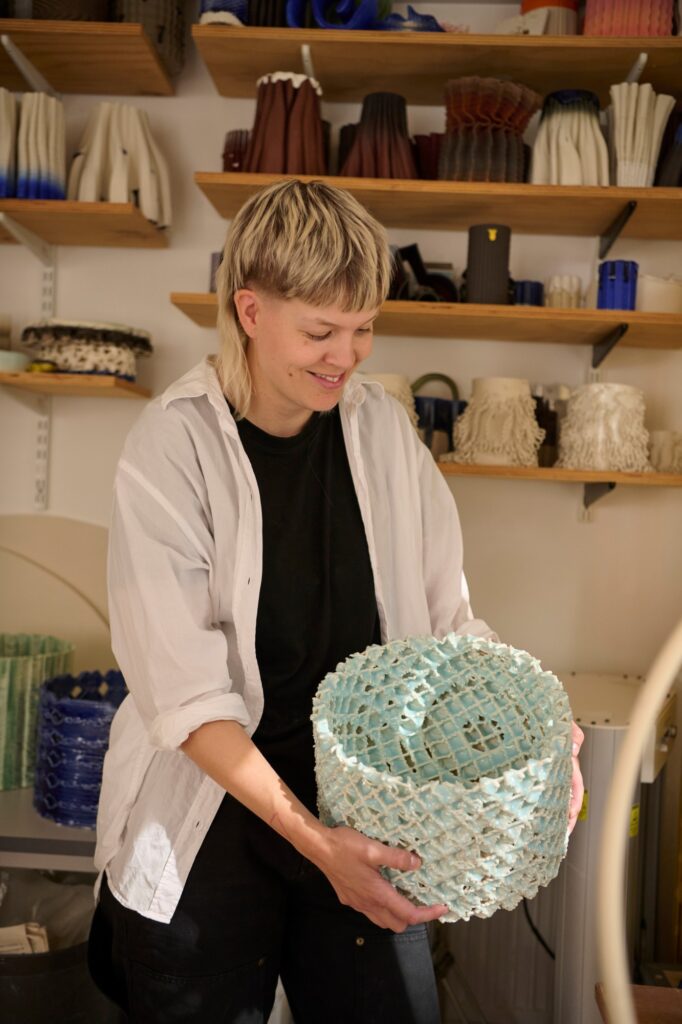
Infill Works by Swedish-Danish ceramicist Hilda Piazzollais is a collection of sculptural objects created from 3D printed
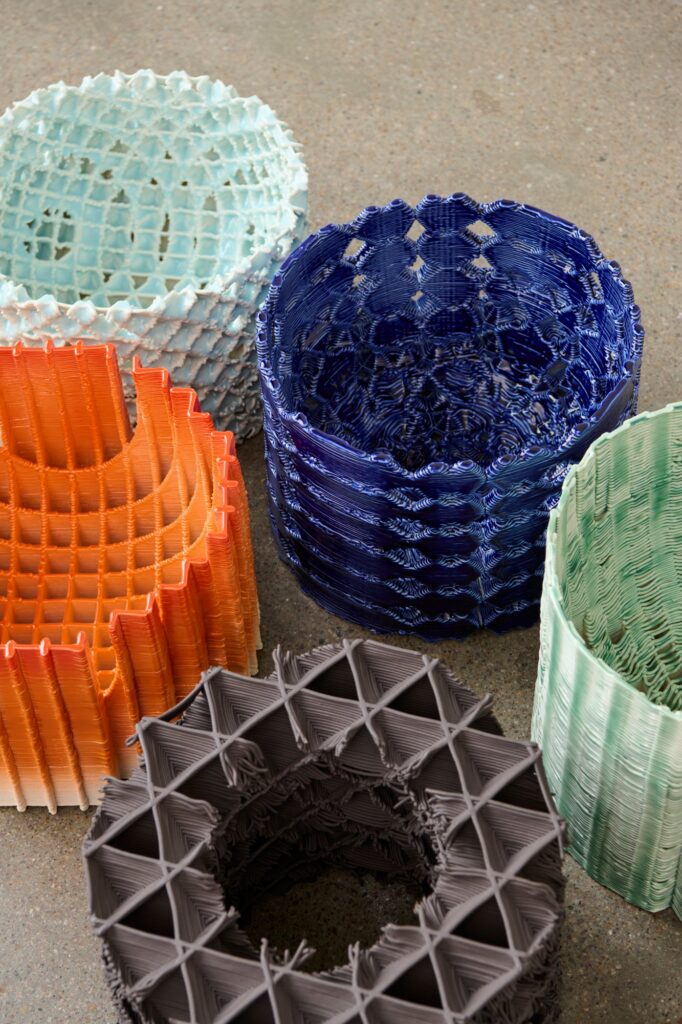
ceramic. Generally hidden away or discarded, infill patterns are utilised as structural components and supports when 3D printing complex forms. Rather than being removed, Piazzolla allows her unique digital compositions to express their innate sculptural qualities when transformed into physical ceramic objects.
Hilda Piazzollais, photo Benjamin Lund
“This collection is an exploration into infill patterns, where they are exposed as the primary structure. While in plastic they print with machine-like precision, clay introduces softness, weight, and unpredictability,” Piazzolla explains.
Working with porcelain, stoneware, and glazes, she allows gravity and imperfections to shape the final forms, turning digital precision into tactile uniqueness.
Based in Copenhagen, Piazzolla has worked with 3D-printed ceramics since her studies at the Royal Danish Academy, constantly experimenting with materials and techniques.
Hilda Piazzollais, photo Benjamin Lund
“Even though 3D printing makes it easier to reproduce a shape, I have never had any interest in that,” she says. “The 3D printing methods are a tool for me to produce unique expressions with the clay.”
Her practice reflects a balance of technology and craft, where archetypal vessels are reimagined as singular objects that embrace distortion, unpredictability, and beauty born from process.
A New Home for Mindcraft
This year’s exhibition took place at The Lab, a post-industrial venue in Copenhagen’s inner north. With six-metre-high ceilings and a vast open floor plan, it offered designers the space to explore both large-scale installations and intricate, detailed works.
The Mindcraft Exhibition 2025 awakened a sense of wonder and connection. It celebrated curiosity, imagination, and the intelligence of nature. Each design revealed the poetry hidden in form and material. Visitors were invited to see the harmony between human creativity and the natural world.