Oommen Thomas on Designing Soubin Shahir’s Home
When your life is spent in front of a camera, the world feels like a stage you can never leave. For Soubin Shahir, building a home was about being able to disappear within his confines. Moving from the noise of a film set to his private life required more than just a house. He needed a sanctuary where he could physically and mentally switch off. To answer this, architect Oommen Thomas of Aviot Architects transformed a 6,300 sq.ft. fifth-floor apartment in Cochin into a sprawling, nature-filled retreat. By Arya Nair
The actor Soubin becomes himself within his confines.
Even though Soubin Shahir’s is a fifth-floor apartment in Cochin, it feels like an old family memory of a large ancestral home. The idea of luxury here is not about what is shown to the world, but how well one can withdraw from it. The design process was defined by a natural shorthand. With Soubin’s deep appreciation for detail and his wife Jamia’s artistic eye, the couple and the architect found an immediate creative rhythm.

The architect, Oommen Thomas, says, “We spoke the same language,” when it came to designing for Soubin.
“Since they understand the nuances of storytelling and aesthetics, we spoke the same language when it came to the fine details,” Oommen Thomas says.
Thomas and Soubin hit it off almost immediately.
“We were in sync before the first sketch was even drawn,” Thomas says. “Soubin and his wife, Jamia, would send over references of textures and colours they loved. We spoke the same language when it came to the fine details.”
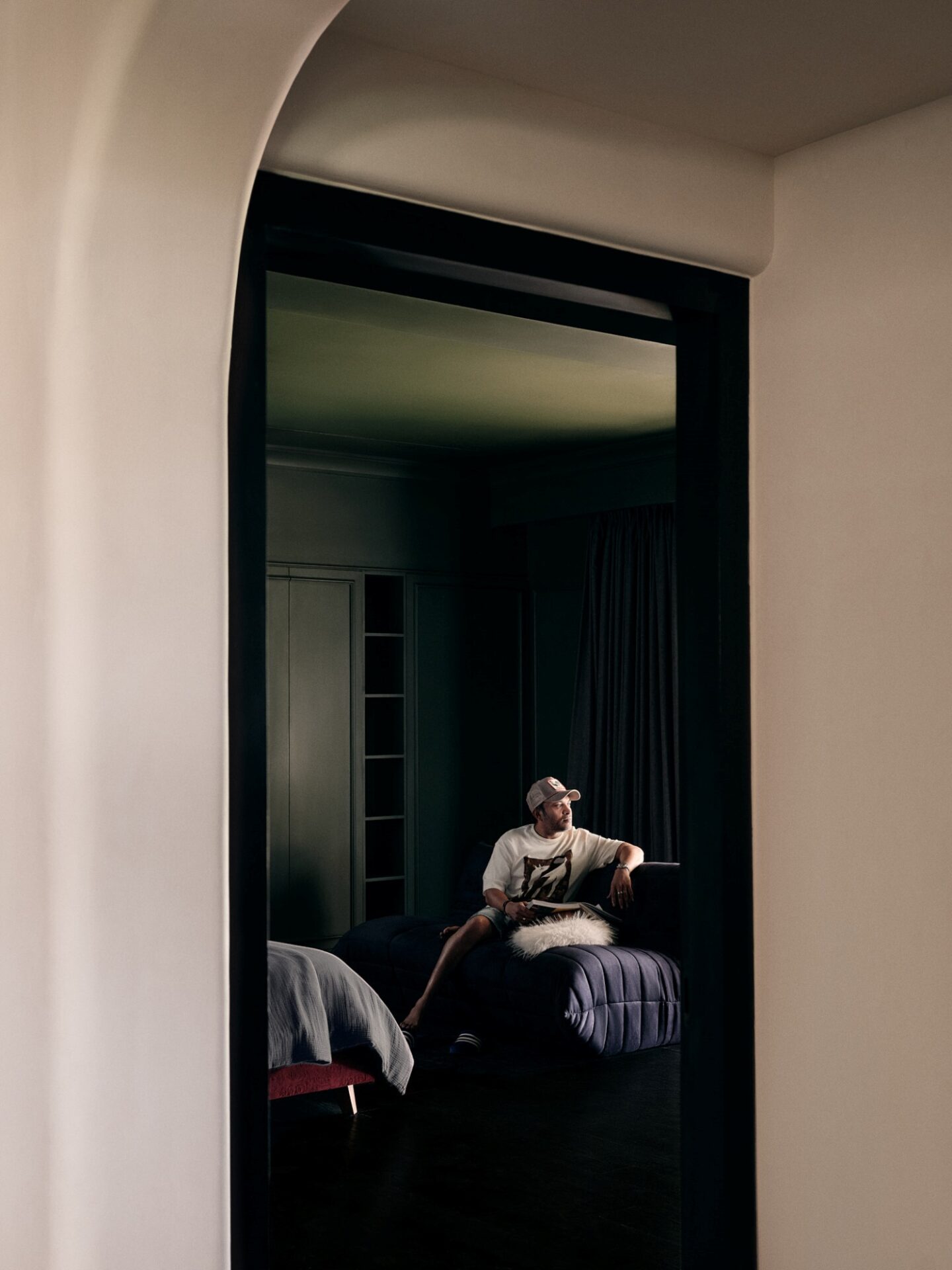
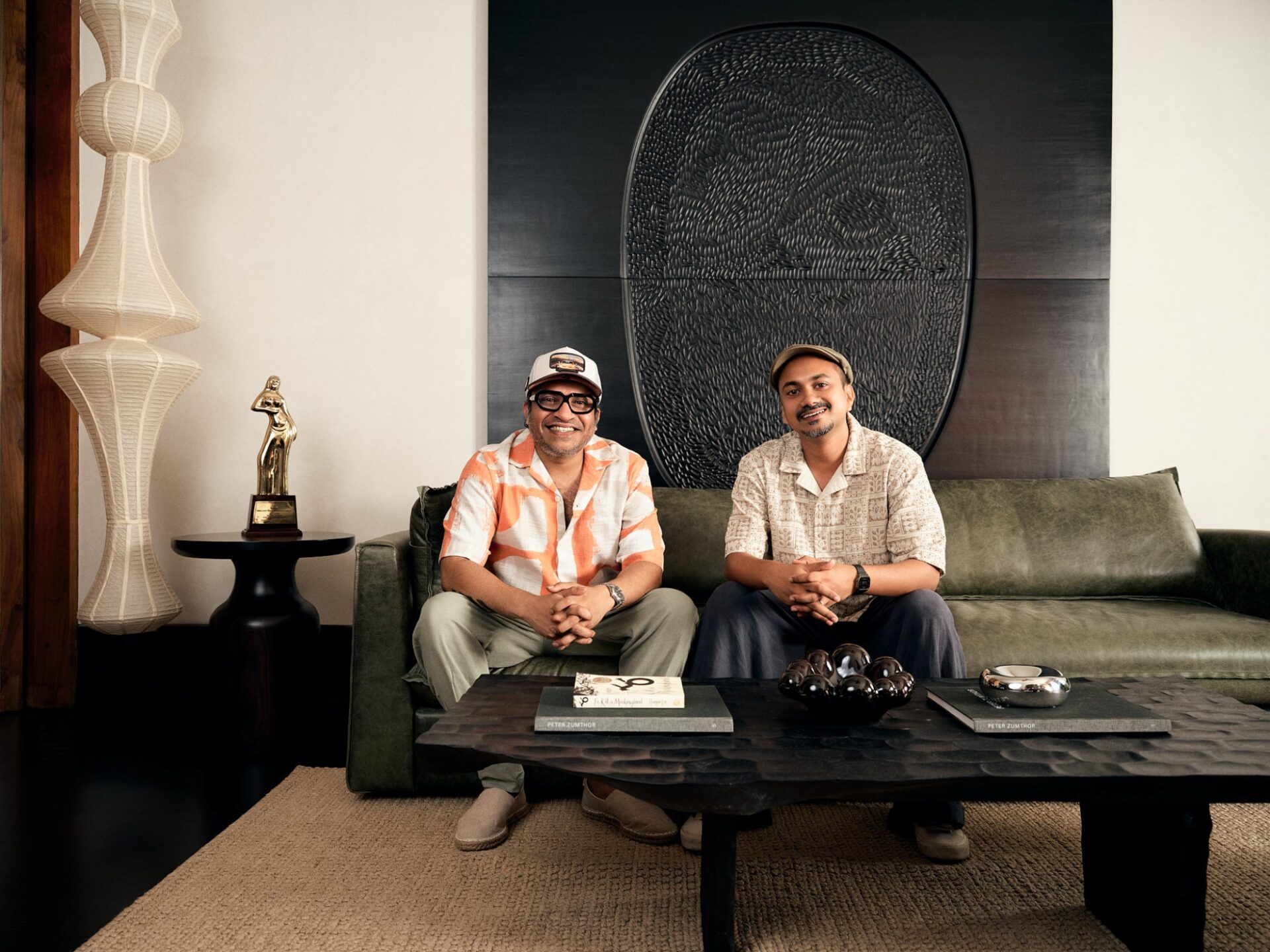
Without the layers of cinema, deep within his comfort zone: Soubin.
There was no rigid or contradictory brief to follow. Instead, the architect began with an empty palette, crafting a modern interior that found its soul through materiality. He sought to introduce textures that Soubin could instinctively relate to, evoking the cool, quiet atmosphere of traditional Kerala homes without leaning on literal nostalgia. To bridge that gap, Thomas looked to traditional materials but gave them a sharp, contemporary edge. Instead of standard tiling, they used black micro-cement to mimic the matte feel of old black oxide floors.
Not a Museum of the Past
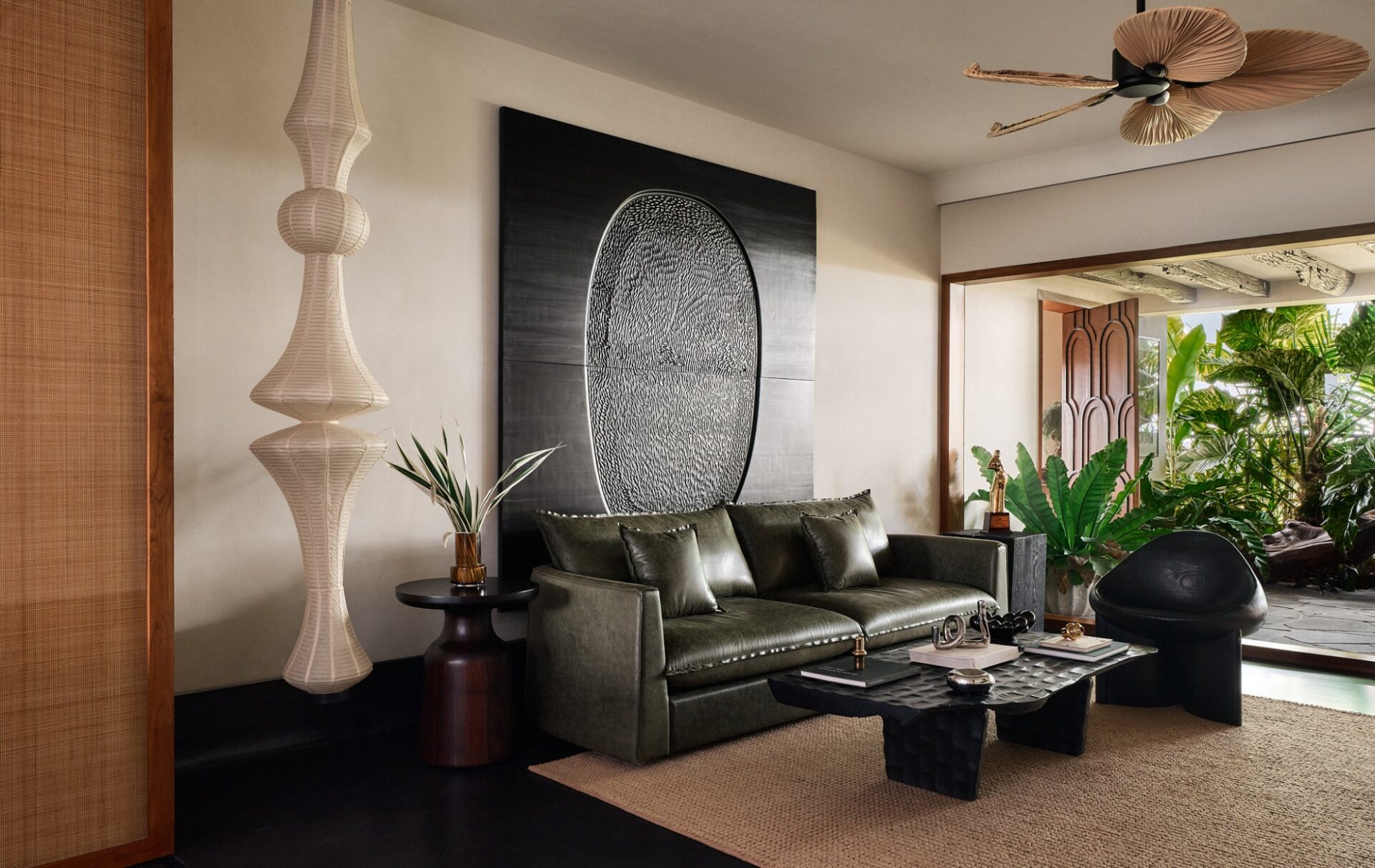
The living room: a blend of modern written in a contemporary palette.
The challenge of blending design with childhood nostalgia is often where designs fail, resulting in a cluttered “museum” of the past. The architect avoids this by translating memories into tactile experiences rather than visual ornaments. While many modern homes are designed as Instagrammable backdrops, this palette serves to absorb light rather than reflect it. This creates a shadow space that acts as a visual silence, providing relief for someone whose professional life is defined by the glare of high-definition lights.
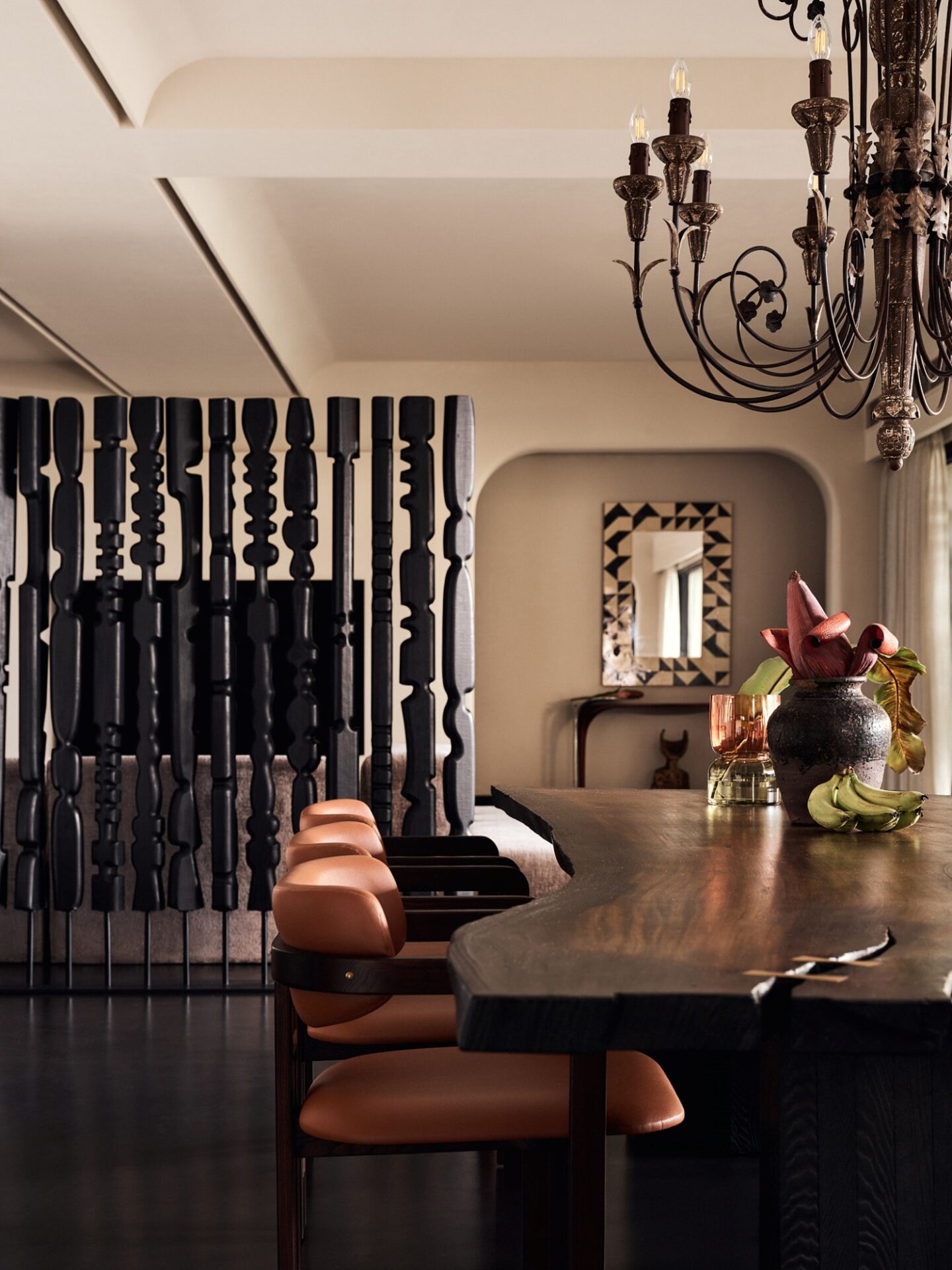
Art serves as functional design.
In the high-stakes world of cinema, privacy is the ultimate currency. To protect Soubin’s peace, the layout is also strictly functional. The formal living area at the front of the house serves as a public face while the rest of the home remains hidden from view.
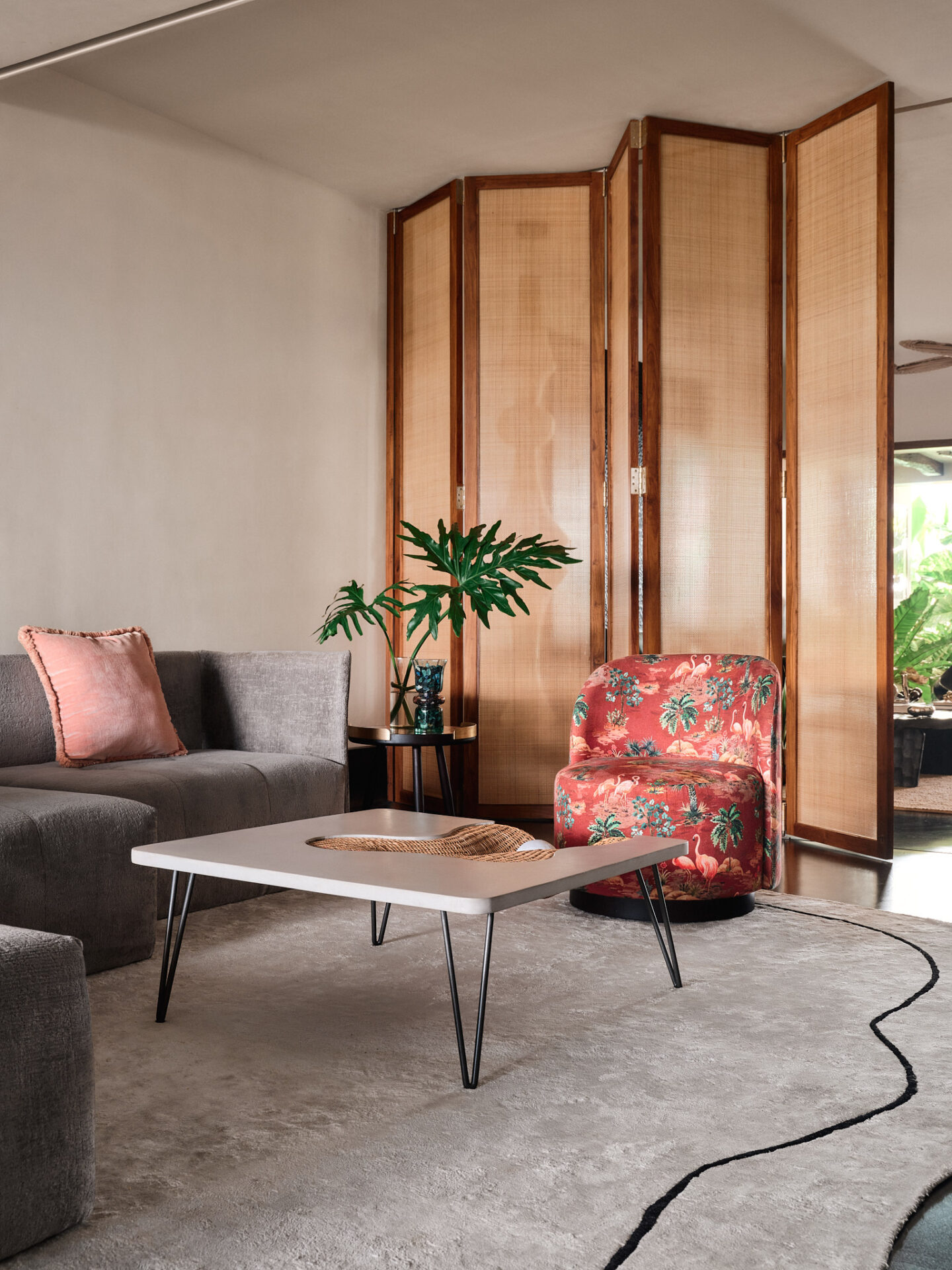
A jute screen divides the public and private spaces.
“The private spaces are divided by a screen, a woven jute screen, that divides this public zone from the private, where his family would be entertained,” Thomas explains.
This divider ensures that even if a work meeting is happening at the front of the house, the family’s rhythm remains undisturbed and shielded from view.
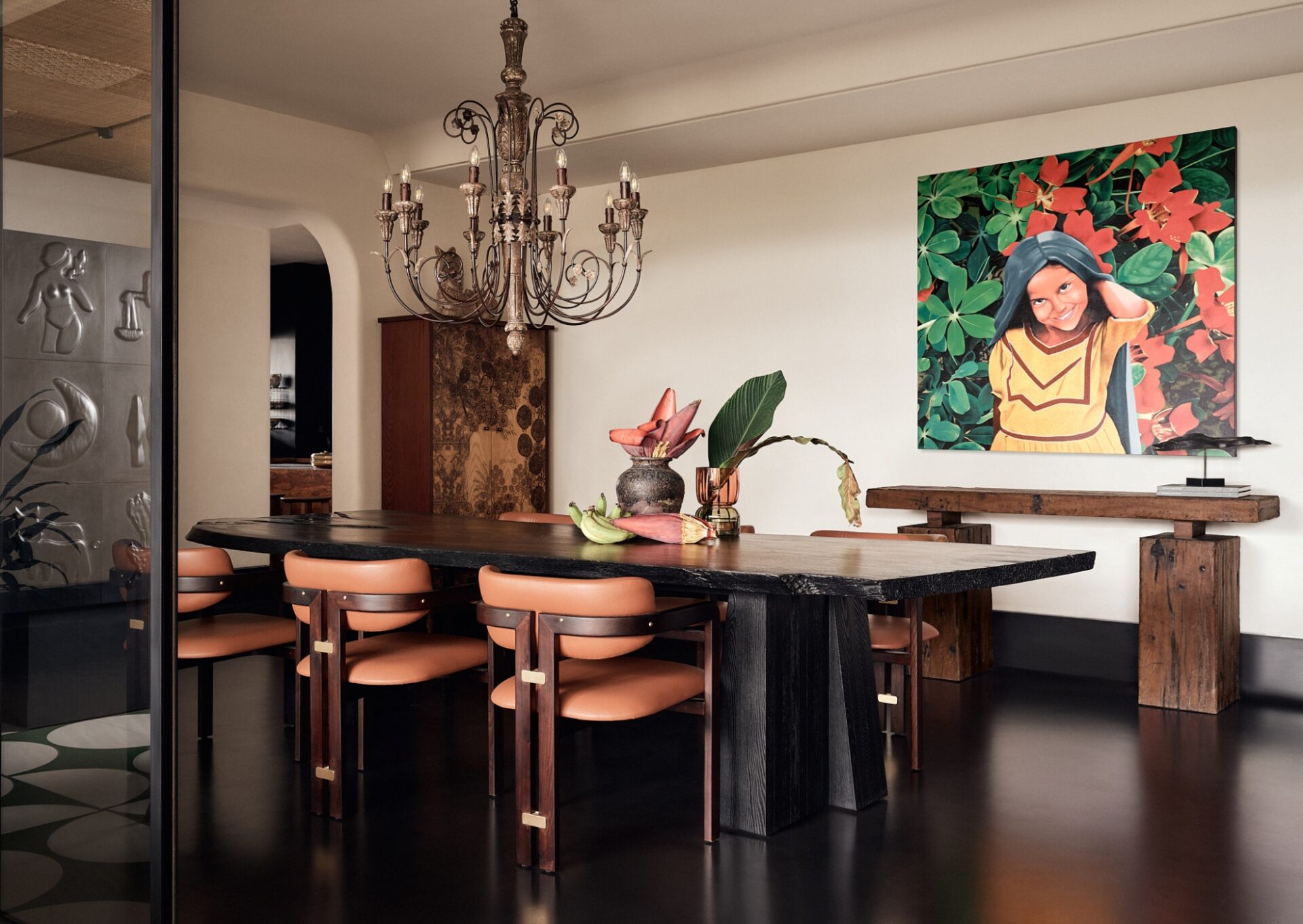
Art and design go hand in hand to create this cosy yet chic dining space. A Benoy Varghese painting takes all the attention.
To keep the space from feeling like a shrine to a movie star, Thomas and the couple made a pact: no trophies and no grand portraits on the walls. The dining room reflects this groundedness, centred around a massive, raw walnut slab and deep leather chairs.
The Greenery Within
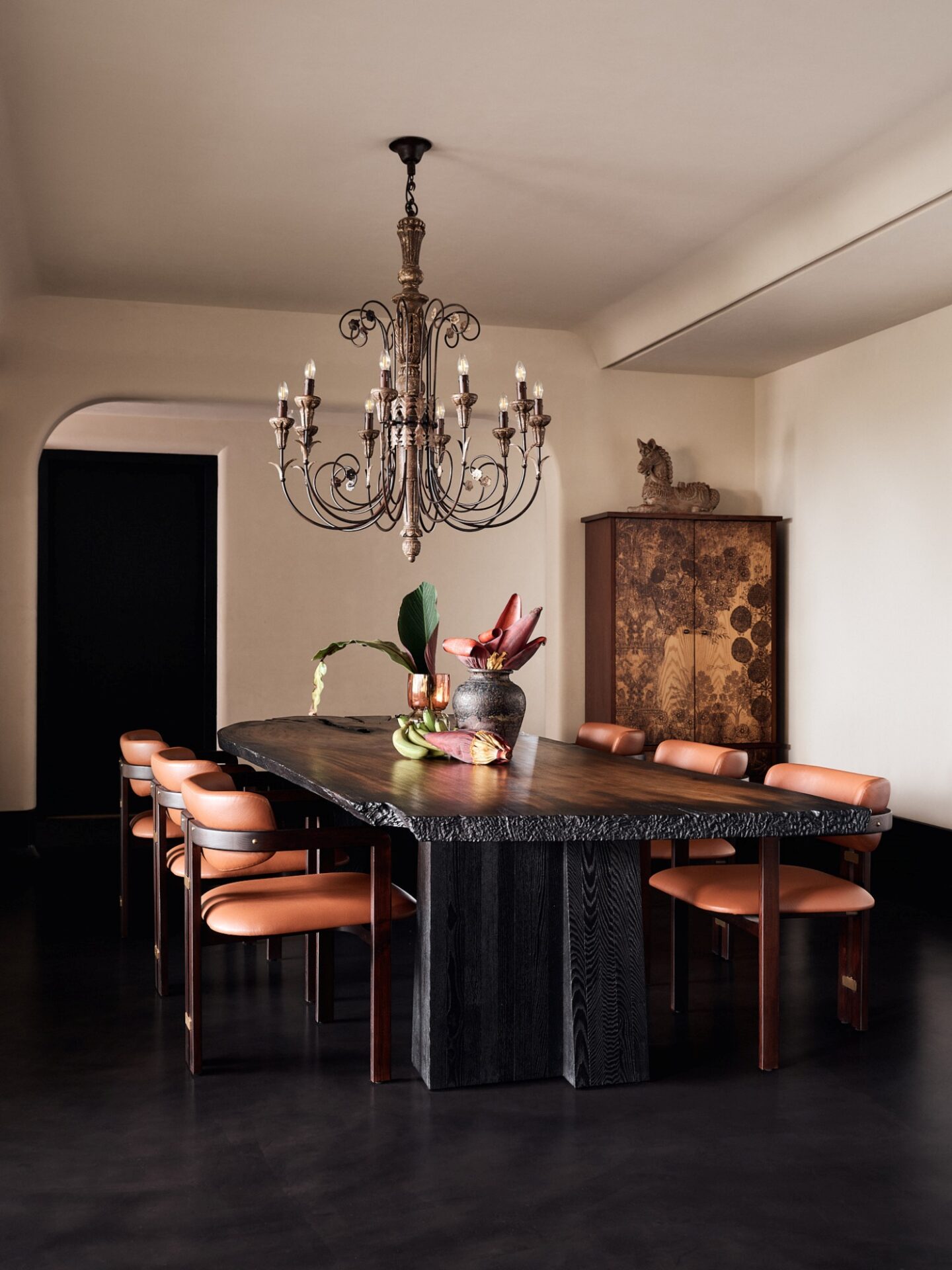
The dining room looks like a space within a movie screen, yet it has all the elements to make it homely.
Instead of an awards shelf, the room’s focal point is a lush Benoy Varghese painting that mirrors the greenery outside, lit by a Victorian-style chandelier. A sepia-toned House of Things cabinet adds a final layer of quiet history. The goal was to ensure the architecture never competed with the actor’s fame. The spaces in this home celebrate the person behind the screen, stripping away the public persona to make room for a family home. A cement relief on one of the columns, inspired by tropical forms and created by their friend Ajayan Chalissery, completes the setting with a personal touch.
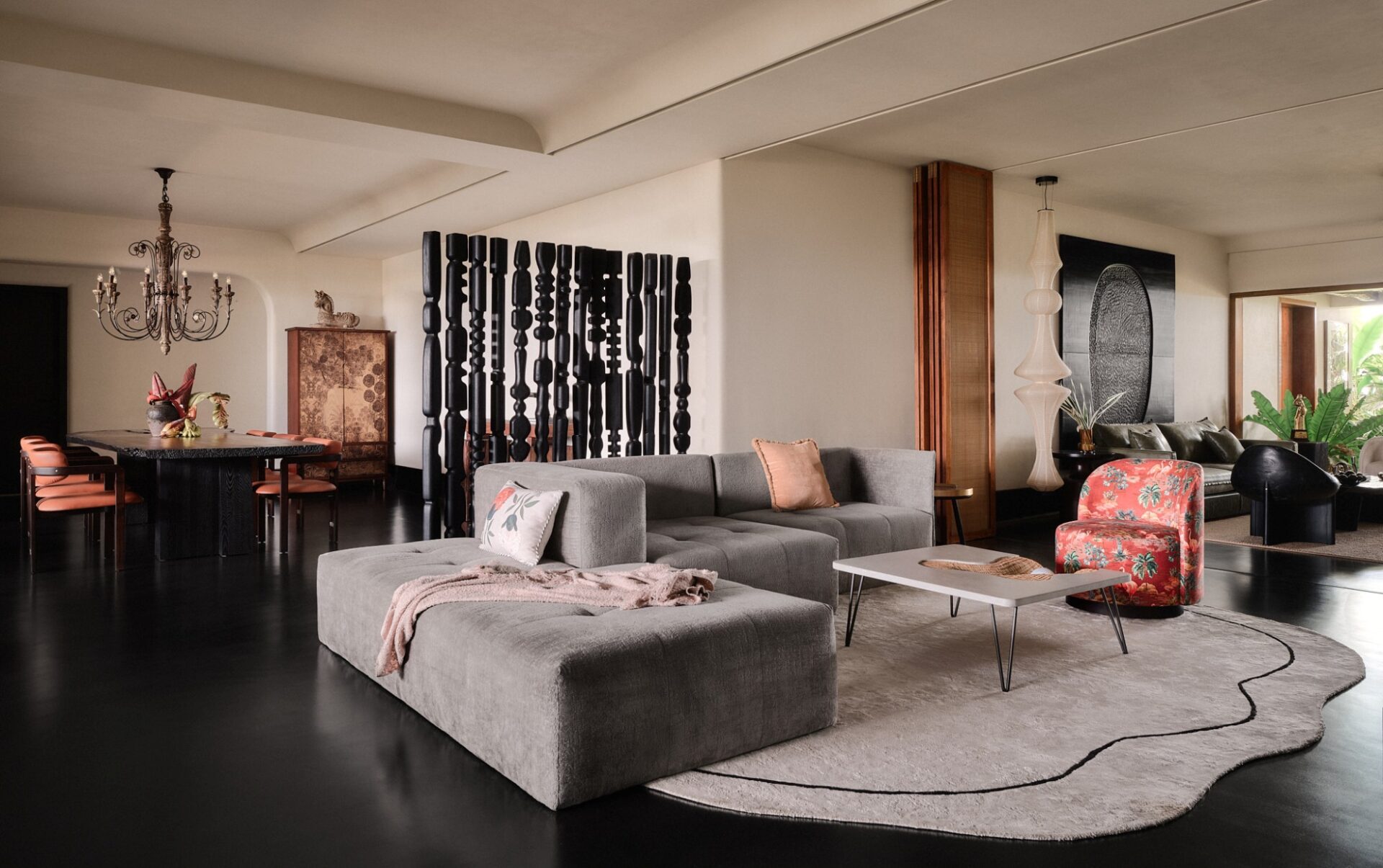
Rooms flow into each other without the strict confines of walls, filling the space with light and air.
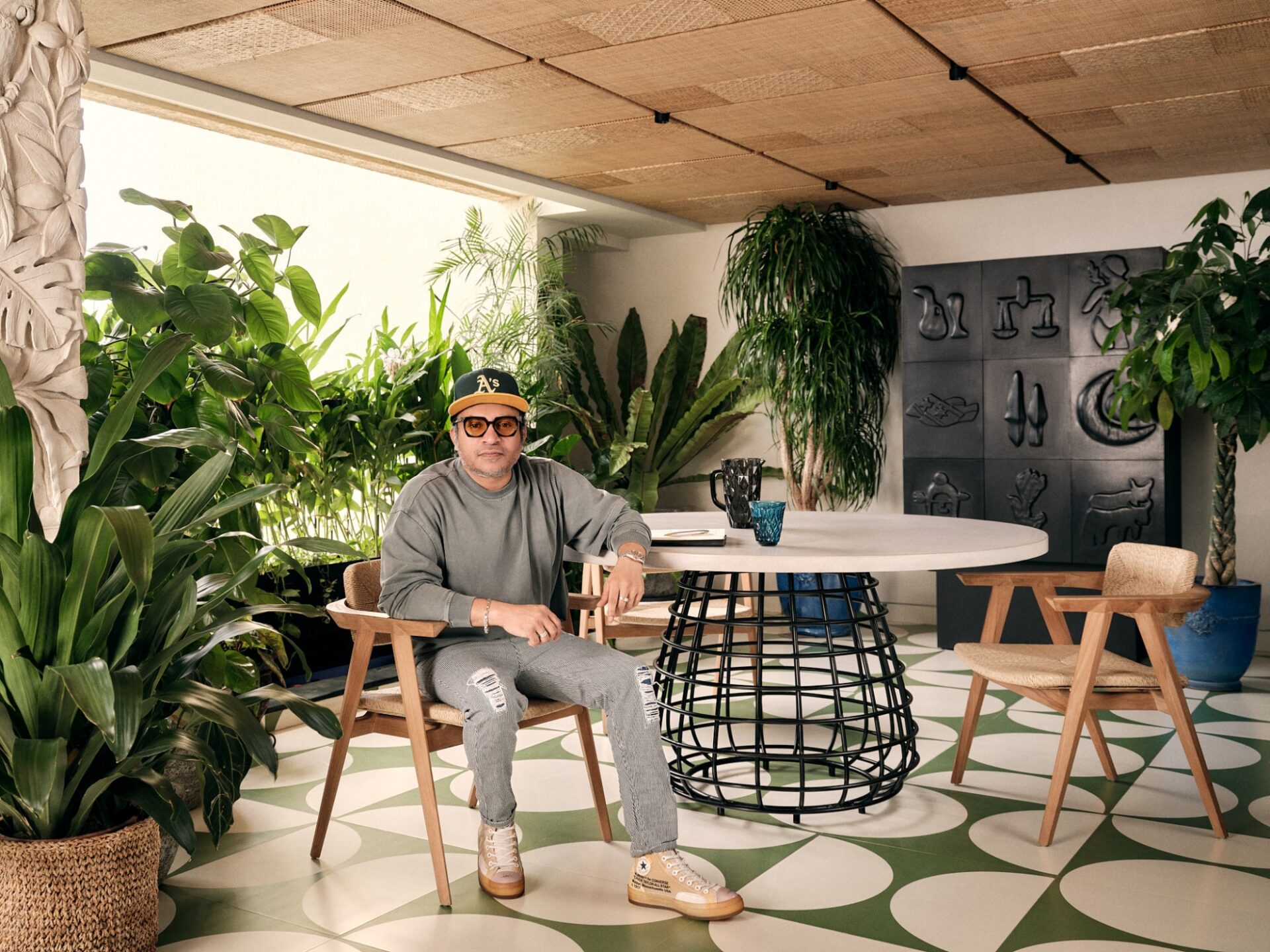
The apartment’s defining feature is an expansive deck that functions less like a standard high-rise balcony and more like a self-contained ecosystem.
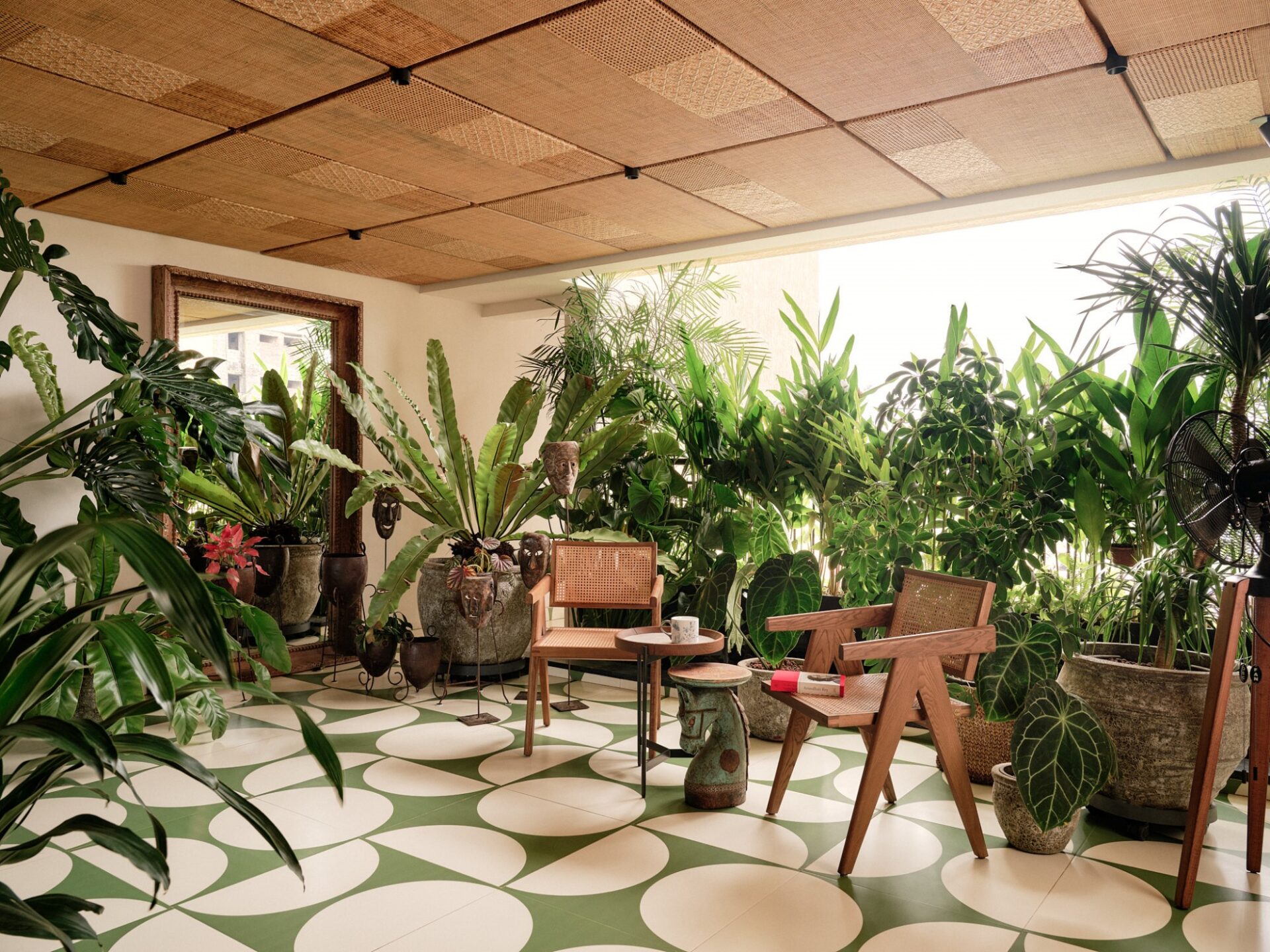
A tropical forest on the fifth floor of an apartment complex in Kochi becomes the setting of Soubin’s dreams.
To satisfy Soubin’s affinity for nature, Thomas, along with landscape architect Sanjay Prince, established this “beautiful garden” as the home’s non-negotiable anchor, ensuring a seamless transition where nearly every room opens directly into greenery. This spatial strategy effectively masks the apartment’s fifth-floor elevation.
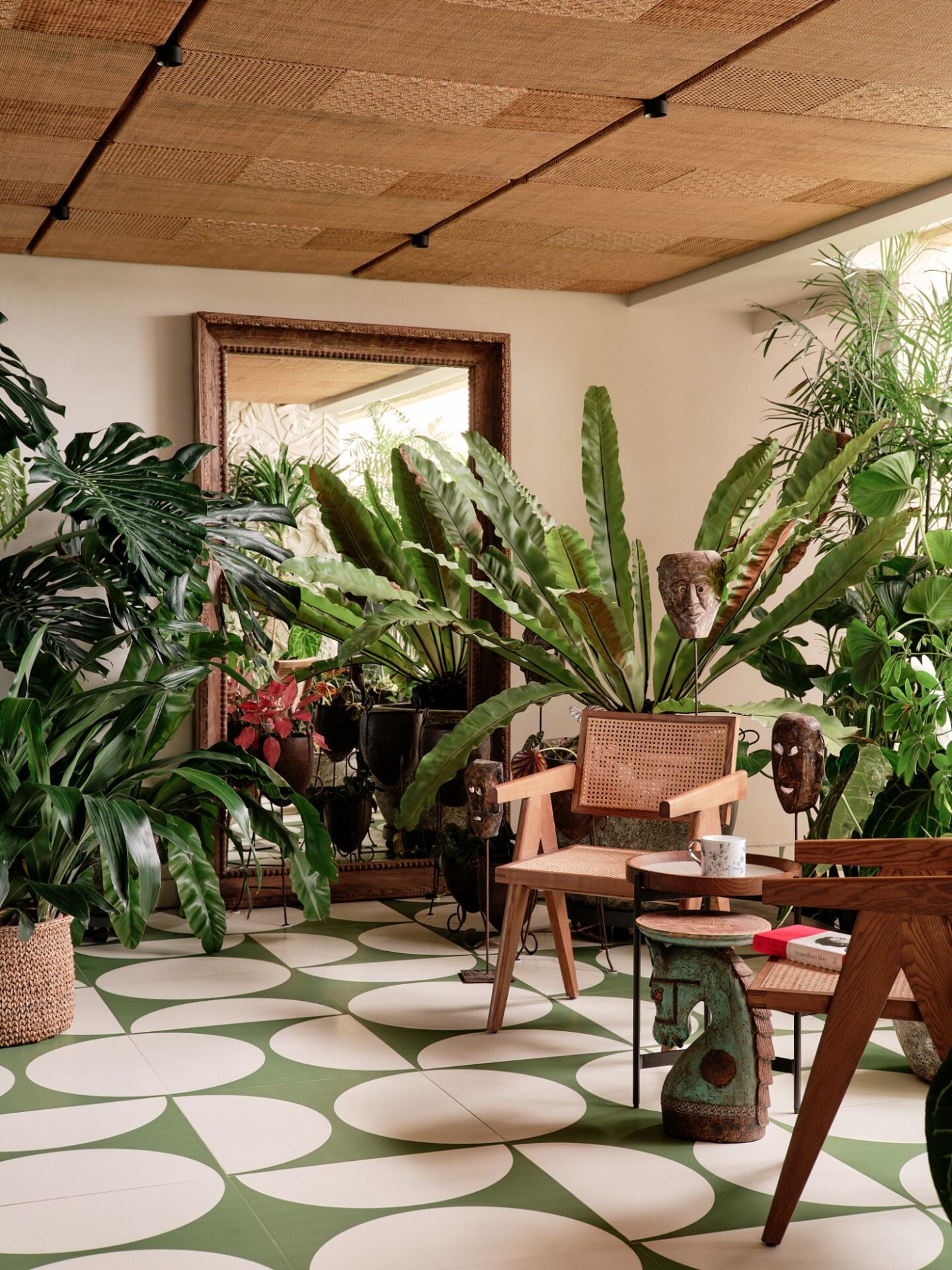
The green, lush garden.
At home, Soubin naturally gravitates toward this deck, often spending hours here reflecting on scripts. The custom-designed flooring complements the dense foliage, where monstera, schefflera, dracaena, palms, elephant ears, anthuriums, and ferns create a lush, enveloping environment.
The environment is further softened by a small water body and an aquarium, while a sizable aviary of exotic birds provides a constant, natural soundscape that assists in the daily “switch off” from the professional world. Instead of filling the home with high-concept ornaments, the architect relied on the familiar.
The Material Palette
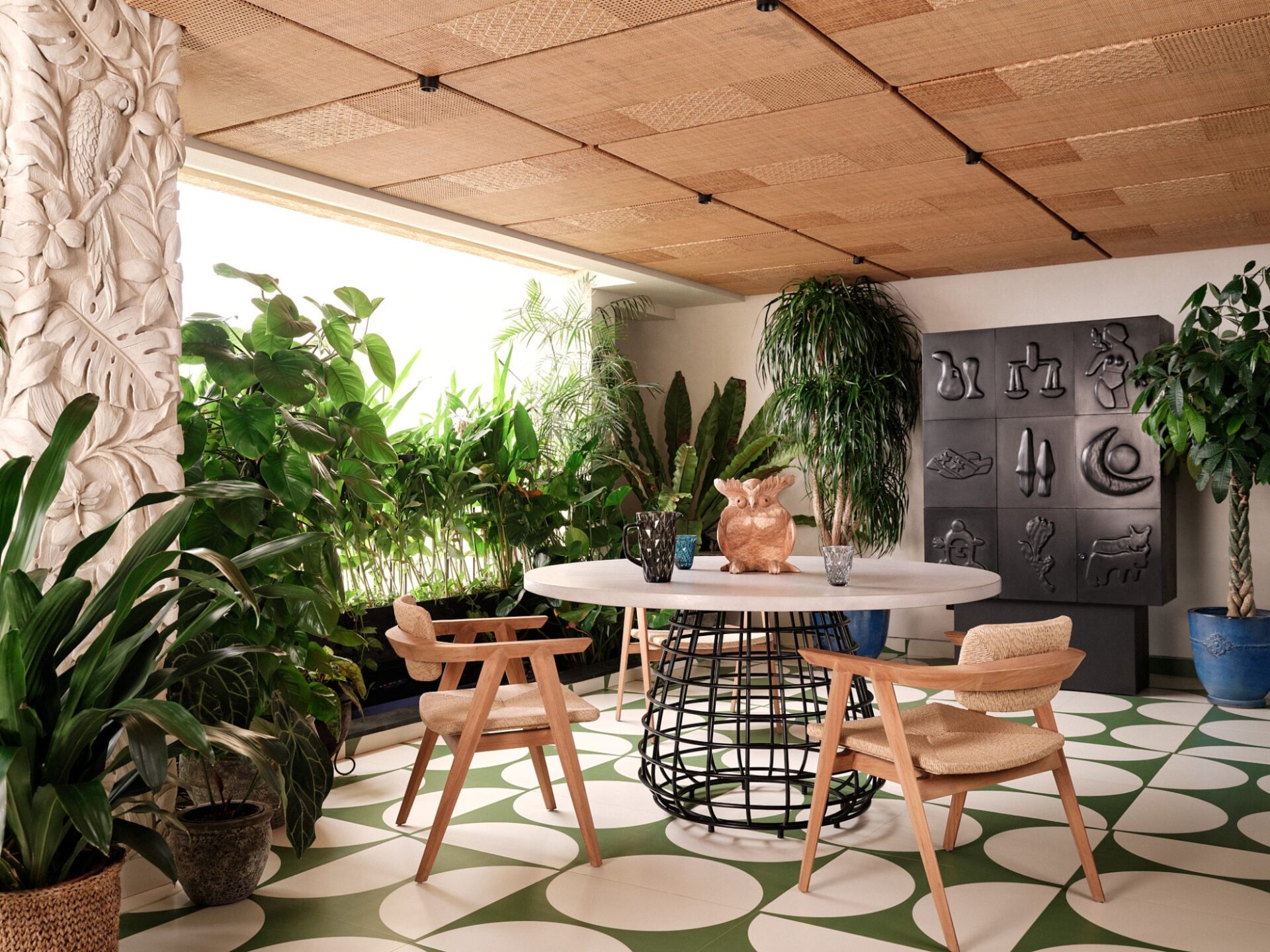
God is in the details; note the finely woven bamboo ceiling of the deck, crafted by artisans.
Materiality plays a critical role in grounding this modern space, most notably in the deck’s ceiling. Instead of using mass-produced panels, it features finely woven bamboo crafted by artisans from Cochin. This choice connects the home to Kerala’s traditions and brings a tactile warmth that balances its more contemporary elements. The use of natural textures and local craftsmanship gives the apartment a calm, enduring presence without feeling overly ornate.
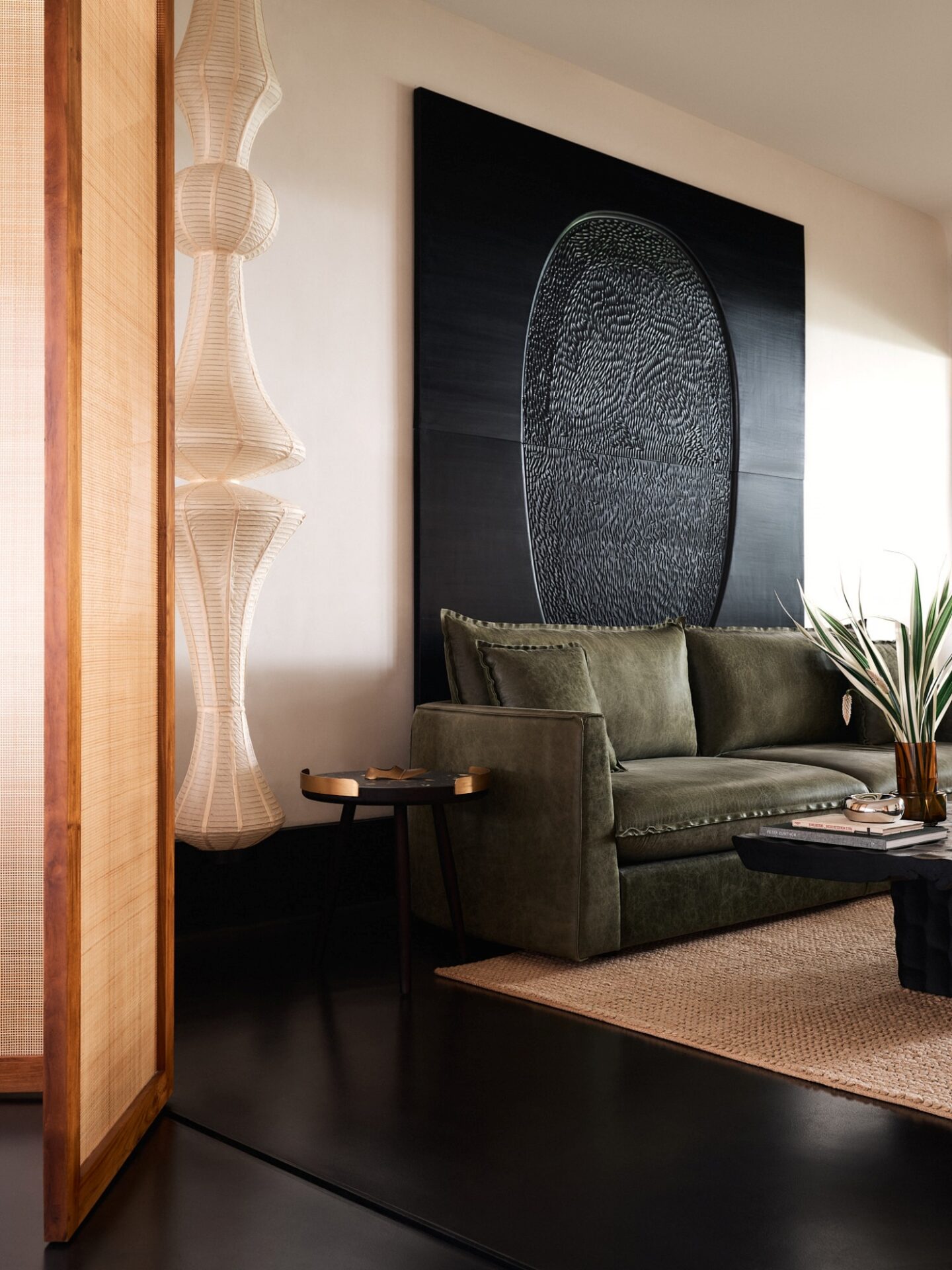
Every piece of furniture has a unique character, adding to the final story of the house.
Designing for an actor requires an understanding of framing and light, and Soubin’s cinematic perspective pushed the project’s boundaries. One of the many interesting arrangements in the house is the seating area, where the sofa and the surrounding couches and chairs are distinctively different pieces cast in diverse materials. Thomas notes that because the couple loves stories and characters, he felt that each piece of furniture should have a different character and that no two pieces should be the same. The house is clearly led by a deep honour for nature, with figurines and art centred on animals such as owls, horses, monkeys, and reptiles abounding throughout.
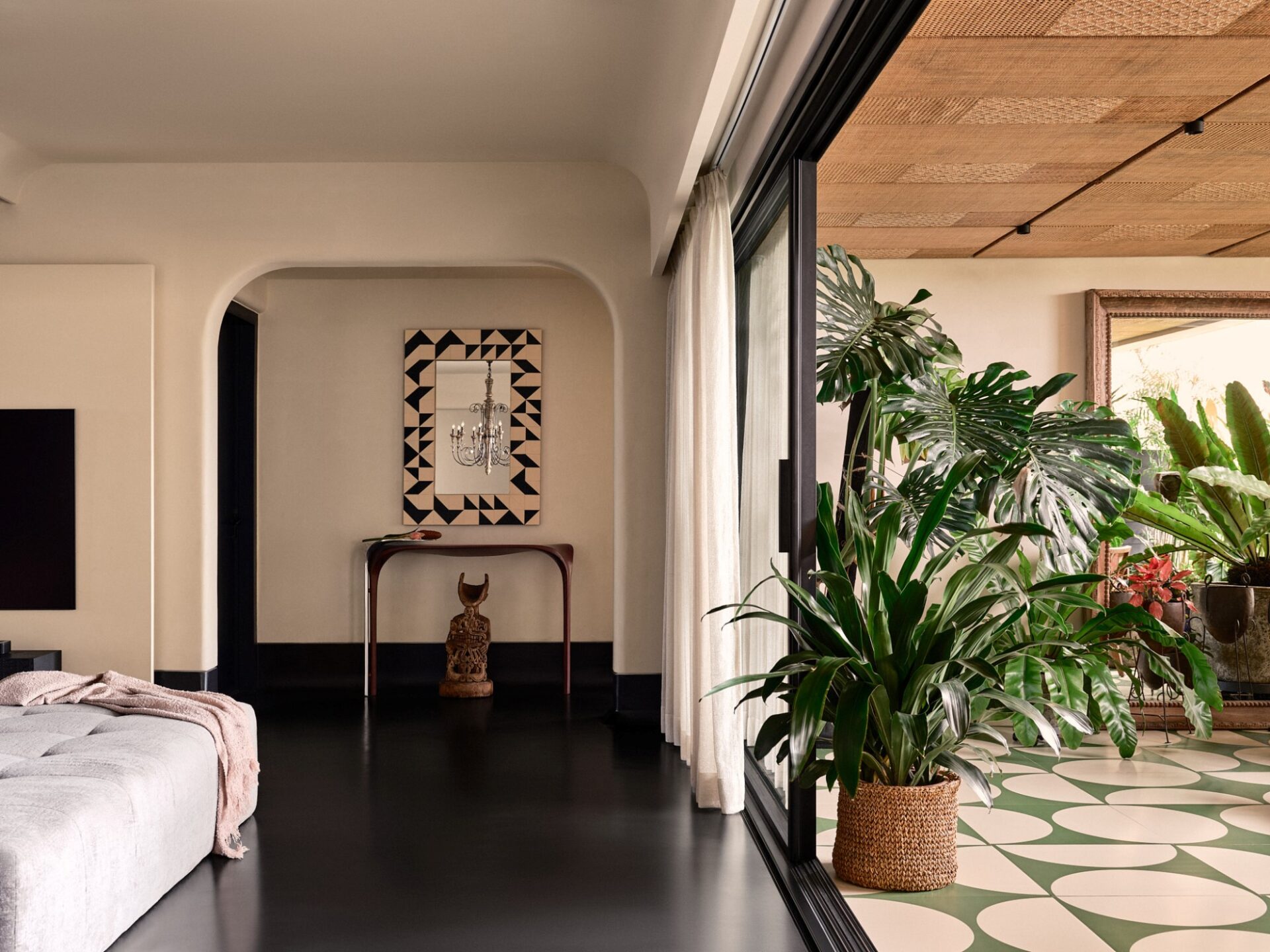
A quiet transition where the indoors open into a lush, living green space.
“Soubin has a keen eye for detail, and that sensibility shaped our entire approach. While we prioritise detailing in every project, this one was especially immersive. We found ourselves deeply engaged and genuinely enjoyed refining and enriching every element,” says Thomas.
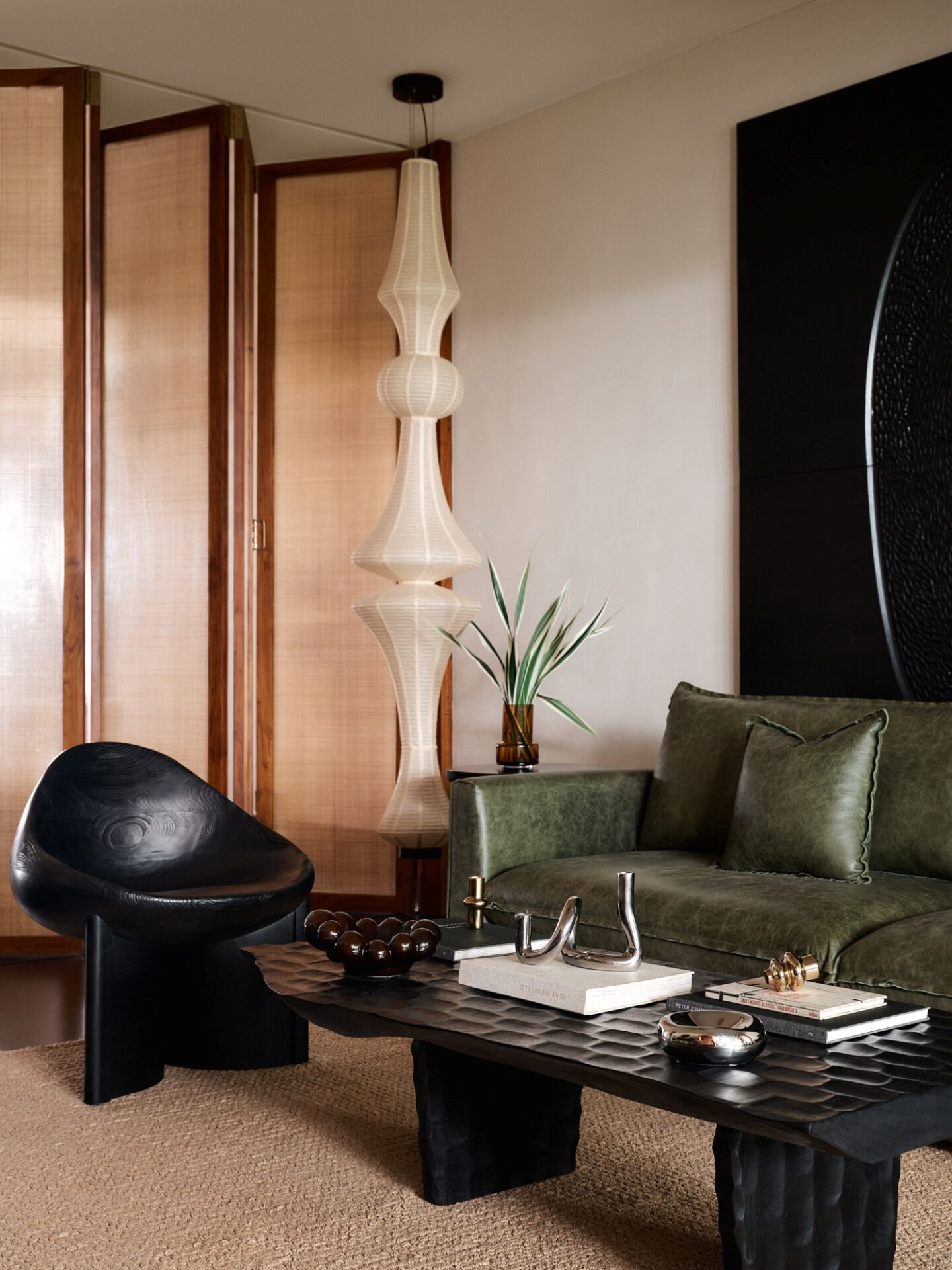
A mix of textures and forms where every piece has its own personality.
There is one more space the public would never notice: a home theatre tucked into the very centre of the apartment. For a man who is both an actor and a director, watching films isn’t just leisure; it’s a craft. By placing the theatre at the heart of the home, Thomas ensured that Soubin’s creative passion had a dedicated, private sanctuary of its own, away from the windows and the noise of Cochin.
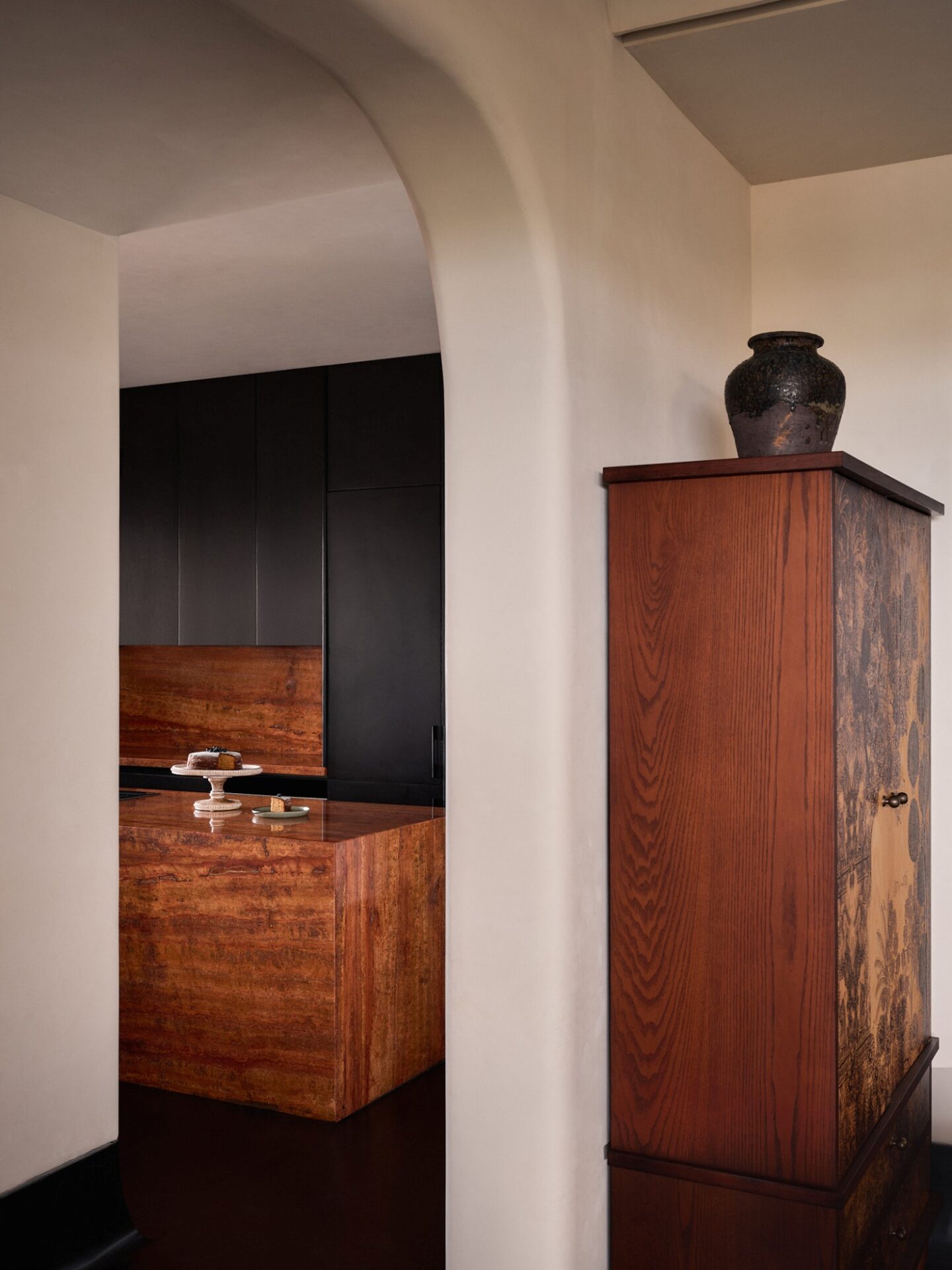
Interplay of wood and curves in the kitchen area.
The kitchen expresses a quiet, refined minimalism, defined by black micro concrete shutters and a striking island in red travertine marble. In the foreground, the dining area draws the eye, where an art cabinet lends a gentle vintage character.
At the heart of the home, the kitchen remains rooted in functional simplicity, softened by the warmth of teak wood and guided by clean, purposeful lines. Mid-century modern influences meet a distinctly South Indian sensibility, creating a space that feels both timeless and lived in. It is a kitchen shaped for slow, unhurried mornings and a more considered rhythm of everyday life.
Collaboration of a Lifetime
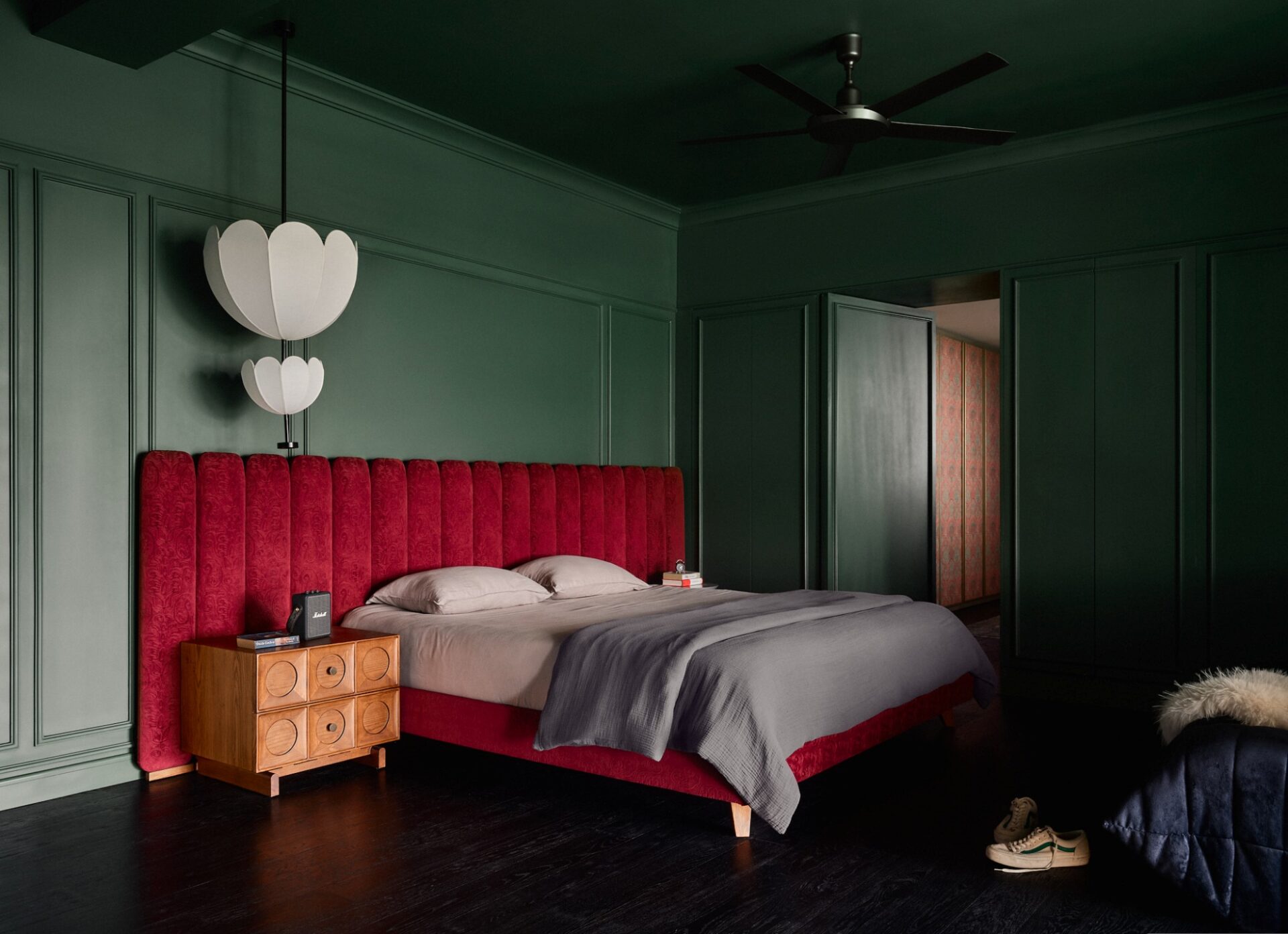
The bedroom for the person himself.
If the living room is for the “persona” and the deck is for the “family,” the master bedroom is strictly for the “person”. To help Soubin truly decompress after the sensory overload of a film set, Thomas designed the bedroom to be almost cave-like in its stillness. Soubin wanted something very calm and cosy, so the team implemented a meditative theme featuring darker wooden floors and walls in sage and dark green. This space is designed to cut off all light and sound. When he steps in there, the rest of the world just stops.
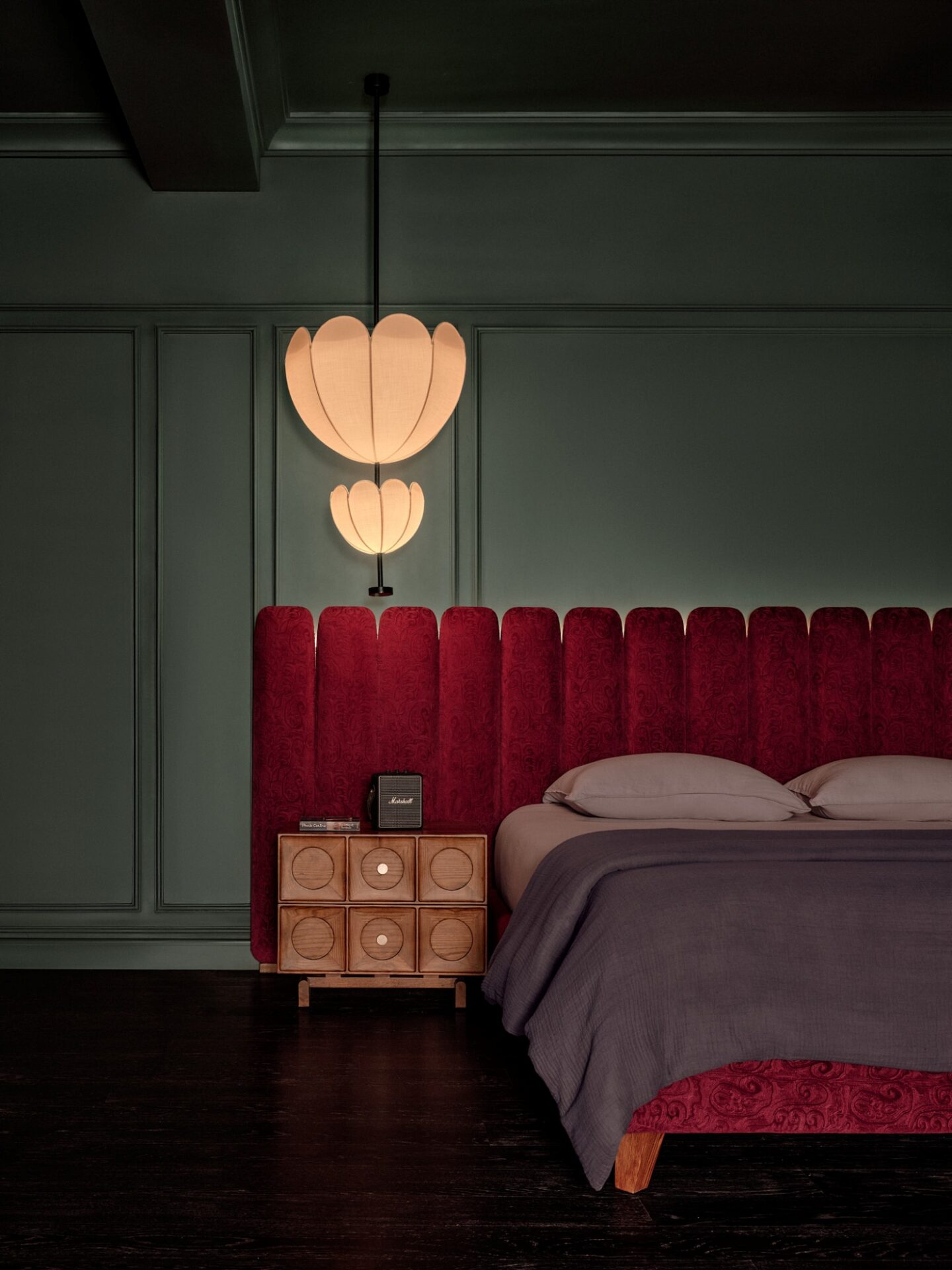
A cocoon of deep tones and soft textures.
The design journey for Oommen Thomas was defined by humour and mutual respect. Throughout the process, Soubin’s personality transformed the construction from a stressful project into a shared creative journey between friends. This camaraderie remains a central part of the story, highlighting a collaboration built on more than just technical specifications.
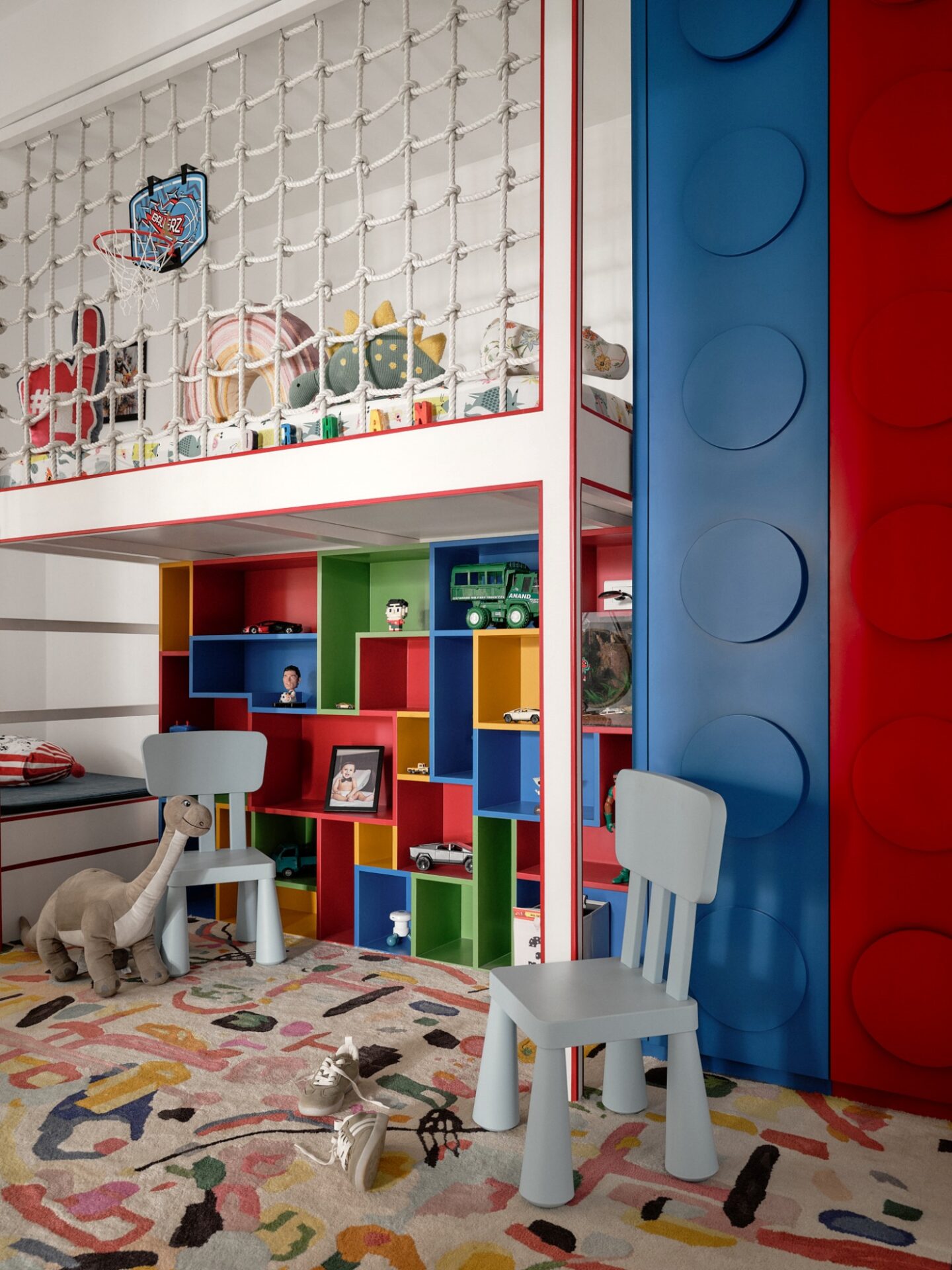
A playful space filled with colour, with room to grow.
Oommen Thomas notes that despite his fame, Soubin remains an incredibly down-to-earth person, a quality that kept the entire project grounded. The greatest reward has not been the finished structure, but the photos Soubin still sends of the family enjoying the space. It is proof that in the design of this fifth-floor sanctuary, the actor has finally found a place where he can simply be himself.
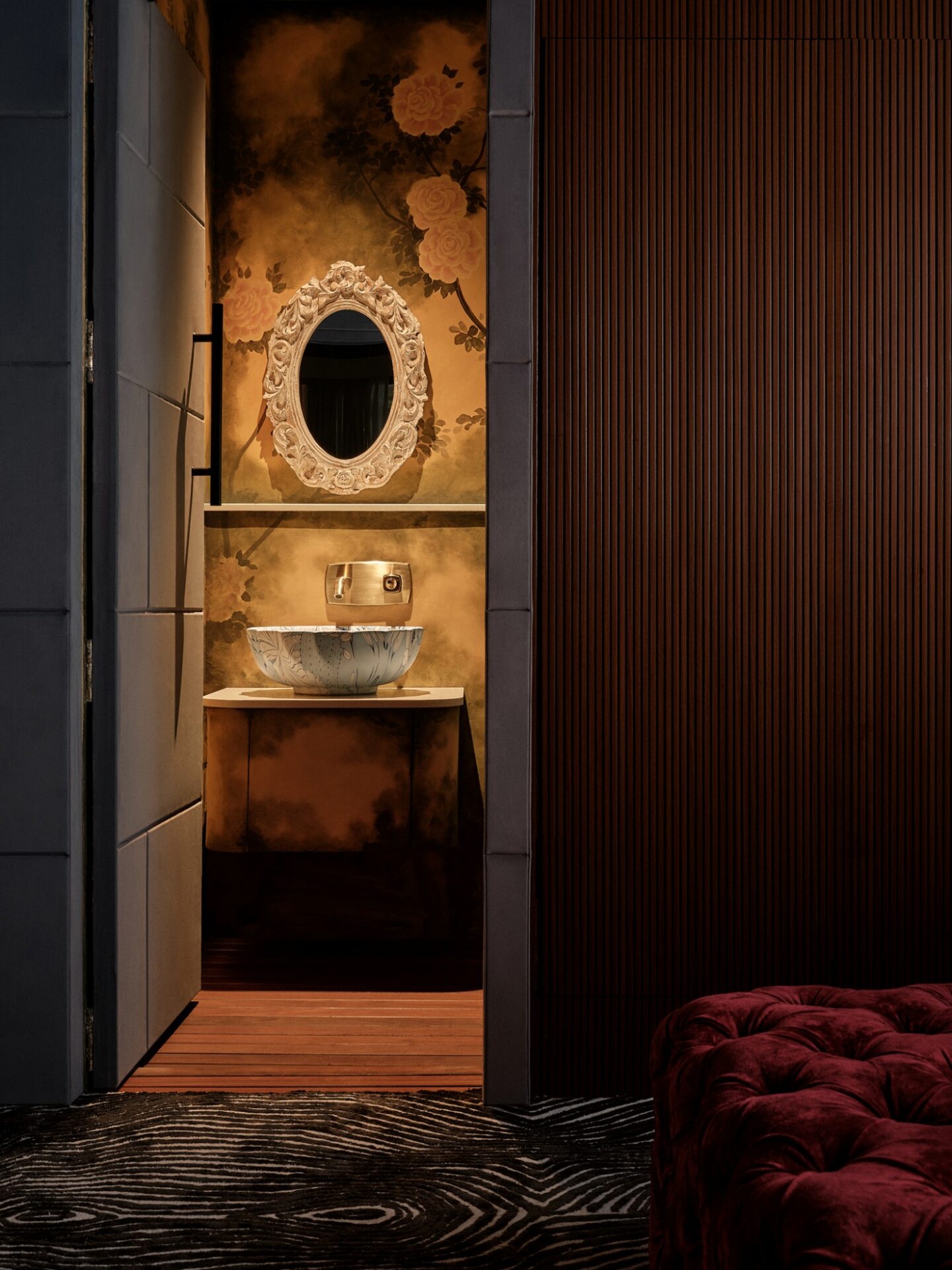
Rich textures and details in every nook of the house.
Project: Raw Haven
Type: Apartment
Area: 6300 sq.ft.
Location: Kochi, Kerala
Photographer: Gokull Rao Kadam
Styling: Joann Joseph
Landscape Consultant: Sanspace